How Damp Develops on Idle Apparatus
Bay humidity usually gets treated as housekeeping: mop the floor, run the extractor fans, hose off the worst of the overspray. That deals with the water you can see. It does nothing about the water already held in the air of a closed bay, and that vapour is what causes the damage. Damp on a parked fire appliance is a humidity and dew point problem, not a cleaning problem.
Where the moisture comes from
A closed bay is a box with a lid on it, and it has several steady sources of water inside. Washdown water and wet hose evaporate into the room instead of leaving it. Floor drains and trench gullies give vapour back to the space. Apparatus coming in from a run brings wet tyres, wet bodywork and a hot engine, which warms the air around it and raises how much water that air can hold. In a tightly sealed building none of that vapour goes anywhere, so relative humidity climbs over days of inactivity. Warm air holds more water than cold air, so when the bay cools overnight the same amount of vapour pushes humidity toward saturation.
Why it lands on the vehicles
Steel, aluminium and electrical enclosures do not behave like the air around them. A chassis rail is heavy, and steel conducts heat far better than the concrete under it, so metal tends to sit near the temperature of the structure rather than the air, then lose heat overnight to cold walls and the roof deck. When a surface drops below the dew point of the air around it, condensation starts, and it starts on the parts that matter: chassis rails, tank skins, pump housings, control cabinets, harness connectors. The water does not arrive as a spill. It forms as a film, on the coldest surfaces first.
Why rust shows up so late
Rust is the end of a long sequence, not the start of one. A thin film of condensate, held in place by dust, road salt and chloride residue, keeps the metal wet for hours at a time. Surface oxidation begins inside that damp phase and stays hidden under paint, seam sealer and underseal. Corrosion only becomes visible once the process has run long enough to break the coating and stain the panel, which is why the chassis corrosion patterns on parked crash tenders usually trace back months before anyone noticed a mark.
The consequence for fleet owners
An inspection regime built on visible rust reports the problem after the damage has been done. By the time corrosion is legible, the damp has already been through electrical enclosures, fasteners and seams. Fleets that get ahead of it watch bay humidity, surface temperature and dew point instead, because a dry-looking appliance in a humid bay is not a dry appliance.
Damp also leaves quieter clues before any rust blooms. Walk the bay at shift start and look for these:
- Condensation beading on polished metal, chrome and handrails at dawn.
- Chalky white bloom or damp residue around fasteners, brackets and bolt heads.
- A musty smell that stays inside cabinets, lockers and electrical enclosures.
- Fogged instrument glass and misted gauge lenses that clear only after a run.
- Water tracking or tide marks under floor plates, often a sign that bay drainage and washdown planning needs review.
- Damp insulation and wet sleeving at wiring entries and harness grommets.
- Panels that feel cold to the touch, and tank skins that sweat long after washdown.
- Swollen door seals and rust-freckled hinges on compartment latches.
Caught early, most of these are a line to add to the weekly check rather than a repair to book in.
The table below is a starting point rather than a diagnosis. Match what you can actually see against the source most likely to be feeding it, then confirm it with the routine check in the last column.
Moisture Sources in an Apparatus Bay and What They Signal
| Moisture Source | Typical Indicator | Where It Shows First | Routine Check |
|---|---|---|---|
| Appliance washdown water | Sour, musty smell | Chassis rails, lower sills | Wipe-test sill seams after washing |
| Wet hose and foam residue | Sticky film on hose beds | Hose trays, reel troughs | Lift and turn hoses weekly |
| Floor slab and drainage evaporation | Cold, persistent damp patch | Slab joints, drain surrounds | Flush traps and inspect monthly |
| Vehicle-mounted air dryers | Sluggish purge, wet tank drains | Tank drain cocks, dryer cartridge | Open drains at shift start |
| Outside air infiltration at bay doors | Condensation on door frames | Thresholds and perimeter seals | Inspect seals and closers quarterly |
| Warm exhaust gas cooling in the bay | Drip marks from above | Roof deck, upper steelwork | Look overhead after run-ups |
If the same two or three rows keep coming back on your own sheet, the problem is a layout decision rather than a cleaning routine. Before buying another dehumidifier, work through apparatus bay drainage and ventilation planning.
Why Idle Apparatus Collects Damp Faster Than Active Apparatus
A truck that works every shift dries itself out as a side effect of working. One that sits does the reverse, collecting moisture slowly and steadily. That difference explains most of what goes wrong with parked apparatus.
Thermal mass is the hidden variable
An engine block, coolant circuit, pump body and water tank together hold hundreds of kilograms of steel, iron and water. Driving warms that mass well above ambient and keeps it there, so panels, castings and fittings stay dry on heat alone. An idle appliance never gets there. A ten-minute shuffle from the bay to the apron and back barely lifts the cab temperature, let alone the chassis rails. Cold metal plus humid air is the recipe for condensation, and a parked truck offers an enormous cold surface for it to form on.
No airflow means no drying
Moving air carries water away. At road speed every panel sheds its film of water within minutes. Parked in a bay, the same panels sit in a boundary layer of air that goes saturated and stays saturated. The moisture settles on horizontal surfaces, collects in frame pockets and works into lap joints where paint never quite reaches.
Seals and breathers cool below the dew point
| Condition | Idle apparatus | Working apparatus |
|---|---|---|
| Surface temperature | at or below ambient | well above ambient |
| Air movement over panels | near still air | road-speed airflow |
| Cabinet air exchange | sealed and stagnant | cycled by heat and vents |
| Net moisture trend | accumulating | driving off |
Seals, gearbox breathers and axle vents sit at the end of a long thermal path to a cold slab and a cold roof, so they drop below the dew point while the bay air around them is still comfortably humid. Every time they cool they draw outside air in through the breather; when they warm again, the water in that air condenses on the inside. That is how gear oil turns milky on a truck that never worked hard, and it is why chassis corrosion on airport crash tenders often starts on machines with the lowest hours, not the highest.
Closed cabinets trap the problem
Pump compartments, foam lockers and hose beds are sealed boxes. Washdown water, slab evaporation and humid bay air get in and never leave. On a working truck, engine and pump heat push that air back out. On a parked one, the cabinet becomes a small humid chamber with metal walls, and a soot-heavy bay makes it worse for the reasons set out in why diesel soot settles on bay surfaces.
Short moves never clear the debt
A five-minute reposition warms the cab, not the chassis. Moisture gets nudged around rather than evaporated, and each cycle adds a little more. Idle time is the exposure window, which is why humidity control matters most when nothing is moving.
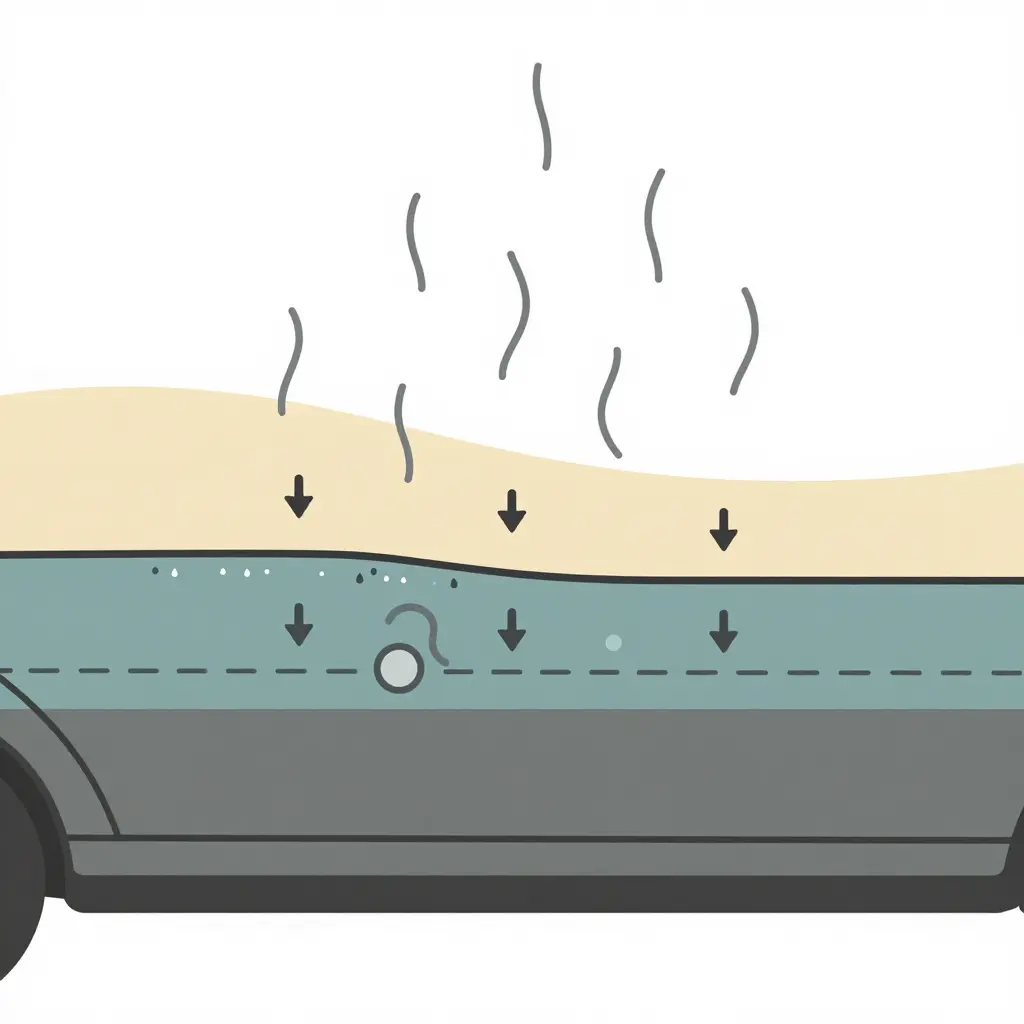
Figure: The same problem in cross-section, in three stages: warm moist air, the cooling layer at the panel face, and the first droplets of condensation. The dashed line is where panel temperature crosses the dew point.
Where Damp Shows First and How to Inspect for It
Moisture does not spread evenly over an idle crash tender. It travels, condenses and settles, and it settles in the same handful of places almost every time. A walk-around that starts with where the water would go, then looks for evidence, then decides what to do, is short enough to repeat and specific enough to trust.
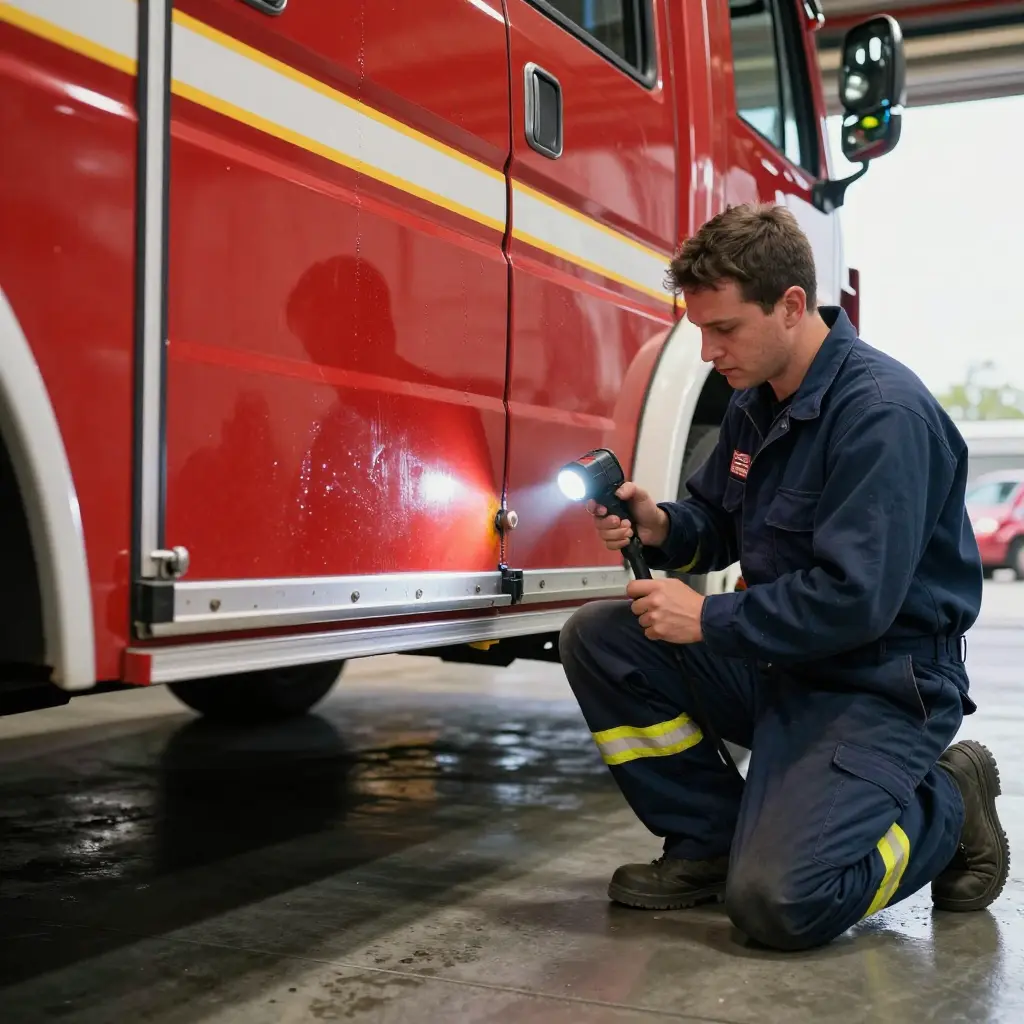
Step 1: Start with where the water would go
Ask where water would end up if you poured it there. Wash-down spray, wet bay floors and warm days cooling into cold nights all push vapour toward low, cold, unventilated steel. That is why damp shows at the bottom of the body first and not on the top panels. Catching water at those low points is most of what humidity control amounts to.
Step 2: Seven places to check, in order
Walk the apparatus from the ground up with your hands and a pin-type moisture meter:
- Lower body seams and welds. Run a bare palm along the seam line; a cooler, slicker patch is your first clue. Look for dull, chalky streaking below the weld.
- Bolt heads and fastener stacks. Water wicks under washers and sits there. Rust blooms around the head long before the panel shows anything.
- Electrical junction boxes. Check the underside of lids for condensation beads and sagging gaskets.
- Battery trays. Feel the corners of the tray floor; crusting and white bloom mean damp plus acid.
- Pump gearbox breathers. Pull the breather and check the oil; milky oil is the giveaway. Learn why wash-down water turns gearbox oil milky before you top it up and call it fixed.
- Air dryer reservoirs. Drain them and catch the discharge in a clear cup. Persistent water means the dryer is being fed moist air; see tracing water back to the wet tank.
- Closed compartment floors. No airflow means no drying. Open, smell and feel the floor of every sealed locker.
| Inspection point | First sign | What it usually means |
|---|---|---|
| Lower body seams | Chalky streaks, cool patch | Condensation running the panel |
| Fastener stacks | Rust ring at bolt head | Water trapped under washer |
| Junction boxes | Beads on lid underside | Bay humidity, not a leak |
| Battery trays | White crust | Damp plus acid vapour |
| Gearbox breather | Milky oil | Water ingress via breather |
| Air dryer drain | Free water in cup | Saturated dryer or wet tank |
| Sealed compartment floors | Soft paint, musty smell | No ventilation, no drying |
Step 3: Reading the pattern, then acting on it
Three or more hits in one walk-around points to a building problem rather than a single failed seal. The bay is holding moisture and the apparatus is simply where it lands. Write the readings down, dry and ventilate the bay, then re-check the same seven points a week later. If the chalky streaks come back, you have evidence rather than a hunch, and you can deal with the humidity before the rust gets a head start.
Bay Relative Humidity and Metal Surface Temperature Across an Idle Day
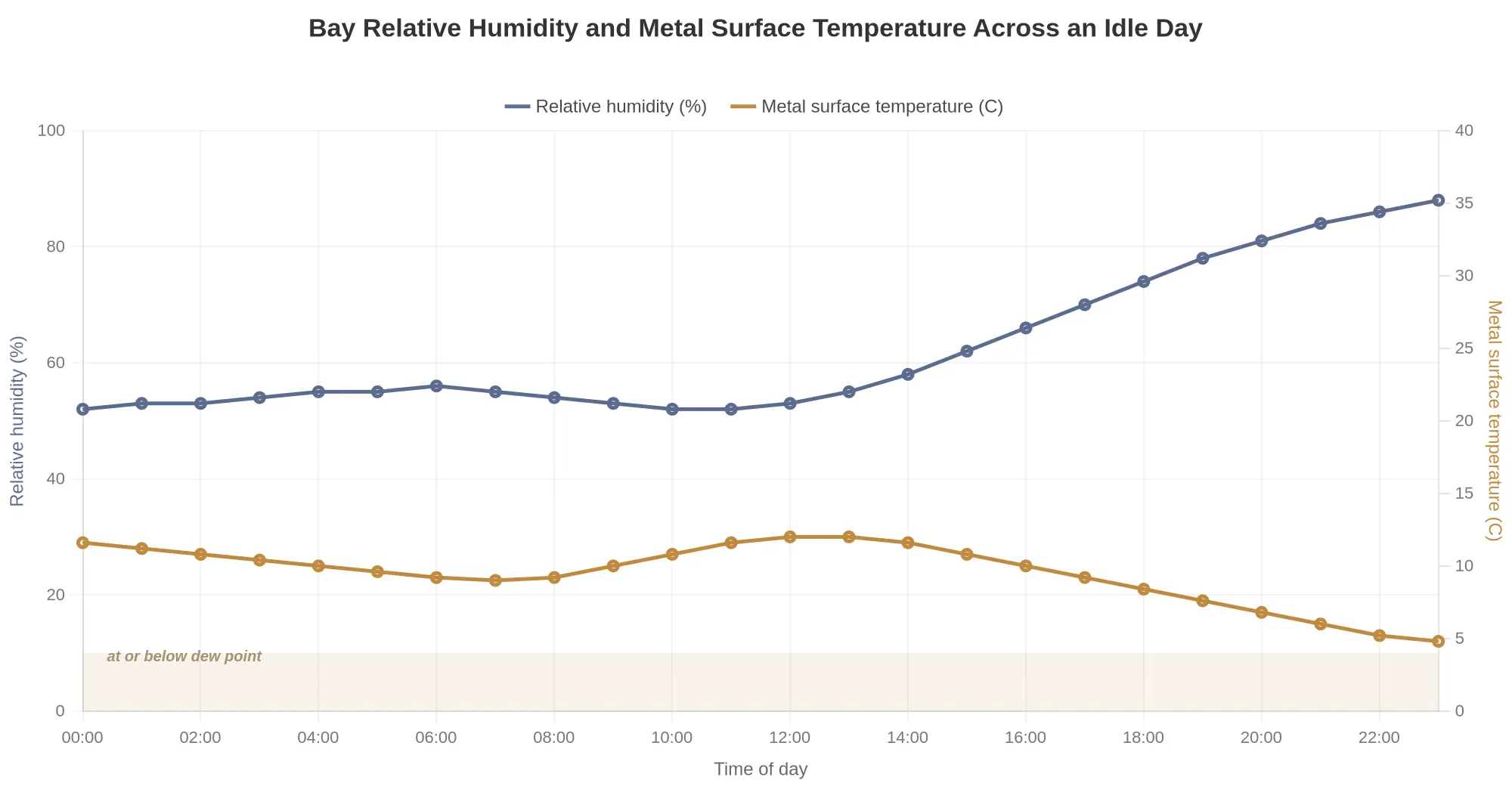
Two lines, one story. Through the working day the bay is unremarkable: relative humidity in the low 50s, steel surfaces well above the dew point, nothing condensing. From roughly 18:00 the lines part company. The apparatus stops running and sheds heat toward the ambient air, while humidity climbs as evening air comes in through doors, louvres and the ventilation path.
That divergence is the problem. Once surface temperature reaches the dew point, the shaded band starts, and from then on moisture is not something that might form; it is depositing on every cool surface in the bay: pump housings, hose reel frames, chassis rails, linkages, fastener threads, tank shells. It sits there overnight. Rust shows up days or weeks later, which is why the damage usually gets blamed on a wash-down or a wet drill rather than on the bay climate that caused it.
Three things to keep in mind when reading the curve:
- The crossover matters more than the average. A bay with a comfortable daily average can cross the dew point every night.
- Heavy metal lags the air. Thick castings and large housings are slow to cool in the evening and slow to warm in the morning, so they can still be below the dew point hours after the bay air has dried out.
- Ventilation timing beats volume. Extraction during the cool-down window, when humidity is climbing fastest, does more than running the fans harder at noon.
Once the mechanism is clear the fix is usually mechanical rather than chemical: control the bay climate and the same iron stops wanting to rust through in the first place.
Closing the Loop: Holding Bay Humidity in a Safe Band
None of these measures is expensive and none of them is interesting. Together they separate a bay that looks dry from one that stays dry.
| Control measure | Why it works |
|---|---|
| Controlled ventilation and extraction | Steady low-level air changes carry moisture-laden air out of the space before it settles on cool steel, and extraction at the apparatus itself catches warm, wet exhaust air at the source. |
| Managed door discipline | Every door open in rain or high humidity is a fresh load of water vapour, so short, coordinated openings stop the bay from importing the weather. |
| Dehumidification sized to bay volume | Capacity matched to the cubic metres of air in the space, not to floor area, keeps the whole envelope below the point at which condensation forms on cold metal. A bay depth and volume sizing guide helps here, because volume is what the plant has to dry. |
| Drainage and slab drying | Standing washdown water and a saturated slab are slow-release moisture reservoirs, so sloped, trapped drainage and a slab that can actually dry removes the supply instead of chasing the symptom. Good drainage planning for washdown water and foam runoff is the foundation of the whole programme. |
| Prompt removal of wet hose and foam residue | Wet hose and foam deposits hold water against surfaces and keep releasing it for hours, so clearing them stops the bay from humidifying itself overnight. |
| Periodic dew point logging | Trending dew point against bay temperature shows the safety margin shrinking well before damp patches or rust appear. |
The log only earns its keep when it meets your inspection records. A log in a drawer is a diary; read alongside the walk-around findings, it is an early-warning system. When a technician finds a cold spot or a pale bloom near a chassis rail, the preceding weeks of readings say whether the cause is a failing extractor, a blocked drain, or a door left ajar every shift.
That matters most for the vehicles that never move. An idle appliance cools to ambient, holds that cold surface for hours and collects condensation while everyone assumes it is safe because it is stationary. Damp on an idle vehicle is usually a building problem wearing a vehicle’s coat.
So treat humidity control as maintenance rather than repair. Ventilate, dehumidify, drain, clear the wet kit and read the log, every week, whether or not anything looks wrong.
Frequently Asked Questions: Apparatus Bay Humidity Control
Does damp on idle apparatus always lead to rust?
No. A light film of moisture that dries out the same day rarely produces rust on painted or galvanised surfaces. Rust becomes a real risk when damp persists in seams, wheel arches, chassis pockets and bracket joints, where condensation collects and cannot evaporate. Standing damp is an early warning that humidity control is drifting, not an automatic rust verdict.
What humidity level should an apparatus bay be held at?
Target 40 to 50 percent relative humidity and treat 60 percent as an upper working limit. Above roughly 70 percent the margin between steel temperature and dew point closes, and condensation forms readily on cold steel, tank shells and floor plates, especially overnight when doors are closed and vehicle surfaces sit below dew point. A logged hygrometer reading is the simplest way to confirm the bay is holding through winter and the shoulder seasons.
Is ventilation alone sufficient?
Usually not. Exhaust extraction and general ventilation clear moisture-laden air and diesel soot, but they do not remove standing water, dry wet hose beds or reach dead-air corners behind parked vehicles. Effective control pairs ventilation with drainage, door discipline and targeted dehumidification. Layout and airflow losses are covered in our guide to apparatus bay exhaust extraction.
How quickly does damp become visible corrosion?
On bare or damaged steel, flash rust can appear within 24 to 48 hours in warm, humid, salt-laden air. Painted bodies usually show bubbling or seam staining within weeks to a few months, and the damage underneath is worse than the surface suggests. Because condensation hides behind trim and inside compartments, visible corrosion is a late indicator rather than an early one.