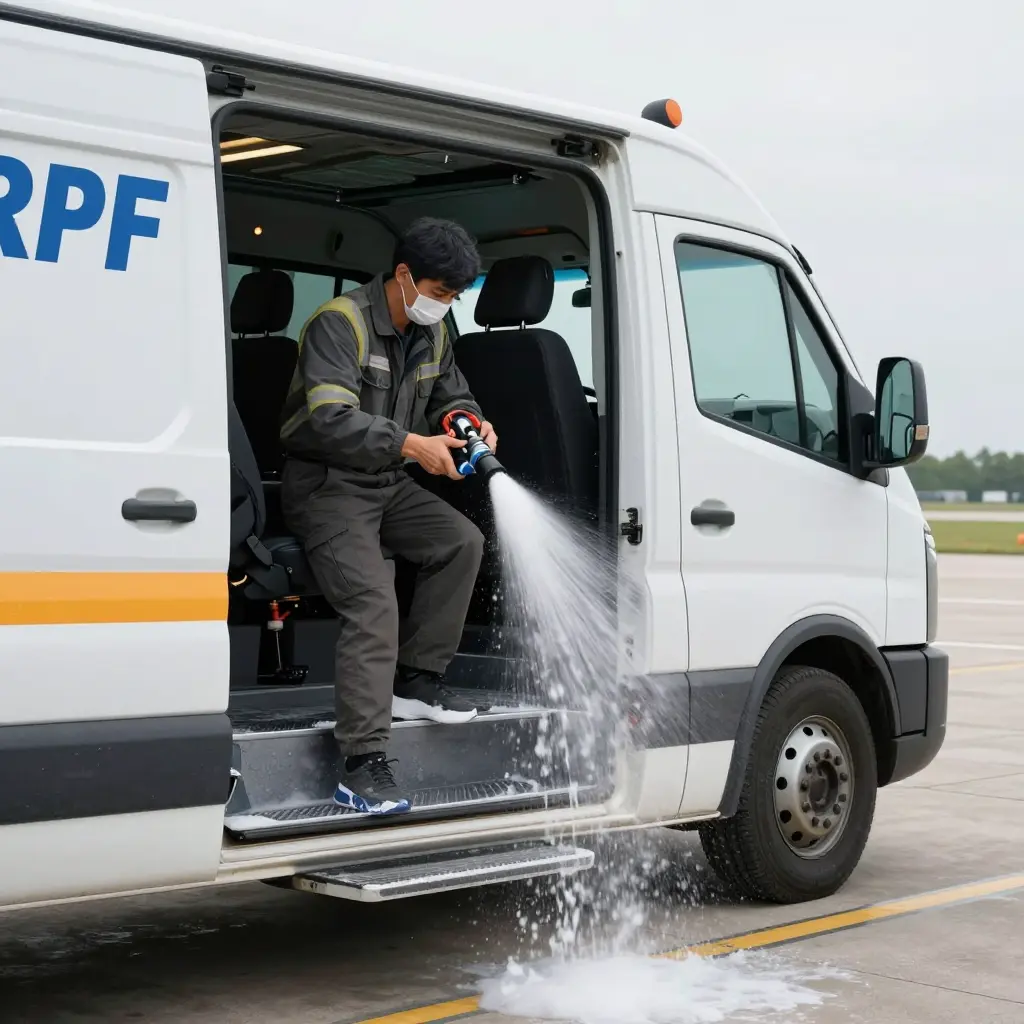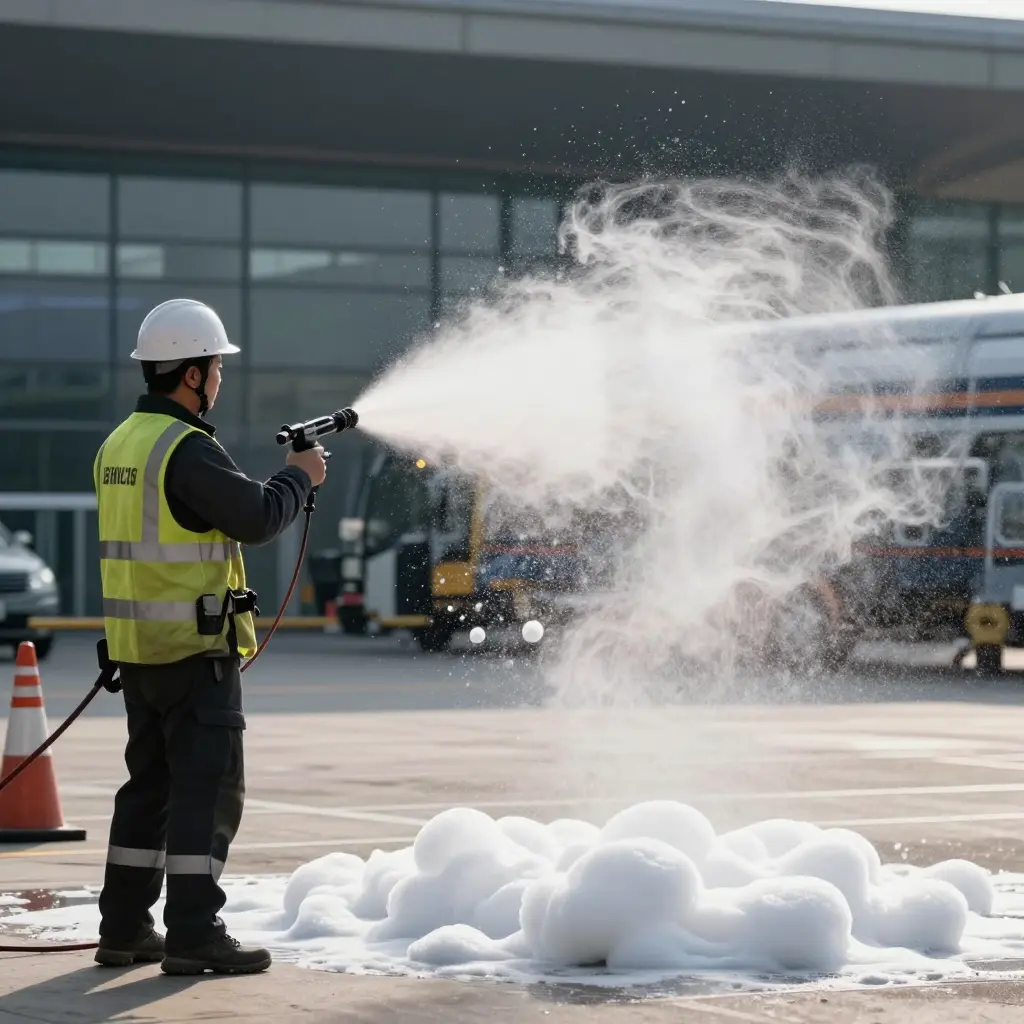
Airport crash tender chassis corrosion is a chemical attack from below that ARFF fleets often discover only after measurable structural metal loss.
Frame rails, crossmembers, suspension mounts, and underbody steel degrade because corrosive liquids collect and stay beneath the apparatus. This is not ordinary atmospheric rust. It starts at the lowest point of the vehicle and works upward into load-bearing members.
Two sources cause most of the damage: aqueous film-forming foam (AFFF) runoff and de-icing salt.
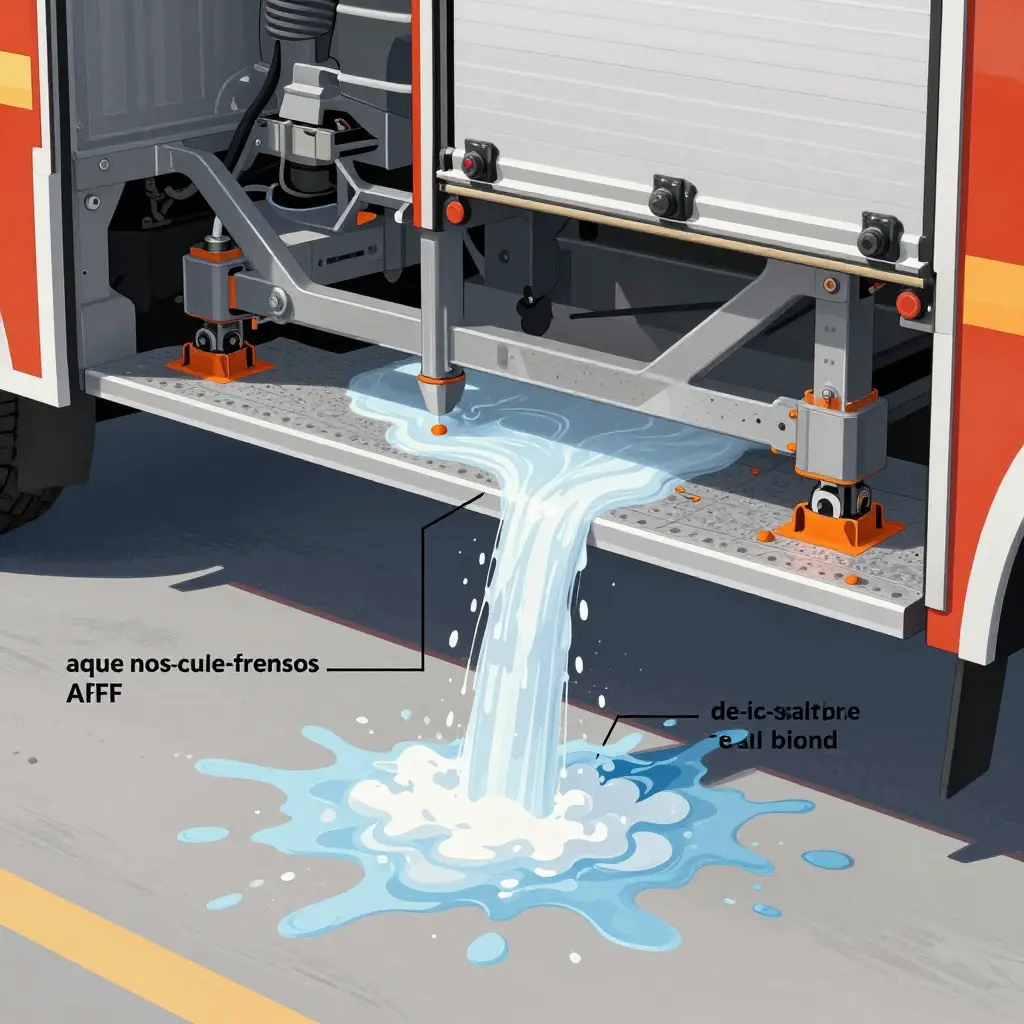
Foam runoff carries fluorochemical surfactants and wetting agents that stay fluid, cling to steel, and work into seams, welds, and crevice cavities where the protective coating is thinnest. De-icing salt dissolves into brine that splashes onto the chassis underside and speeds electrochemical corrosion in trapped moisture. Excess concentrate left on the ramp by foam proportioning drift makes it worse, feeding the underside a continuous corrosive film between washes.
Both attack from below, out of the line of sight. Drivers and walkaround inspectors rarely examine the frame areas where liquid pools and wicks, so degradation goes unnoticed between scheduled inspections.
Scope of This Article
This article covers the mechanism and the maintenance response: how foam runoff and de-icing salt interact with chassis geometry, coatings, and drainage; how to recognize early-stage corrosion during inspection; and which rinsing, coating, and protection practices extend frame service life for ARFF fleets and apparatus mechanics.
Surface discoloration is only the visible signal. The structural risk sits in crevices, boxed sections, and weld toes that hold moisture long after the rest of the vehicle has dried.
How Foam Runoff Chemically Attacks the Crash Tender Chassis Frame From Below
When an ARFF crew discharges AFFF or another foam concentrate, part of the solution misses the fire. It sheets off the turret, drains down the bodywork, and pools on the lowest, least-inspected surface of the vehicle: the underside of the frame. What collects there is not harmless water but a chemically active liquid that starts chassis frame corrosion from below, where a walk-around inspection rarely reaches.
The mechanism is cumulative. Every discharge lays down a fresh film of aggressive chemistry, and each cycle carries it a little deeper into the coating and the steel underneath.
Alkalinity and pH Behavior of Foam Solutions
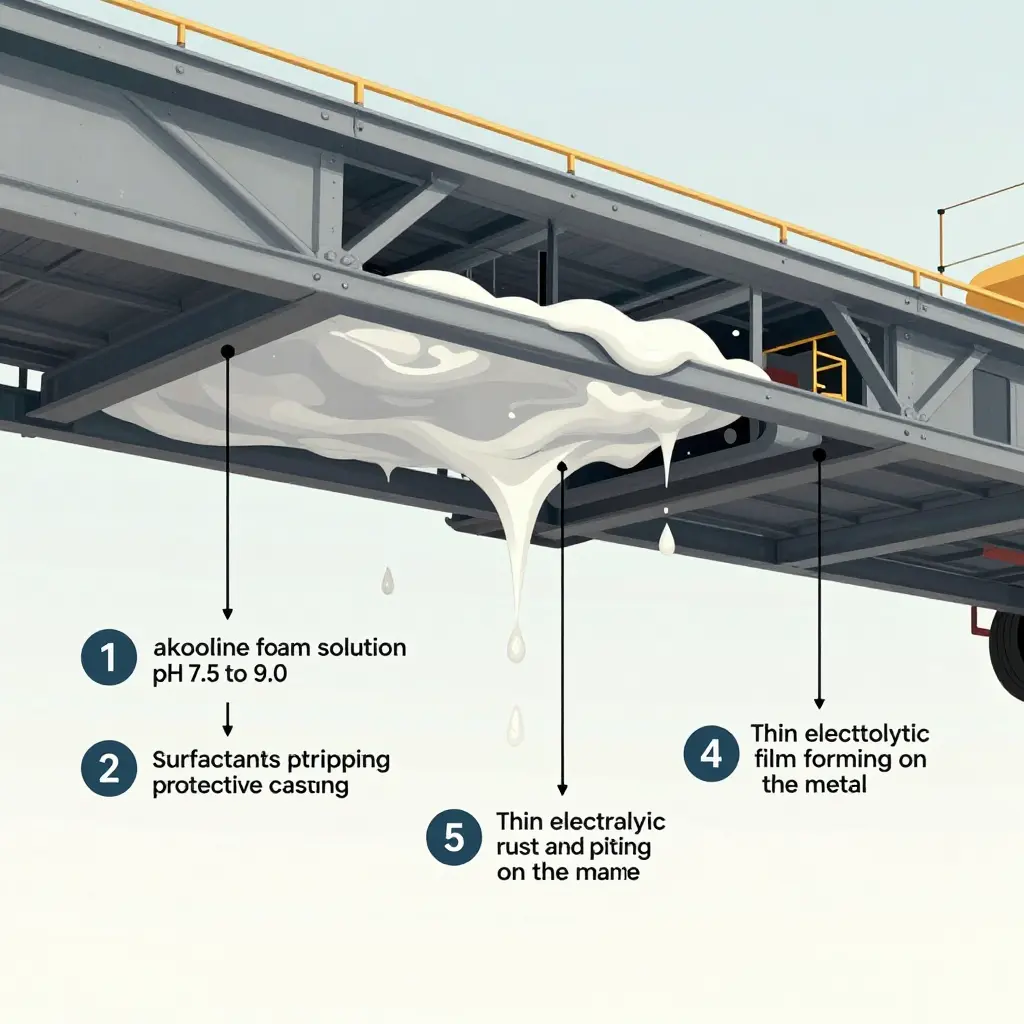
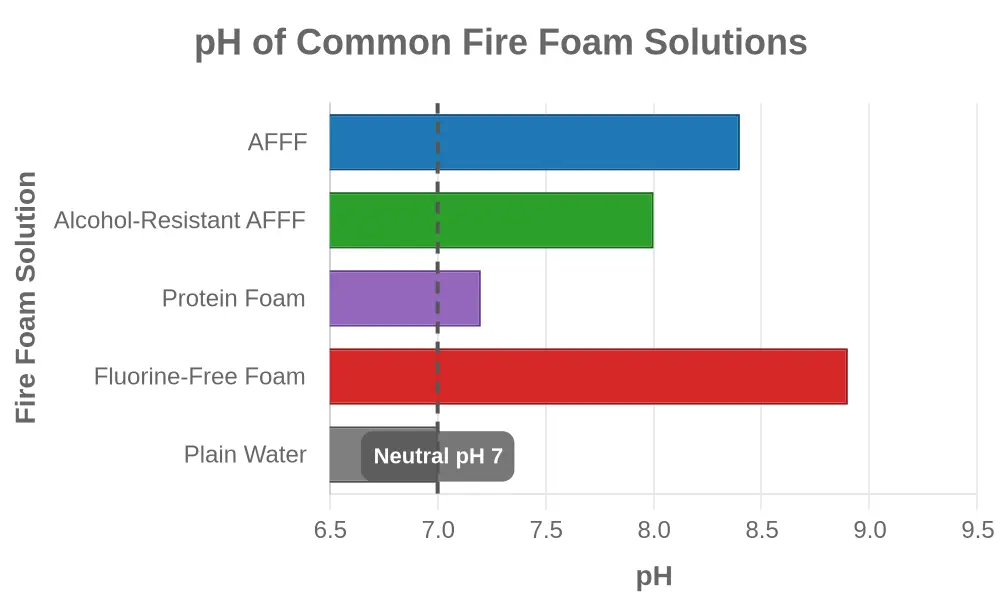
AFFF concentrates are formulated near neutral to mildly alkaline. Depending on the concentrate and the proportioning ratio, a dilute AFFF solution typically sits between pH 6.5 and 8.5, and fluorine-free formulations can run higher, close to pH 9. The alkaline end of that range stabilizes the surfactant package and improves foam blanketing, but it also leaves the underside of the frame bathed in a mildly caustic film. Through repeated wetting and drying cycles, that residual alkalinity slowly saponifies organic coatings and re-wets them before they fully cure, softening the barrier meant to protect the steel. Proportioning sets how strong the solution you actually discharge is; see why proportioning drift can go unnoticed on the ramp.
Surfactant Action That Strips Paint and Protective Coatings
Surfactants do most of the firefighting work in a foam concentrate, and they are the main reason foam runoff damages coated steel. The molecules that lower surface tension so foam can spread across a fuel spill also lower it on painted metal. They wet the frame, work into microscopic scratches and stone chips, and migrate under the paint film. At the primer-metal interface they break the bond holding the coating in place, so the paint lifts, blisters, and flakes, exposing bare steel to the next discharge.
Dissolved Chlorides and Sulfates in the Runoff
Foam concentrate and the water it is proportioned with both carry dissolved ions. Chloride and sulfate matter most. Chlorides are especially aggressive toward steel: they break through the passive oxide layer, promote pitting, and accelerate the electrochemical reactions behind oxidation. Sulfates raise the liquid’s conductivity, and together the two make the runoff an efficient electrolyte rather than a neutral rinse. On a frame that already has coating damage, those dissolved species set the rate at which corrosion advances.
The Electrolytic Film That Accelerates Oxidation
After each discharge, a thin film of ion-rich runoff clings to the frame, held there by the same surfactants that stripped the coating. That film is an electrolyte. It carries dissolved chloride and sulfate and keeps electrical contact across the steel, effectively turning the frame into a weak galvanic cell. Where the coating has failed, oxygen-rich wet zones and oxygen-starved crevices form an anodic-cathodic gradient, and metal at the anode gives up electrons and dissolves. Because the film absorbs moisture and dries slowly, the circuit stays live far longer than it would after a plain water rinse, driving pitting and section loss with each wash-down.
The underside of a crash tender frame is a chemical battery waiting to happen, and foam runoff is its electrolyte. Alkalinity, surfactant stripping, dissolved salts, and lingering films work together, so the surfaces that never get looked at are the ones worth inspecting and protecting.
Not every corrosive reaches the frame the same way. The table below shows how each agent that lands on the ramp attacks the chassis from below, ranked by relative corrosion rate on mild steel.
Foam Runoff vs. De-Icing Salt: How Each Agent Attacks the Crash Tender Chassis
| Corrosive Agent | Typical pH / Chemistry | Primary Attack Mechanism | Most Affected Chassis Zones | Relative Corrosion Rate |
|---|---|---|---|---|
| AFFF runoff | pH 6.5-8.5; fluorosurfactant + hydrocarbon | Surfactant cuts surface tension, wets crevices, mobilizes chloride; drives anodic pitting | Lower frame rails, crossmembers, under-body cavities | High |
| Protein foam residue | pH 6.5-7.5; hydrolyzed protein slurry | Sticky film holds moisture and salt; bacterial decay yields organic acids | Wheel wells, step wells, battery-box floors | Moderate-High |
| Chloride de-icing brine | pH 6-9; 23-30% NaCl / CaCl2 / MgCl2 | Chloride depassivates steel, sustains deep pitting | Lower frame rails, spring hangers, fastener stacks | Very High |
| Dry salt | Near-neutral; hygroscopic chloride crystals | Draws ambient moisture, forms concentrated localized brine cells | Ledges, shelf brackets, frame-flange tops | Moderate |
| Wet-stored salt film | Near-neutral brine held under mud and slush | Persistent wetting under deposits creates oxygen-differential cells | Sub-frame recesses, undercoating breach points | High |
| Mixed foam-plus-salt exposure | Buffered foam pH; chloride-rich surfactant matrix | Synergistic: surfactant carries chloride into tight crevices, chloride then accelerates pit growth | Entire underside frame, lap joints, weld seams | Extreme |
Foam and salt rarely act alone. The worst damage happens where a buffered foam film pins chloride-rich brine against the frame and widens pits long after the ramp looks dry. Disciplined post-run flushing, plus monitoring how much concentrate actually reaches the deck, links accurate agent delivery to long-term chassis integrity.
How De-Icing Salt and Chloride Brine Attack the Crash Tender Frame From Below

The crash tender undercarriage works in one of the harshest chloride environments in ground support equipment. Through winter, aircraft de-icing fluid, pavement-treatment chemicals used on runways and aprons, and chloride-based salt and brine from access roads and service areas are thrown up as mist and sprayed along the chassis by the vehicle’s own wheels. Because the frame sits only inches above the surface, that spray coats the underside continuously rather than intermittently. A low-slung ARFF chassis is effectively a collection tray for whatever the tires throw up.
Chloride Ion Penetration Through Crevices
Chloride ions are small, mobile, and aggressive toward the passive oxide layer that protects steel. On open, freely draining surfaces they get washed away. The damage happens in crevices: lapped frame sections, boxed gussets, and unwelded seams where brine wicks in by capillary action and stays trapped. Inside a crevice, oxygen differentials open up between the shielded interior and the exposed exterior, and chloride attack concentrates on the shielded metal. De-icing salt corrosion starts there, from the inside out, long before surface rust is visible.
Galvanic Corrosion at Welds and Fasteners
Welds and fasteners create metallurgical and galvanic discontinuities. Weld metal, heat-affected zones, and adjacent base metal differ in composition and microstructure, so small potential differences form between them; a chloride electrolyte bridges the gap and drives galvanic corrosion. The same happens where stainless fasteners, aluminum brackets, or plated hardware are bolted to a carbon-steel frame. The salt film completes the circuit, and the less noble metal corrodes first. Fastener heads and weld toes are usually where failure first shows, and the damage often runs beneath the coating.
Moisture Retention in Salt Films
Chloride salts absorb moisture. A residual brine film on the undercarriage does not dry the way clean water does; it pulls moisture from the air and, for calcium and magnesium chloride in particular, stays wet at humidities where a sodium chloride film would dry. That extends the wet time per exposure, the single most important variable in atmospheric corrosion rate. Repeated wet-dry cycles concentrate the chloride, and each cycle re-wets an already contaminated surface, accelerating attack.
Continuous Undercarriage Exposure on Aprons and Taxiways
A highway vehicle leaves the treated zone; a crash tender on airport property stays inside a treated footprint all winter. Aprons, taxiways, and runway shoulders are dosed continuously, and foam runoff behavior on the ramp adds surfactant-laden liquid that wets the frame and carries chloride into crevices. The frame never fully dries between shifts, so corrosion accumulates with no recovery period.
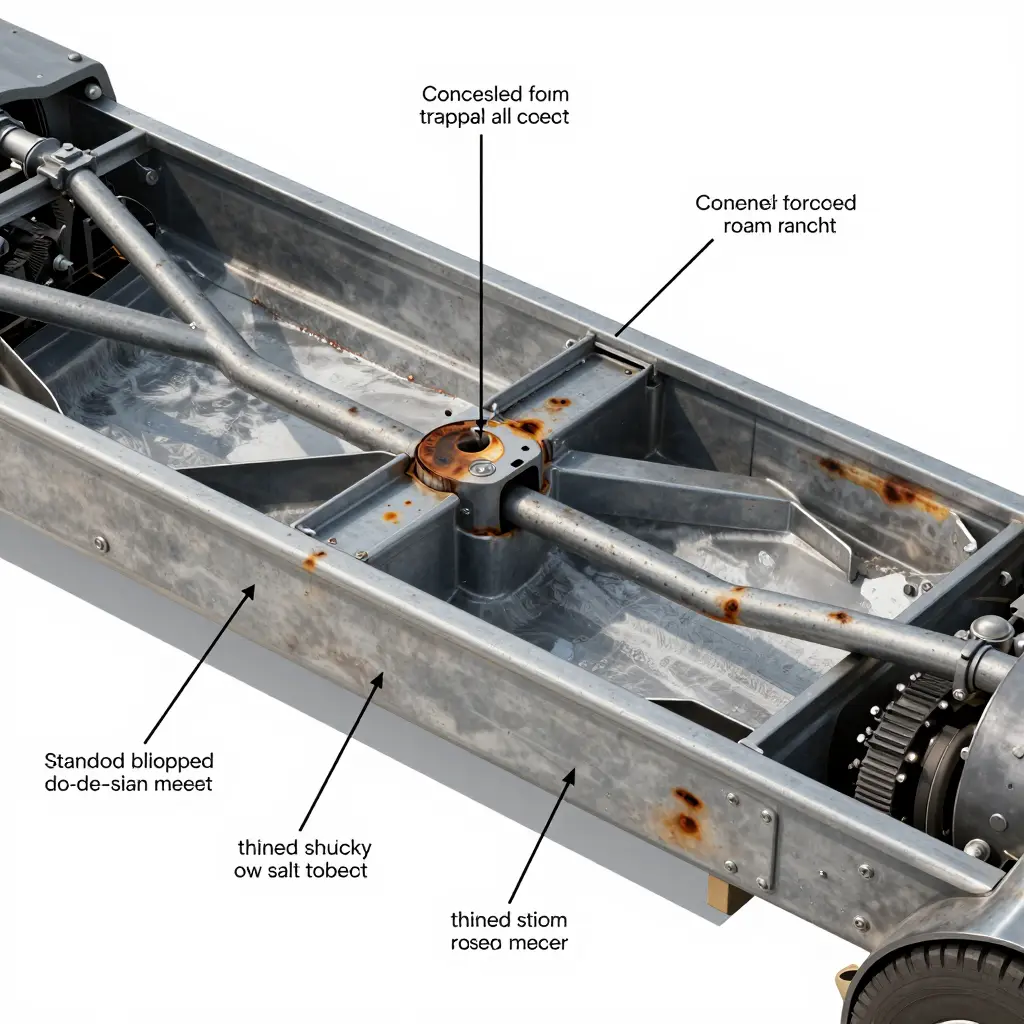
The diagram below maps the underside of a crash tender chassis, highlights the five most corrosion-vulnerable zones, and traces the upward splash and runoff paths from the road surface.
The Combined Chassis Corrosion Effect: When Two Contaminants Team Up
On an airport apron, two contaminants routinely reach the crash tender underside: foam runoff from ARFF training and discharge, and de-icing salt tracked and sprayed across the ramp. Each corrodes steel on its own. Together they produce combined chassis corrosion that outpaces the sum of the two, because the mechanisms reinforce each other.
Wetting-Cycle Retention: No Time to Dry
Corrosion needs an electrolyte layer that stays in place. Foam surfactants lower surface tension, so runoff spreads into a thin, clinging film instead of beading and draining. Salt dissolves readily in that film and makes it conductive. Because the surfactant film resists evaporation, the frame stays wet far longer than it would after a plain water rinse.
Surfactants Keep Salt in Solution Against the Frame
The core effect is carriage: the surfactant holds chloride-laden moisture against the frame rail, crossmembers, and fasteners, extending how long the salt solution stays in contact. Every extra hour the electrolyte lingers is another hour of electrochemical attack.

Bio-Fouling and Debris Bridging
Surfactants also feed microbes, which produce organic acids and a sticky biofilm. That film traps grit, foam residue, and salt crystals, bridges gaps between overlapping plates, and creates stagnant crevices. Those occluded zones lose oxygen while the surrounding surface stays aerated, forming oxygen-differential cells that drive current toward the shielded metal.
From Mechanism to Consequence: Localized Deep Pitting
Inside the crevice, chloride concentrates while oxygen cannot get in. The steel’s passive film breaks down, and because the electrolyte is trapped rather than diluted, the pit grows deep instead of spreading wide. The result is tight pitting that can perforate a frame rail long before surface rust suggests a problem. This is why tenders exposed to both foam runoff and de-icing salt fail faster than fleet schedules predict, and why undetected foam proportioning drift can add to the salt loading that drives the cycle.
Chassis Corrosion Rate Across a 12-Month Airport Operational Cycle
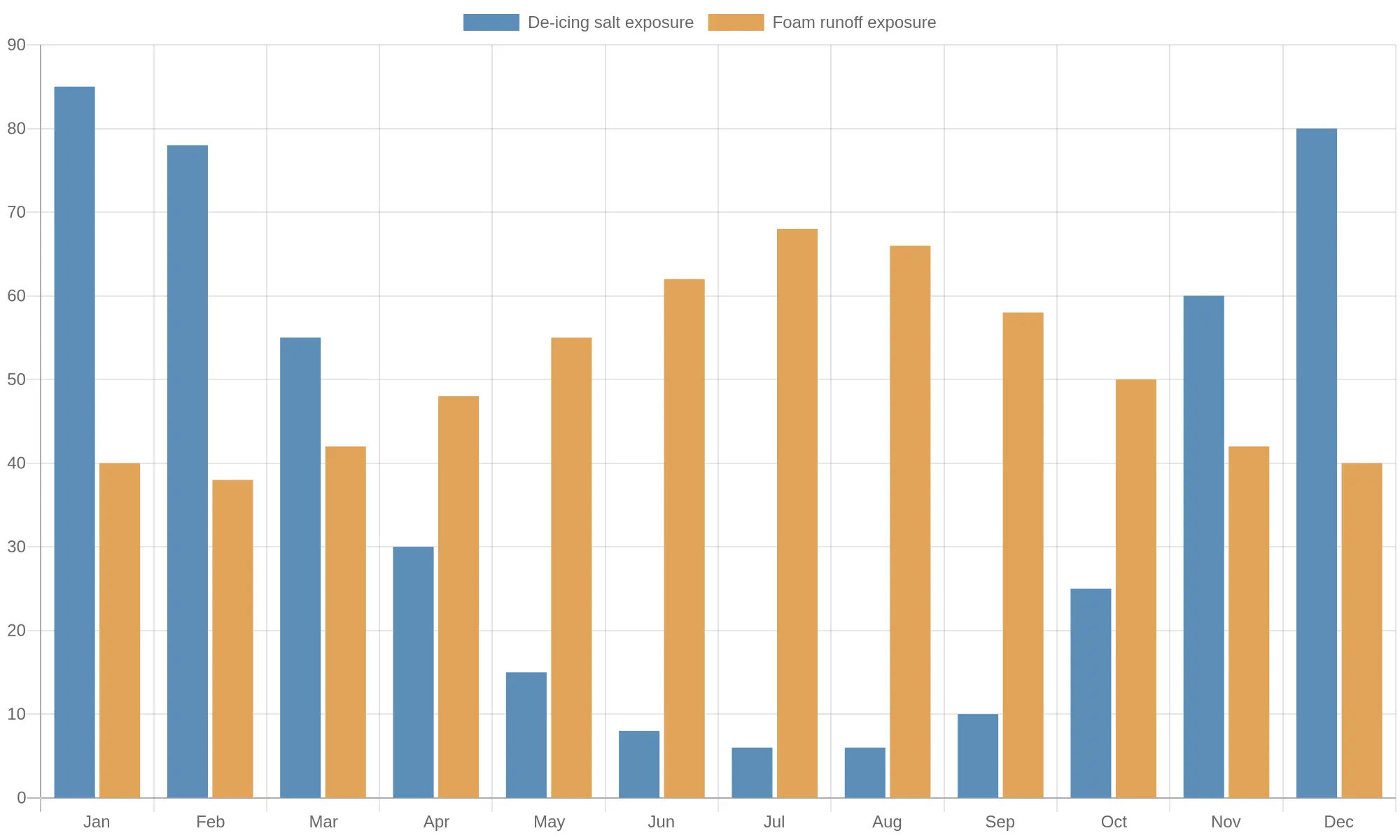
Winter de-icing salt drives the seasonal baseline. From November through March, chloride-laden ramp spray and runoff migrate upward into the frame rails, where pooled brine attacks the inner surfaces of boxed sections from below. That produces a sharp spike in the corrosion index that does not fully decay when the cold ends. Foam sustains the attack through summer: aqueous film-forming foam (AFFF) and fluorine-free alternatives leave a chloride-bearing residue, and after drills or equipment checks it runs off the apparatus onto the same underframe, a pathway examined in our analysis of foam proportioning drift that goes undetected on the ramp. Summer heat speeds the electrochemical reaction, so the foam-runoff months keep the baseline elevated even as salt exposure drops. The result is a year-round cycle rather than a single seasonal event.
Why Corrosion Goes Undetected
Frame corrosion rarely announces itself. It develops where the eye cannot easily see and the hand cannot easily reach, which is why hidden chassis corrosion can advance for years before anyone notices.
Low-Visibility Underside Geometry
Chassis frames are built from C-channel rails, box-section crossmembers, and overlapping gussets. These shapes form enclosed pockets, ledges, and drainage paths that face downward. Foam runoff and de-icing salt splash upward, then settle in cavities where airflow is minimal and moisture lingers.
The geometry shelters the steel, so the wettest zones are often the ones least exposed to view.
Protective Coating as Camouflage
E-coat, paint, and undercoating are meant to seal the frame, but they also hide what happens beneath them. Rust creeps sideways under a film that still looks intact, and by the time the surface blisters or flakes, the failure is well established.
Surface Rust vs. Structural Section Loss
Not all rust is equal. A thin oxide film on a painted flange is largely cosmetic. Structural section loss is different: a measurable reduction in steel thickness that erodes the rail’s load capacity. The two look alike from a distance and can only be told apart by measurement.
Why Pre-Trip Inspections Miss the Frame
Routine checks center on the driver’s walk-around: tires, lights, fluids, mirrors, cab functions. Few procedures ask a crew to crawl under a crash tender, and fewer still require probing the lower frame flanges or the inside of box sections. Foam-related failures on the chassis go unnoticed for the same reason.
The Blind Spot Has a Consequence
Missed inspections compound. Coating masks progress, geometry conceals pooling, and cosmetic rust disguises structural thinning. Appearance-based checks cannot catch any of it; detection has to reach the lower surfaces of the frame.
Undercarriage Corrosion Inspection Checklist
Use this checklist to inspect a crash tender chassis from below and catch hidden corrosion driven by foam runoff and de-icing salt before it compromises structural integrity or emergency readiness.
- Inspect frame rails along their full length for pitting, scaling, and section loss, concentrating on the low points where runoff collects and bare steel is attacked first.
- Examine floor pan seams for cracked sealant and seam separation that trap moisture and let it wick upward into the rail web.
- Probe cross members with a hardened pick or tap hammer to reveal thinning walls, delamination, and concealed rust blooms where road spray settles.
- Check suspension and axle mounts for corrosion at bracket-to-frame welds, bushing pockets, and mounting bolts, where load-bearing joints meet both mechanical stress and chemical attack.
- Trace drain paths to confirm weepholes, gussets, and drain channels stay clear and flowing, because a blockage lets corrosive liquid sit against the chassis for hours; see why lingering foam proportioning drift on the ramp matters here.
- Evaluate fasteners and welds for rust jacking, cracked fillets, and loose or missing hardware that accelerate crevice corrosion.
- Assess coating integrity by mapping chips, blisters, and undercut edges where the protective film has failed, and flag any exposed bare metal.
- Document corrosion rates by recording each location, severity, and measurement date against prior inspections so trends are tracked and repairs are prioritized.
Work top to bottom, photograph every finding, and schedule remediation before surface rust becomes structural loss.
Maintaining the Frame: Engineering-Grade Prevention and Mitigation
Foam runoff and de-icing salt attack the chassis on two fronts, and reactive repairs never win. Durable chassis corrosion prevention means breaking the exposure cycle before deposits bond to the frame. The measures below are built for the realities of ARFF operations.
Wash-Down Frequency and Sequence
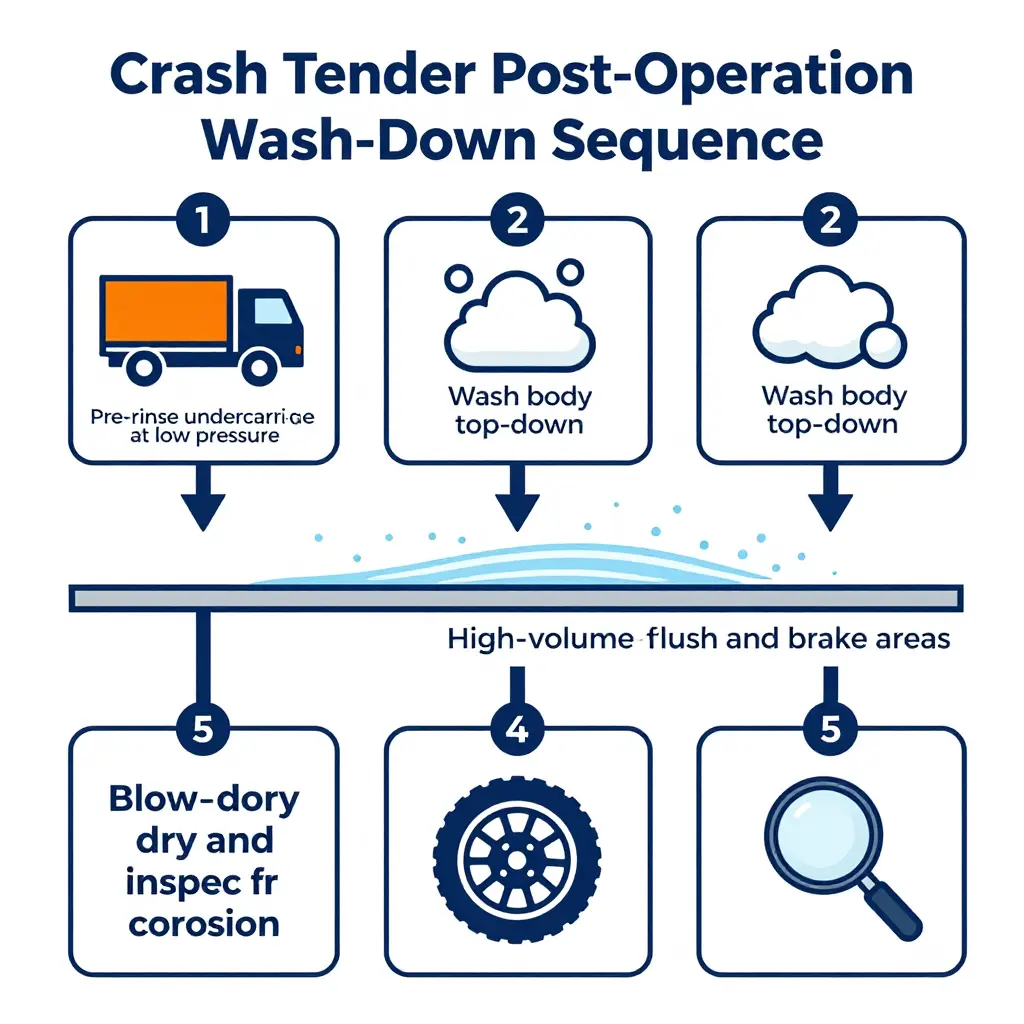
Corrosion tracks contact time, so frequency matters more than intensity. Wash within two hours of any foam discharge, and at the end of every winter shift while de-icing salt is active on the apron. Order matters as much as schedule: pre-rinse the undercarriage at low pressure to rehydrate hygroscopic foam residue, wash the body from the top down, then finish with a high-volume flush of the frame and box sections. Skip the undercarriage-first pass and you drive concentrate deeper into enclosed cavities.
For a clearer picture of how much agent can reach the ramp undetected, review this analysis of why foam drift goes undetected on the ramp.
Undercarriage Rinse and Drainage Design
A rinse only works if the water has somewhere to go. Confirm that drain and weep holes in frame rails and crossmembers sit at the true low points, and clear mud, foam cake, and ice from every opening. Water that pools in box sections becomes an electrolyte reservoir that feeds pitting and crevice corrosion.
Corrosion-Resistant Coatings and Cavity Wax
Where procurement allows, specify hot-dip galvanized or e-coated frames, then overcoat with epoxy primer and a polyurethane topcoat. Inject cavity wax into enclosed sections once a year, prioritizing seams, weld lines, and the top flange of the frame where runoff and salt collect.
Fasteners, Seals, and Dissimilar-Metal Isolation
Use stainless or coated fasteners with isolating washers to prevent galvanic coupling against aluminum structures. Apply sealant at every fastener interface, and fit closed-cell seals at body-to-chassis junctions so brine cannot wick inward.
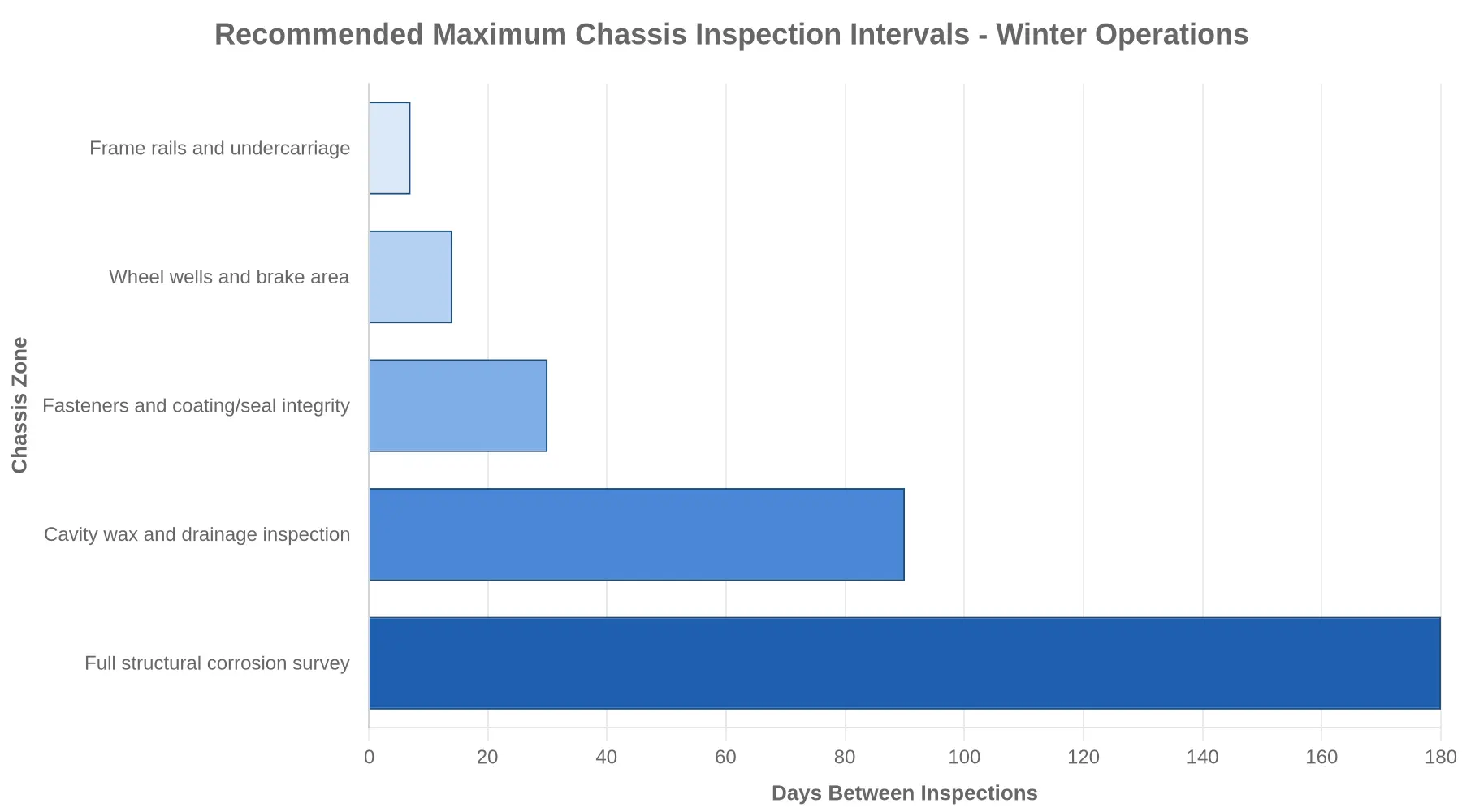
Inspection Intervals Tied to Winter Operations
Anchor inspections to the de-icing season, not the calendar.
| Chassis Zone | Maximum Winter Interval | Primary Focus |
|---|---|---|
| Frame rails and undercarriage | 7 days | Surface corrosion, coating damage |
| Wheel wells and brake area | 14 days | Caked salt, seal integrity |
| Fasteners and coating/seal joints | 30 days | Galvanic attack, sealant gaps |
| Cavity wax and drainage | 90 days | Wax depletion, blocked drains |
| Full structural survey | 180 days | Section-thickness loss |
Recommended Post-Operation Steps
- Pre-rinse the undercarriage at low pressure to rehydrate foam residue.
- Wash the body top-down using the correct dilution.
- Flush frame rails and box sections at high volume, following rail direction.
- Rinse wheel wells and brake areas without soaking friction surfaces.
- Blow-dry the frame and inspect for fresh corrosion or coating breach.
- Log the wash and flag any drainage or seal defect for immediate repair.
Run this routine through the winter and the chassis will outlast the rest of the truck.
From Chassis Corrosion to Whole-Fleet Lifecycle Planning
For airport operators and procurement officers, chassis corrosion is not just a maintenance line item. It is an early indicator of how long an ARFF fleet will stay safe, compliant, and economical to run.
Why corrosion compresses asset longevity
De-icing salt and foam runoff attack the frame from below, creeping into boxed sections, behind brackets, and around fasteners where inspections rarely reach. Once section loss starts, load paths weaken and the margin that keeps a fully loaded tender stable during a high-speed response narrows. A component engineered to last the vehicle’s life becomes a consumable, and replacement capital moves forward by years.
Safety compliance and reliability planning
Corrosion-driven degradation is also a compliance risk. Cracked welds, fastener pull-through, and decayed mounting points can compromise the pump, tank, and boom attachments, exactly the systems that must perform on the ramp. Reliability planning should therefore rank the chassis alongside the firefighting systems it carries. Foam delivery is a useful parallel: proportioning faults go unnoticed much like foam proportioning drift on the ramp, so both mechanical and chemical degradation reward proactive diagnostics over reactive repair.
The total cost of ownership picture
Total cost of ownership rarely accounts for corrosion properly. It should include inspection labor, protective treatment, premature frame repair, and unplanned downtime, all of which grow as a fleet ages. Agent chemistry belongs in the same equation, since temperature swings shorten foam agent shelf life and slow shelf-life loss erodes readiness the way structural decay does. Managing corrosion and consumables as one lifecycle program instead of separate budgets is what keeps a crash tender dependable from delivery to decommissioning.
Frequently Asked Questions: Airport Crash Tender Chassis Corrosion
How quickly does foam runoff begin corroding the chassis frame?
Foam runoff starts attacking unprotected steel within hours of a deployment, not weeks. The fluorochemical surfactants in AFFF and AR-AFFF, along with the neutral-to-alkaline pH of many concentrates, strip factory coatings and leave bare steel exposed to an electrolyte that pools inside boxed frame channels. Flash rust can appear on undercarriage hardware within a single shift, and sustained exposure turns ordinary airport crash tender chassis corrosion into a chronic, load-bearing structural defect. Left unchecked, foam runoff compromises the frame sections designed to absorb the tender’s weight and impact loads.
Is rinse-water alone sufficient after a foam deployment?
Rinse water alone is rarely sufficient. Foam leaves a tenacious surfactant residue that clings to weld seams, bolt heads, and lapped frame joints, and plain water dilutes that film rather than neutralizing it. The recommended sequence is a mild alkaline detergent wash, a high-volume freshwater flush, and forced drying, because residual agent keeps re-wetting the steel. Knowing how foam concentrate behaves in service, and how its chemistry shifts with temperature swings that shorten agent shelf life, helps crews anticipate where residual deposits will concentrate.
How does de-icing salt exposure differ from foam exposure?
De-icing salt, chiefly sodium and calcium chloride, drives the chloride pitting and galvanic corrosion that bores deep, localized pits into the frame, while foam runoff tends to produce broader, more uniform surface attack paired with alkaline degradation of protective coatings. The two mechanisms also peak at different times: de-icing salt dominates winter ramp operations, whereas foam exposure is episodic and tied to deployments and training. Both feed the same trapped-moisture zone beneath the deck, so a frame can suffer overlapping damage that neither threat alone would cause.
How do I distinguish structural section loss from surface rust?
Surface rust is a cosmetic oxide layer that can be scraped or wire-brushed away, while structural section loss means the steel itself has thinned and no longer meets its original load capacity. The reliable test is ultrasonic thickness gauging at known high-risk points, compared against the manufacturer’s minimum wall thickness specification. Perforation at frame rails, flaking laminations, and flexing under load all indicate that surface rust has progressed into a structural concern.
How often should undercarriage inspections occur?
Undercarriage inspections should run at least quarterly in mild conditions, and far more often when de-icing salt is in use; the winter schedule above sets frame-rail checks at seven days. Add a check immediately after every foam deployment and after each de-icing season. High-duty ARFF fleets operating in salt-exposed or coastal environments may need monthly reviews of frame rails, crossmembers, and mounting brackets. Recording thickness readings and rust progression over time turns a routine visual check into a predictive maintenance tool, so mechanics can schedule repairs before corrosion threatens vehicle readiness.