Falling Debris, Not Heat, Ends the Mission First
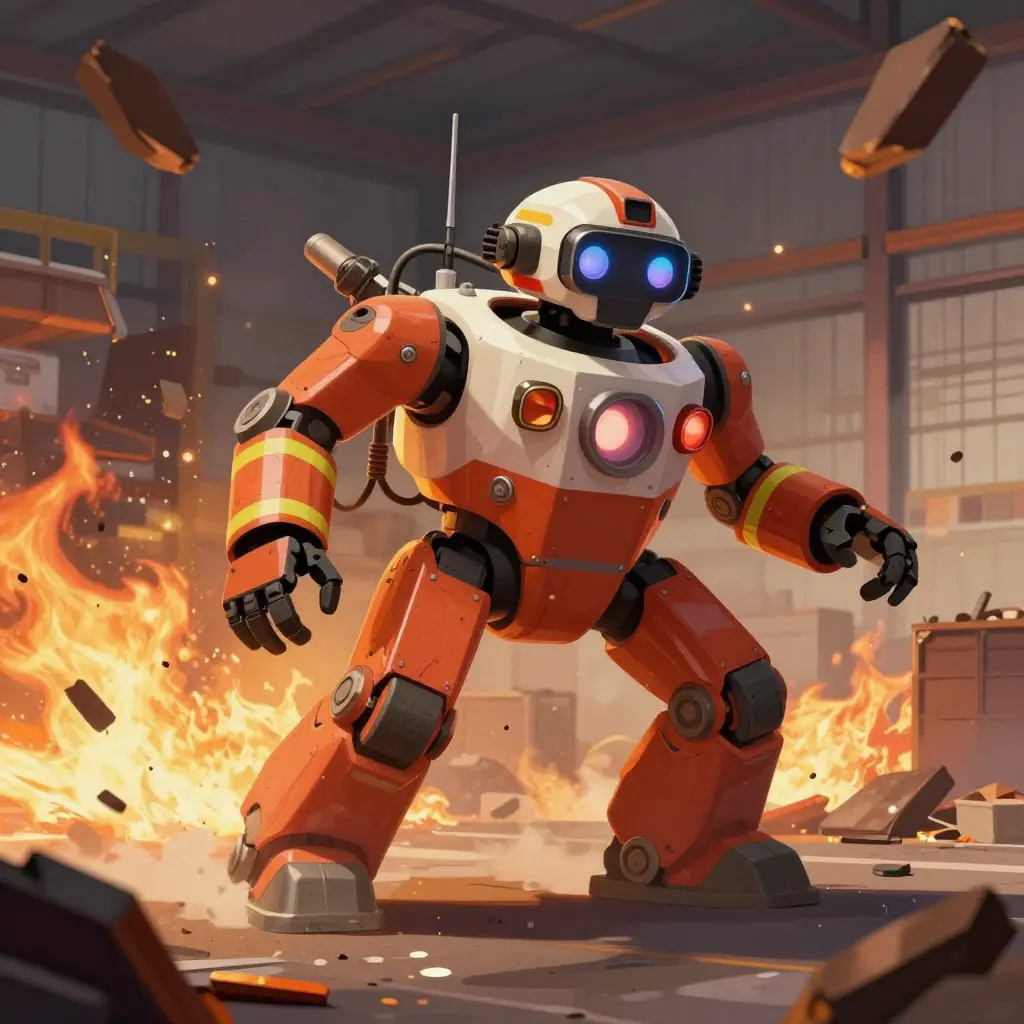
In a warehouse fire, a firefighting robot is far more likely to be knocked out of service by falling debris than by heat. Thermal exposure builds over minutes and can be measured the whole time. Falling debris arrives in a single instant, with no warning curve at all. For an owner judging whether a robot will stay in service long enough to matter, that difference is the one to plan around.
Heat accumulates gradually, and thermal protection is designed around that fact: temperature sensors on critical components, coolant loops, insulation and automatic derating all work because the danger arrives on a measurable timeline. Operators can watch the trend, reposition the unit or pull it back before limits are reached. Left to itself, heat rarely takes a healthy machine from working to useless without warning.
Debris offers no such timeline. A collapsing rack, a failing roof section or a dropped slab delivers its full energy in one impact, often onto the highest point of the machine. That is where radiators, sensor masts, antennas, hose connections and cable runs sit, because those components need line of sight and clearance. One strike can crush a radiator core, shear an antenna or sever a control cable, and the unit stops responding while every thermal reading is still normal.
Most aborted missions trace back to lost situational awareness or interrupted water delivery rather than overheating. That shifts the engineering priority toward overhead protection and impact tolerance, not thicker heat shielding. How the trade-off plays out on a real fireground is covered in our breakdown of the fireground tasks that justify a firefighting robot.
The Debris Failure Modes That End a Warehouse Firefighting Robot Mission

Heat is rarely what ends a warehouse fire mission. In most post-incident reviews, a warehouse firefighting robot stops working because something fell on it. Loose racking, shifting pallet loads, roof deck and spalling concrete all arrive from above, where the machine’s most exposed hardware sits. The failure modes below appear in roughly the order debriefs surface them, and none can be repaired inside a collapse zone, which is what makes each one terminal.
- Direct impact on sensor masts and cameras. A struck mast shears at its mount or cracks the lens housing. Sight lines cannot be re-established from the control station, so the operator is blind and the mission closes.
- Crushed top-mounted radiators and cooling packs. Impact flattens fins and closes airflow paths. There is no field repair for a crushed core; the electronics derate and shut down within minutes.
- Severed or chafed cable harnesses. One cut conductor isolates the monitor circuit or the drive loop. Re-terminating the harness means pulling, cooling and disassembling the unit well away from the fire.
- Blocked or deformed water and foam outlets. Crushed nozzles and bent monitor barrels distort the stream pattern and skew proportioning. The crew can no longer trust the attack line, so the unit comes out.
- Impact damage to communication antennas. A bent or snapped antenna drops the command link. Without telemetry the operator cannot confirm position or state, and recovery turns manual and high-risk.
- Jammed drive assemblies from fallen racking and pallet loads. Collapsed racking pins the tracks under tons of stock and trips the torque limits before the motors burn out. The robot stops where nobody can safely reach it.
- Loss of line of sight or tether integrity. Debris walls the machine off or shears the tether, and a mobile tool becomes a fixed anchor inside the collapse zone.
- Cascading collapse across the operating zone. A secondary failure drops roof deck or a rack bay onto the recovery path. A recoverable machine becomes unrecoverable and the entry is over.
Why This Matters for Owners
Positioning, standoff distance and mast protection can prevent most of the items on this list. A more powerful pump prevents none of them.
Plan for debris before heat, and treat every overhead void as a hazard the robot cannot see coming.
Debris Exposure vs. Thermal Exposure: A Side-by-Side View
Heat and debris threaten a firefighting robot differently: on different timelines, against different defences, and with very different warning.
| Threat | How It Arrives | Early Warning Available | Typical Outcome for the Machine | Protection Approach |
|---|---|---|---|---|
| Radiant heat and hot gas layers | Builds and thickens over minutes; steadily measurable | Yes: thermal sensors, rate-of-rise alarms | Gradual derating, then orderly shutdown | Thermal shielding, active cooling, rated housings |
| Falling ceiling and roof elements | Sudden release when truss or deck fails | No: seconds at most, often none | Crushed mast and sensors; mission ends instantly | Overhead impact frame, sacrificial mast geometry |
| Collapsing racking and pallet loads | Lateral collapse once heated uprights lose capacity | Indirect only: heat exposure gives partial warning | Pinned or tipped chassis; recovery becomes difficult | Compact footprint, low centre of gravity, crush zones |
| Falling stock and fixtures | Drops from shelves as supports or sprinkler loads give way | Little: timing is random along the aisle | Blocked path and damaged sensor pods | Debris-tolerant running gear, protected sensor placement |
| Impact from structural steel | Falls or swings in as beams lose load capacity | No: instantaneous, high-energy event | Penetration or total loss of the unit | Roll cage, deflection surfaces, standoff operating distance |
Reading the table
Start with the third column. Heat gives you a warning curve you can act on; debris gives you a single frame. That difference explains why a machine with an excellent thermal rating can still be carried out of a burning rack aisle on a pallet.
If you are scoping a unit against fireground conditions rather than datasheet numbers, work out which tasks you actually intend to send it into before the specification is locked.
How Warehouse Structures Fail, and What That Means for Robot Exposure
Warehouses are not designed to stay up while they burn. They are designed to be cheap, wide and light, and that economy is what turns a contents fire into a structural event.
The steel goes first, quietly
Most single-storey warehouses are framed in unprotected structural steel. Steel conducts heat into its own section, and its strength falls long before the member glows. Above about 400 °C, yield strength starts to drop quickly; at 600 °C an unprotected member retains roughly half its room-temperature capacity. Long-span beams deflect, columns rotate at the base, and the frame sags as a system rather than failing at one neat point.
Purlins and suspended services drop early
Roof purlins are thin, high-surface-area members sitting in the hottest gas layer. They lose stiffness fast, buckle between supports and let go of the roof sheet above them. Sprinkler mains, cable trays, HVAC ductwork, lighting track and signage hang from that same ceiling zone and are lighter still. They come down early, in sheets and lengths, usually before the main frame has visibly moved.
High-rack storage topples as a mass
Racking is tall, slender and lightly braced, and its stability depends partly on the loads it carries. Once flue-space fire distorts the uprights or a forklift-damaged leg buckles, a whole bay can rotate and come down as one unit instead of shedding individual cartons. That is a mass event, not a debris shower.
Contents are loads the envelope never counted
A fire-rated assembly is tested for the building, not for a pallet of dense goods arriving from ten metres up. Pallets, totes, drums and shrink-wrapped blocks add impact loads that no roof deck, purlin or protection schedule was ever scoped to absorb.
| Failure mode | Typical trigger | What comes down | Robot exposure |
|---|---|---|---|
| Unprotected steel softening | Section temperature climbing past ~400 °C | Beams, columns, frame deflection | Progressive loss of overhead clearance |
| Purlin and service collapse | Hot ceiling gas layer | Purlins, sprinkler pipe, cable trays | Severed cables, mast strikes |
| Rack toppling | Upright buckling or base damage | Entire bay of racking plus loads | Mass impact, route blocked |
| Contents shedding | Pallet burn-through, rack distortion | Pallets, drums, totes | Unpredictable impacts |
Why this is a geometry problem, not a rating problem
Overhead exposure dominates. The highest-mounted components (mast, camera pod, antenna, monitor nozzle, lidar) are the first casualties, and falling debris does not need to be hot to end a mission: it shears a mast, cuts a harness or blocks the only way out. A thermal rating tells you how hot a shell can get. It says nothing about where things land, so the effective protection envelope is a radius question (drop zone, overhead structure, fall paths) rather than a single temperature rating. Where a machine sits inside that radius is part of deciding whether it should go in at all, because a warehouse firefighting robot survives on its position relative to overhead structure, not on its insulation class.
Structural collapse risk belongs in the mission plan as overhead geometry and fall radius, long before anyone debates heat tolerance, because the structure usually decides before heat does.
Reading the Overhead Exposure Diagram
Heat shielding is usually the first thing buyers ask about, because fire is the visible threat. The diagram above tells a different story. It maps the upper surfaces of a typical firefighting robot and marks the five zones where falling debris does its damage first, each one a service interruption waiting for a collapsing rack, a dropped roof purlin or a sheet of charred insulation board.

The five exposed zones
- Sensor mast – the tallest point on the machine, and the first thing an angled fall path crosses.
- Radiator / cooling pack – wide and flat, with fins that bend shut on contact.
- Antenna – thin, cheap, and the usual cause of a robot that drives fine but no longer answers.
- Hose connection – an exposed coupling that takes a glancing blow and starts weeping under pressure.
- Cable run – the harness along the deck, where one crushed conduit takes out several circuits at once.
Why the arrows come in at an angle
Debris rarely drops straight down. Ceiling panels, ducting and shelving skin fall in arcs, so strikes arrive at a shallow angle and skid across flat upper surfaces instead of stopping at a single point. A guard plate sized for a vertical drop is often too narrow.
What fails first versus why it matters
| Zone | Typical debris | Failure mode |
|---|---|---|
| Sensor mast | Roof purlin, tray | Camera knocked out of alignment |
| Radiator pack | Insulation board, concrete | Fins flattened, coolant temps climb |
| Antenna | Cable tray, light fitting | Command link lost |
| Hose connection | Brick, cladding | Seepage, pressure loss |
| Cable run | Falling sheet metal | Chafed harness, dead circuits |
The takeaway for buyers
A heat shield protects the shell. Overhead protection keeps the robot mission-capable. If you are sizing a machine for warehouse or industrial duty, ask what mass the deck and the mast can take on a glancing hit, not just what temperature the shell survives. It is also worth checking whether the tasks you have in mind warrant putting a robot inside at all.
Engineering and Operational Countermeasures for Overhead Debris Risk
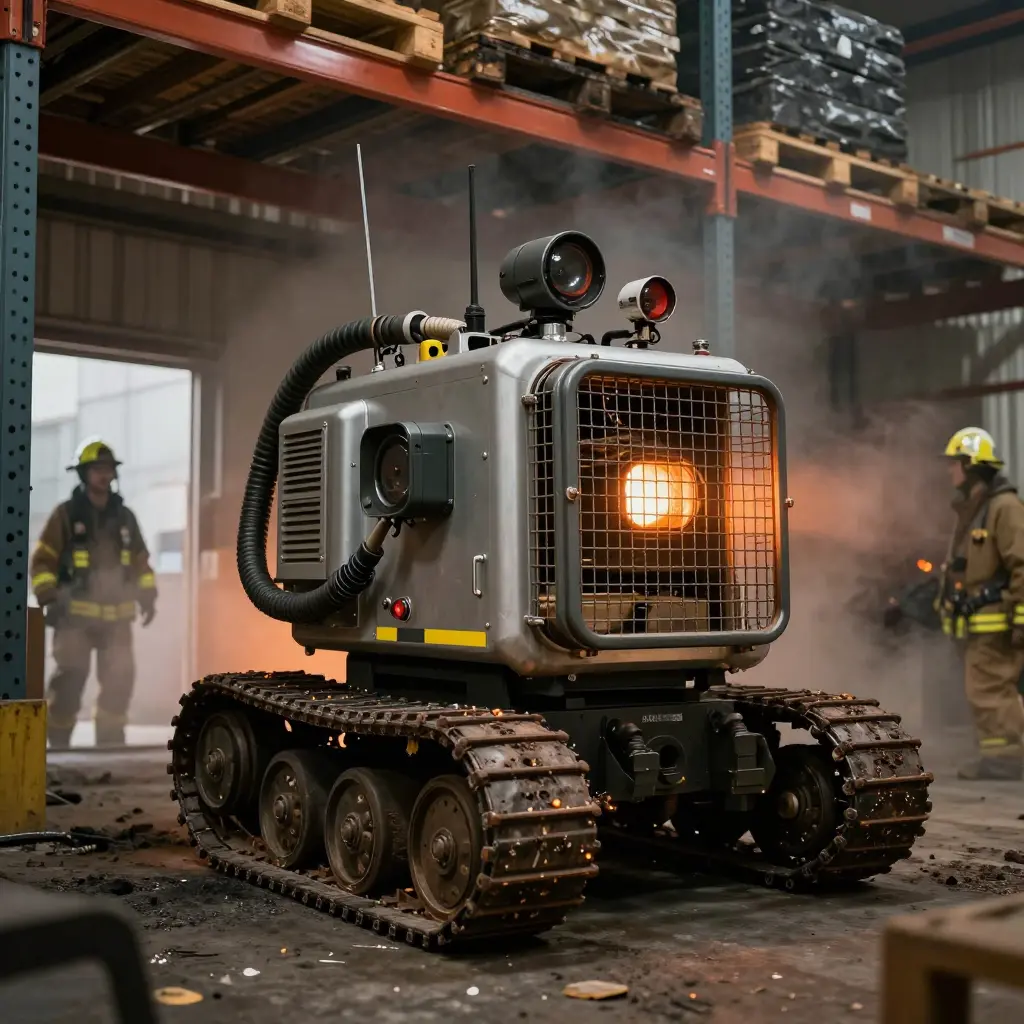
Falling debris does not have to hit hard to end a mission. It only has to break something the machine cannot work without. The countermeasures below come in two kinds: hardware that absorbs the first strike, and doctrine that keeps the machine out of harm’s way.
Structural Armour and Sacrificial Frames
Treat the frame as a shell around the machine envelope. Bolt-on sacrificial rails, a sloped roof cage and replaceable panels over the pump bay take the impact and are swapped out afterwards, rather than passing load into the chassis. Design the frame to fail in a controlled way at bolted joints, and keep the roof profile angled so pallets and beams glance off instead of settling on top.
Protecting Sensors, Antennas and Cables
Thermal cameras, LiDAR and radio antennas are the first things a falling beam takes out. Recess them into shielded pockets with a narrow field of view, mount antennas under the cage rather than on masts, and route cabling in two independent paths with strain relief loops at every termination, so a severed run does not kill the whole unit. This is the cheapest debris protection available, and it is almost always an afterthought.
Quick-Change Access and Standoff Geometry
A disabled unit is only a problem if it stays disabled. Build camera pods, nozzles and armour panels as tool-free quick-change modules with accessible connectors, so a struck machine can be turned around at the cordon in minutes rather than towed out of service. Position matters just as much: keep the machine on the standoff line where racking uprights are not directly overhead, approach aisles along their long axis, and never park under a suspended mezzanine or a leaning stack.
Before entry, read the overhead load: damaged beams, displaced roof deck, sagging sprinkler mains, racking that has lost its bracing. If a rack is standing only because a pallet is trapped under it, the aisle is not viable, whatever the heat readings say. Not every fireground task justifies putting a machine in that position, which is the question the fireground task breakdown is meant to settle before you commit the machine.
Operating Doctrine
Hardware buys time. Doctrine decides whether you get the machine back.
| Trigger observed | Response |
|---|---|
| Small items dropping in the aisle | Continue, reposition 2–3 m back |
| Armour panel deformed or camera pod lost | Pause, assess, resume only if overhead load is intact |
| Visible racking lean, sway or bracing failure | Abort the advance immediately |
| Debris on the roof cage restricting airflow or sensor view | Withdraw, clear the machine, re-plan |
| Repeated impacts in the same area | Abort; treat the aisle as structurally compromised |
Two rules carry most of the weight. Keep the machine under an overhead cover line where possible, because a solid roof beats any armour. And put an observer in a protected position to watch the ceiling rather than the fire, since the operator driving through smoke will not see the beam that is already falling. Fold both into mission planning and pre-incident drills, and once abort thresholds are written down, treat them as fixed.
Station housing needs the same attention. A machine rebuilt after debris strikes needs bay space, lifting gear and module storage to come back online quickly, and station bay depth sizing covers how to budget for that.
What Actually Ends the Mission: Debris First, Heat Second
When a firefighting robot goes silent inside a burning warehouse, the instinct is to blame the fire. The pattern in the chart below, which is illustrative rather than a formal study, points somewhere more structural: falling debris and rack collapse account for 41% of aborted missions, close to twice the share attributed to thermal damage at 23%.

Illustrative field-reported distribution, not a formal study.
What the bars tell a facility owner
- Debris and rack collapse (41%) – the dominant cause. Robots are built to survive heat; they are not built to survive a pallet of shrink-wrapped stock landing on a sensor mast.
- Thermal damage (23%) – real, but secondary. Heat is gradual, and a well-insulated unit can often outlast it or back away.
- Supply interruption (14%) – the hose line runs dry or kinks, or the pump loses prime, and the robot becomes a spectator.
- Comms loss (12%) – the mission ends administratively rather than physically once the operator loses the link.
- Mobility obstruction (10%) – pallets, toppled shelving and debris stop the tracks without damaging the machine.
A higher heat rating addresses less than a quarter of the problem. The first question is whether the machine can keep its head clear of falling steel.
Practical implication
Specify roof guards, low-profile sensor placement and dense bumper geometry before you upgrade anything thermal, then pair that hardware with a debris-aware entry plan. To check whether a robot belongs in your response model at all, start with which fireground tasks actually justify a firefighting robot.
FAQ: Falling Debris Risk in Warehouse Robot Deployments
1. Why does falling debris end missions before heat does?
In a warehouse fire, the first thing to fail is usually not the heat shielding but something mechanical: a track, a mast, a cable. A falling purlin, a collapsed racking beam or a sheet of roof deck lands in the aisle, blocks the path, pinches a track or severs a cable, and the machine stops there. A tracked firefighting robot may tolerate a few hundred degrees for several minutes; it cannot push a 200 kg steel section out of its way. Once mobility is lost, the mission is over no matter how much heat resistance remains in reserve.
2. Do higher heat ratings solve the problem?
No. A higher temperature rating buys time in a hot environment and does nothing about impact loading, crush force or blocked access. A unit with a 1,000 °C rating still loses a track to a beam falling on it at 200 °C, and a cable snagged and severed stops the robot as surely as one melted by heat. Specify thermal protection for endurance and mechanical protection for survival, and budget for them separately.
3. How can we assess overhead collapse risk before committing a machine?
Start with the racking layout, sprinkler drawings and pre-fire plan, and mark the roof and mezzanine zones that are unsprinklered, water-loaded or already showing deflection. Ask the fire attack team which overhead loads are likely to release first (roof deck, ducting, lighting tracks, high-bay racking) and trace the approach lanes that run underneath them. Unprotected steel loses strength quickly under fire exposure, so if the intended route passes under unsupported members, plan a different route or accept that the machine cannot go there.
4. Which protection features should we specify?
Look for a reinforced superstructure rated for impact, cable routing kept away from exterior edges, guarded sensor masts that can be knocked down without disabling the drive, and a chassis that holds its centre of gravity low. Ask for impact and drop test data alongside the thermal data, and confirm the payload margin with the monitor and hose drag attached. Specify quick-release couplings and a tow point as well, so a stalled unit can be recovered instead of abandoned.
5. How should a debris-related abort be planned into the response procedure?
Give falling debris its own abort trigger, separate from thermal alarms: loss of forward progress, a sudden current spike on the drive motors, or a listed overhead load releasing. The written sequence should stop the monitor, retract to the last known clear point, log the position for the recovery crew and notify the incident commander within a fixed time. Rehearse it before deployment, and brief crews that a stalled firefighting robot is a recovery task, not a reason to send people under the same debris.
Bringing It All Together: Order of Priorities
The thread running through this discussion is sequence. Mission success in a warehouse fire turns first on whether the machine survives the overhead impact of falling racking, roof deck and sprinkler pipe, and only then on how long its thermal endurance holds. Those two thresholds are consecutive, not interchangeable, and everything built around the deployment should follow the same order.
- Survive the impact before you fight the heat. A platform that resists temperature but stays exposed to crushing debris has solved the second problem first, which is the wrong way round.
- Treat thermal endurance as the second gate. It decides how long a machine can work once it is still standing, not whether it is still standing at all.
- Write the abort doctrine around both thresholds. Withdrawal triggers should reference structural debris behaviour as explicitly as temperature limits.
- Let specification, placement and doctrine inherit that sequence. Start with which fireground tasks actually justify a firefighting robot, then size protection and access around the overhead risk those tasks involve.
For owners, procurement order matters as much as budget. CIMC Fire Rescue, an international firefighting enterprise, supplies intelligent equipment, integrated vehicles, services and station-building solutions, and frames capability this way at cimcfirerescue.com. The more useful next step is to fold robotic capability into the wider fire and emergency strategy rather than treating it as a standalone purchase.