Ask a vendor what a firefighting robot can do and you get a specification: chassis, payload, nozzle flow, thermal camera, battery endurance, price. Ask your own crews what happens at a structure fire and the answer is narrower, and it comes as a specific job rather than a category: the rack aisle a line has to be held in while the racking above shifts, the bund wall that has to stay sealed under foam. That narrower answer is what decides whether a machine has a job at your site. The unit of analysis is the fireground task: a bounded piece of work someone has to do at an incident, described by what must be done, where it must be done, and how long it takes. A task described that way can be timed against your own incident records, costed, drilled and written into an emergency response plan. A capability description cannot be compared to anything.
What follows sorts industrial fireground tasks into those that justify deploying a firefighting robot and those that do not. Some fit a machine cleanly. Others, several of them fixtures of vendor demonstrations, produce an asset that stays in the bay. The distinction carries into capital planning, into how you frame risk reduction with an insurer, and into whether the robot appears in your emergency response plan as a tactic or as an intention.
Why the Task, Not the Robot, Comes First
Three factors decide it, and all three can be answered from your own incident records before anyone raises a purchase order.
- Time spent in an IDLH atmosphere. How long a person has to stay inside an immediately dangerous to life and health environment to finish the task, and how often that happens. Work that forces sustained exposure is the strongest candidate you will find.
- Access and standoff. Whether the job requires entering a space that is hard to reach, prone to collapse or too hot to work in, or whether it can be done from a protected position a machine can reach instead.
- Repetition. Whether the work follows a sequence you can script and drill, or needs judgement that changes minute to minute.
A task that scores on all three belongs on the candidate list. A task that scores on none of them belongs to people, and no line on a specification sheet changes that. Station planning belongs in the same conversation, because bay depth, apron space and wash-down decide which tasks you can assign at all; industrial fire station planning is worth settling before the robot shortlist.
The rule underneath all of it is that a robot earns its cost where it replaces sustained human exposure in an IDLH atmosphere. Looking impressive is not a criterion. The rest of this article tests industrial fire response scenarios against that rule, so the tasks worth funding can be separated from the tasks worth declining.
Screening Criteria for a Firefighting Robot Task
- Sustained presence in heat, smoke or toxic atmosphere beyond crew endurance. If crews would have to change bottles, take cooling breaks or withdraw before the work is finished, that gap is the justification, and it is the one that is hardest to argue against.
- Geometry that puts crews inside a collapse or entrapment envelope. Does the only route to the seat of the fire run under roof loads that have already lost strength, through narrow voids, or past racking that could fail without warning? If it does, taking people out of that envelope is a safety gain rather than a convenience.
- Heavy equipment handling at distance. Long hose lays, master stream repositioning and tool work far from the appliance all take physical effort in a hostile space. A machine that carries and holds the load takes fatigue out of the calculation.
- Work that repeats predictably enough to pre-program or to operate remotely with confidence. Remote operation and pre-programming only pay off when the job runs the same way each time. Variable, judgement-heavy work belongs with a person; repeatable sequences belong with a machine.
- Application that has to continue while crews reposition. Break the stream and you lose the foam blanket, and the fire takes the surface back. Compare what a machine holds during repositioning against what a manual line can realistically hold.
- A stalled manual operation where delay costs fire growth. If ten minutes changes the fire’s behaviour, screen the task against automation. Measure the delay in fire growth, not in labour hours.
- Exclusion rule: work a crew can finish safely in a few minutes does not justify a firefighting robot on its own. Fast, low-risk, low-consequence work stays manual. The case has to rest on endurance, exposure or continuity that people genuinely cannot sustain.
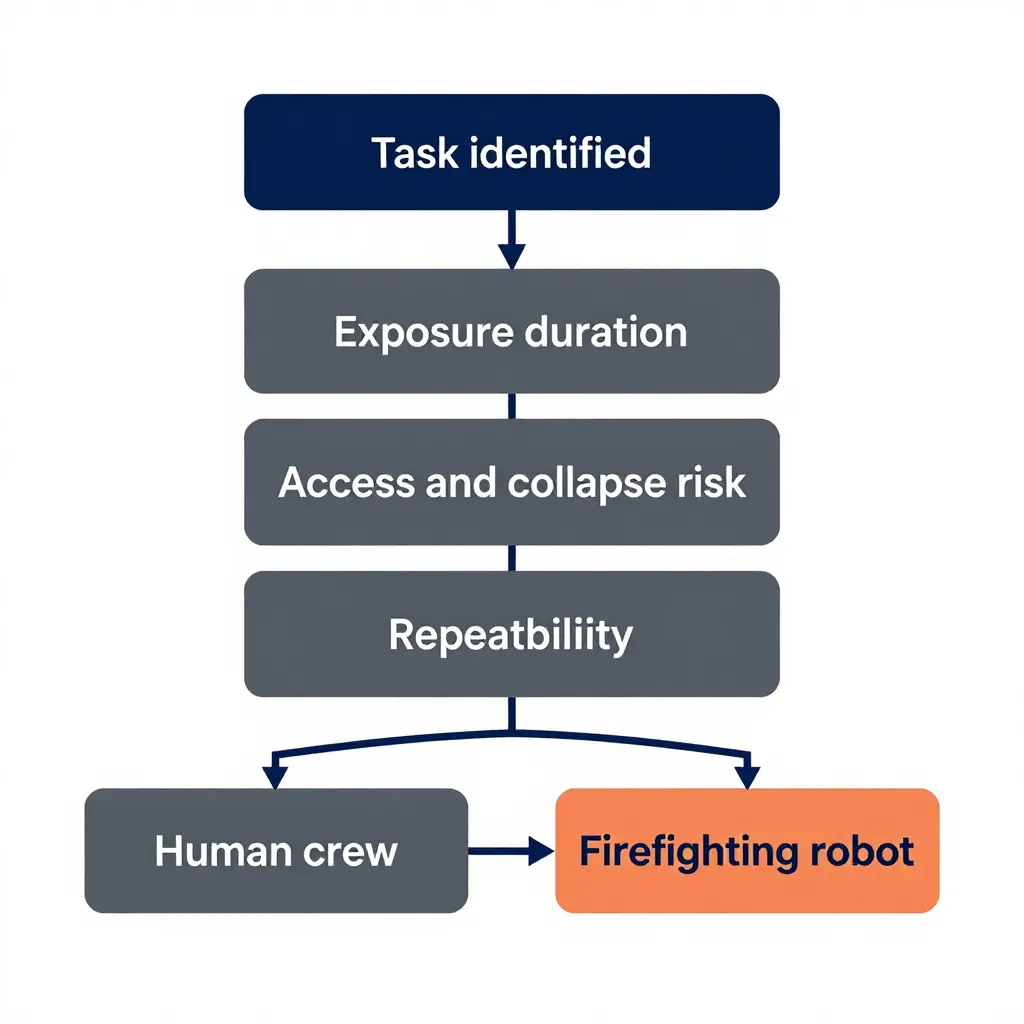
Decision flow: a task survives all three screens before it earns a robot; a single stop sends it back to the human crew.
Fireground Tasks That Justify a Firefighting Robot
A robot does not replace a competent crew. It replaces one particular kind of punishment: work that outlasts a human work cycle, sits behind access constraints that slow people down, and comes back at every incident in that occupancy. The machine still needs somewhere to park, charge, refuel and wash down, so plan the footprint as you would for any other appliance and use this industrial fire station bay depth sizing guide to size apron and bay clearances early. Four tasks clear the bar in our assessment.
Sustained Interior Attack and Cooling in High-Heat-Release Storage or Process Areas
Racked storage and process rooms hold heat for 30 to 90 minutes or more. Crews cycle through air bottles in roughly 20 to 30 minutes, and narrow aisles limit how much hose, and how many people, can reach the seat of the fire. Exposure therefore outlasts a single crew’s work cycle, the building constrains access, and the same job returns at every fire in that occupancy. Fire size has nothing to do with the verdict. Water goes on continuously instead of in bursts separated by bottle changes and rehab, and the load shifts off crew endurance onto the machine.
Foam or Water Application over Large Fuel Surfaces in Bunded or Tank Areas
Bund walls, pipework and tank skirts break up the approach line and keep crews back, while a foam blanket only seals the surface if application continues long enough without interruption. The job takes hours, the geometry is hostile to foot access, and the same layout will demand the same tactic at the next incident. Plan agent consumption and manpower around a repeatable tactic instead of an endurance guess, and the capability spend ends up with a documented basis rather than a claim.
Reconnaissance and Hotspot Confirmation in Areas with Suspected Structural Instability
Floors, mezzanines and roof sections are often too doubtful to put a crew on, and somebody still has to establish where the heat is before anyone commits. Access constraints dominate the case here, and hotspot reconnaissance is a repeatable pre-entry step rather than a one-off judgement. That is why the verdict is conditional rather than strong: the robot earns the job where the structure is genuinely in doubt, not as a substitute for a look from the doorway.
Extended Overhaul and Re-Ignition Watch in Areas That Stay Hazardous for Hours
Deep-seated smouldering in baled goods, dust layers or lagging routinely needs two to six hours of watch after knockdown, and crews are usually wanted somewhere else by then. Duration and repetition carry the whole case; the skill requirement is low, the endurance requirement is not, and the work quietly drains a shift. Handing the watch line to a machine puts crews back in service and leaves you with evidence rather than an assertion when the capital case is reviewed.
If a task is short, easy to reach and happens once, leave it with people. Where duration, access and repetition line up as they do above, the argument runs the other way.
Seven categories were scored against the same three screens. Heat dose came first, access risk second, and the third question was whether the machine adds reach you did not already have – the same filters that decide foam output and response limits on any mutual-aid run.
Fireground Task Assessment: Where a Firefighting Robot Earns Its Place
| Task Category | Typical Exposure Duration | Access and Collapse Constraint | Justification Verdict | Key Operating Note |
|---|---|---|---|---|
| Interior attack, high-heat storage | 20-30 min per crew rotation | Narrow aisles, racking collapse | Strong | Cool from doorway, crews stay at the hydrant |
| Large-surface foam application | 30-90 min sustained | Open yard, radiant heat at bund edge | Strong | Watch blanket integrity, no entry until flush |
| Structural reconnaissance | 5-15 min per pass | Unknown voids, weakened floors | Conditional | Thermal imaging only, stop at marked line |
| Overhaul and re-ignition watch | 2-6 h smouldering | Charred debris, hidden hot pockets | Strong | Machine holds the watch line while crews return to service |
| Tank or bund firefighting | 20-60 min, longer if unbounded | Bund walls, vapour layer, no approach | Strong | Remote monitor, watch for boil-over signs |
| Ventilation support | 10-30 min | Roof access, ladder placement | Weak | Saw and lift work stays manual |
| Scene monitoring after containment | 4-12 h, often overnight | Stable structure, hot zones remain | Conditional | Fixed thermal cameras beat a parked unit |
Fireground Tasks That Do Not Justify a Firefighting Robot
Four commonly cited fireground tasks do not justify a firefighting robot today. The machines are not the problem: the crew, the appliance or the fixed system already on site produces the same outcome faster and for less money, so a robot bought for these jobs buys a second copy of a capability you already own. A robot earns its price when it takes a person out of a hazard nothing else can reach them in, or when it delivers output nothing else on scene can deliver. Where a cheaper, quicker, proven answer exists, the machine adds setup time and maintenance load and no margin.
Rapid initial intervention on small fires
A trained crew stretches a line and knocks down a room-and-contents fire faster than the same crew can unload, position and manoeuvre a robot into the doorway. Setup time settles the argument. Containment arrives sooner, damage and water use stay lower, and nobody has to find a power supply.
Search and rescue
Search rewards sensory judgement: the sound of a wall breathing, a change of heat through a glove, a floor that feels wrong underfoot. Crews read those cues and change the plan mid-search. We have not seen a platform that adapts at that speed to what it cannot clearly sense.
Fine manual manipulation
Valve isolation, tool operation and confined-space work need fine, force-felt manipulation. Turning a stiff gate valve half a rotation at a time, or feeling a tool seat, is still a hand task. A robot sent to do it adds failure points and no capability.
Hydraulic and ventilation work
Where a conventional appliance or a fixed installation already delivers the required flow, pressure or air movement, the question is cost rather than output. A standard pumper or a permanent installation usually wins on both; this comparison of foam output and response time in mutual aid shows how much output existing apparatus brings before a robot is considered.
The commercial case for waiting
Capital tied up in a duplicate capability cannot be spent on the tasks where a robot changes the outcome. Capital planning works by subtraction, and every duplicated function takes budget from the one function that would actually reduce risk.
A cautious conclusion
Not yet justified is not the same as never justified. Two conditions move a weak case to conditional: a documented change in building geometry or storage configuration that blocks conventional access, and a documented increase in how often crews are exposed on a specific task. Until one of the two is written down and measured, the answer is no.
Where the Line Falls: One Chart, Nine Tasks
Both sides of the argument fit on one chart. It plots nine task categories on a justification index running from 0 to 10. That index is a composite we built for this assessment rather than a published standard, and it rolls together the three things that decide the verdict: how long a crew would be exposed doing the job themselves, how constrained access is once they arrive, and how often the task repeats across a shift. High on all three and the robot case is strong; low on all three and you are buying a gadget.
The seven bars in orange share a profile: sustained heat, tight or collapsed access, work that recurs. Large-surface foam application is the clearest of them, because steady output over time counts for more than a short burst of effort – the same reasoning behind getting foam output and response time right in mutual aid instead of guessing at it.
The two grey bars at the bottom are the two clearest non-starters. Initial intervention on a small fire and confined-space valve isolation both score low, for honest reasons: short exposure, quick human access, and a job a trained pair with the right tool finishes before a robot is unstrapped. Two further candidates from the previous section, search and rescue and fine manual manipulation, are not charted at all, because no score on exposure or repetition would make them machine work.
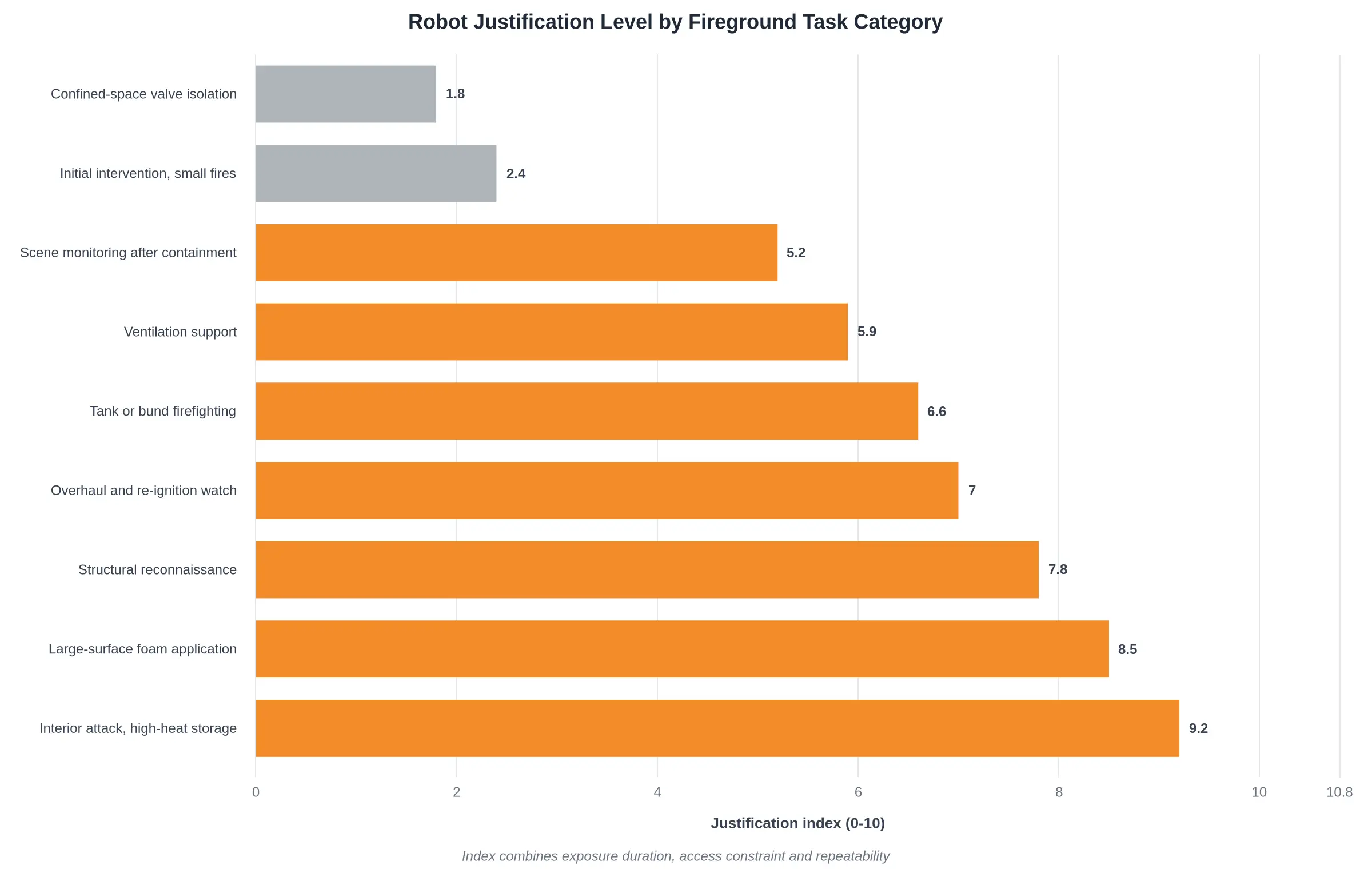
A horizontal bar chart comparing nine fireground task categories on a 0-10 justification index that combines exposure duration, access constraint, and repeatability. The seven justifying tasks are shown in orange; the two non-justifying tasks are shown in grey.
Read left to right and the procurement conversation gets simpler. The choice is not robot or no capability; it is where on that scale your own incident history actually sits.
Frequently Asked Questions
Can a firefighting robot replace a crew entirely?
No. A firefighting robot extends a crew’s reach and endurance; it is not a substitute for the crew. Robots take the hot, repetitive, time-critical portion of a response. Sizing up an incident, ordering entry and rescuing occupants remain human judgements, and a trained crew still has to be on site to set the machine up, supervise it and take over the moment conditions stop matching the plan.
How do you measure whether a specific fireground task is repeatable enough to automate or remote-operate?
Count the task, not the incident. If the same fireground task runs dozens of times and the steps, the timing and the acceptable outcome vary only slightly across runs, it is repeatable enough for automation. Measure variance in cycle time, setup steps and error rate over real repetitions, and treat a task where operators routinely improvise as a poor candidate. Foam application is a fair test case, because its repeatability depends on how consistently the stream leaves the nozzle, which is what makes compressed air foam discharge behaviour worth measuring before that step is automated.
What conditions turn a conditional verdict into a strong verdict?
When the evidence stops leaning on assumptions. Three things have to hold at once: the task is measured with repeatable data rather than anecdote, the site infrastructure is already in place, and the risk assessment shows the robot lowers crew exposure without adding a failure mode. With all three in place, automation is justified as standard practice rather than as an experiment.
Does a firefighting robot change insurance or risk-assessment conversations?
Yes, and it moves them in both directions. Insurers and risk assessors respond to documented exposure reduction, so a robot that keeps crews out of collapse zones and shortens time at the hot face can support a more favourable risk assessment. The same machine adds exposures of its own – maintenance records, operator training, equipment reliability – and those have to be evidenced too. What shifts is the question asked: from whether the robot is novel to whether its contribution is documented.
What support infrastructure does a robot need on site before it can be counted on during a response?
A water or foam supply it can draw on, a stable communications path, charging or refuelling capacity, and hardstanding that suits its tracks or wheels. Above all it needs a supply chain that sustains the discharge, because a robot that runs dry is a parked machine; how foam output and response time in mutual aid interact is the clearest illustration of that limit. Count the robot as an asset only when each of those elements is in place before the alarm, not after.

Figure: Where the division of labour actually sits. The left column holds the tasks that still need judgement on scene – search, manual valve work, rapid intervention. The right column holds the tasks a robot can hold for hours without fatigue: sustained cooling, large-surface foam application, and continuous monitoring. Read the two columns as a filter rather than a hierarchy: a task that sits in neither column probably does not justify the machine.
Turning the Task Assessment Into a Capability Decision
The conclusion is worth restating, because procurement conversations drift from it quickly: a firefighting robot is justified by the fireground tasks it takes off human exposure, not by the technology. Once that is accepted, the next steps are administrative.
Start with a written inventory of what your crews actually do at structure fires, tank farms and vehicle incidents, noting duration, proximity to heat and collapse zones, and the number of personnel each task absorbs. Screen the inventory against exposure and access, and keep only the tasks where a machine displaces a human body from harm or reaches space a person cannot safely occupy.
Then run a bounded trial, ideally 90 to 180 days, measured against your own response data rather than a vendor demonstration: time to first water, tasks completed, injuries avoided. Review the verdict formally at the end, and again when call volume, staffing or apparatus age shifts.
The operational result is predictable response output where staffing variability used to sit, a capital rationale that survives audit and budget scrutiny, and a machine matched to the station bay depth and support space around it, from charging infrastructure to wash-down and apparatus clearance. That last alignment is where programs tend to succeed or fail without anyone noticing. Our part is supplying the equipment and the station integration that make it deployable, and sustaining that capability for fire services.