Foam Blanket Integrity on the Apron
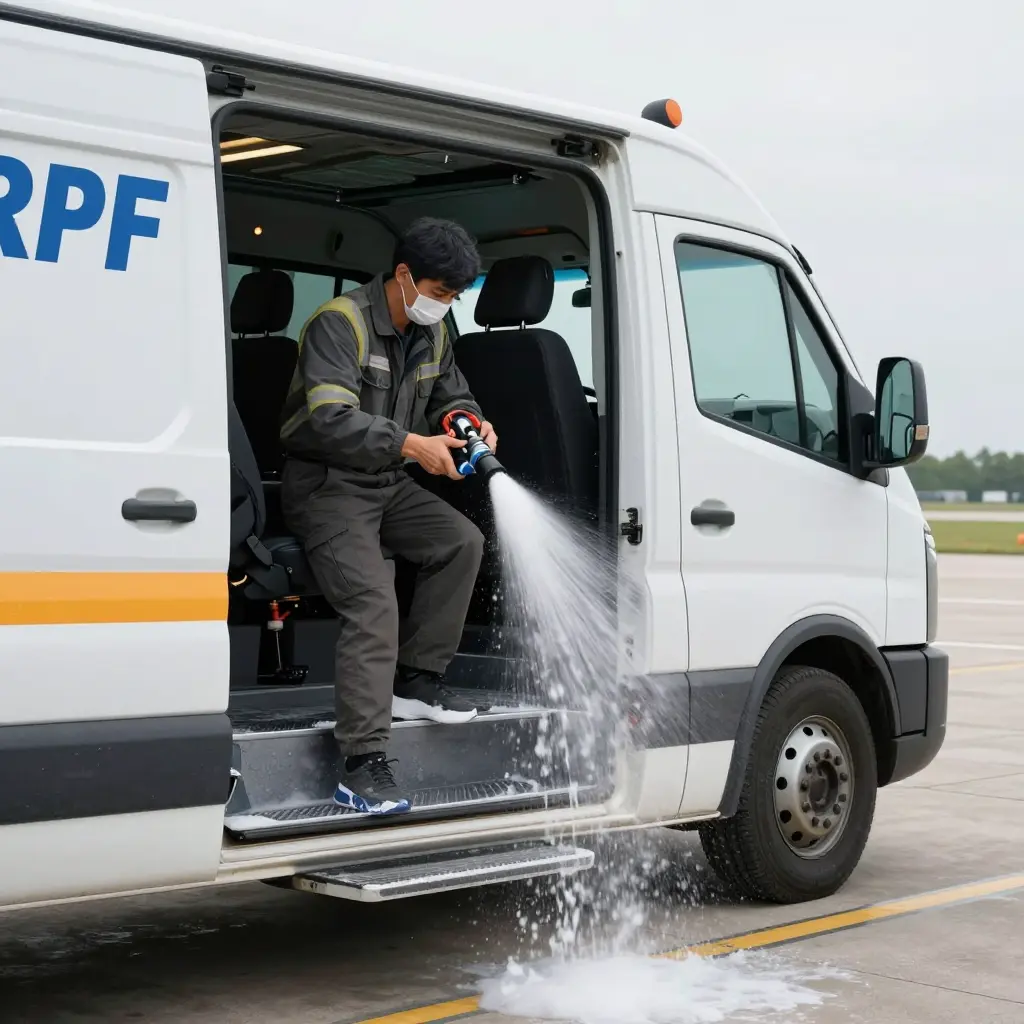
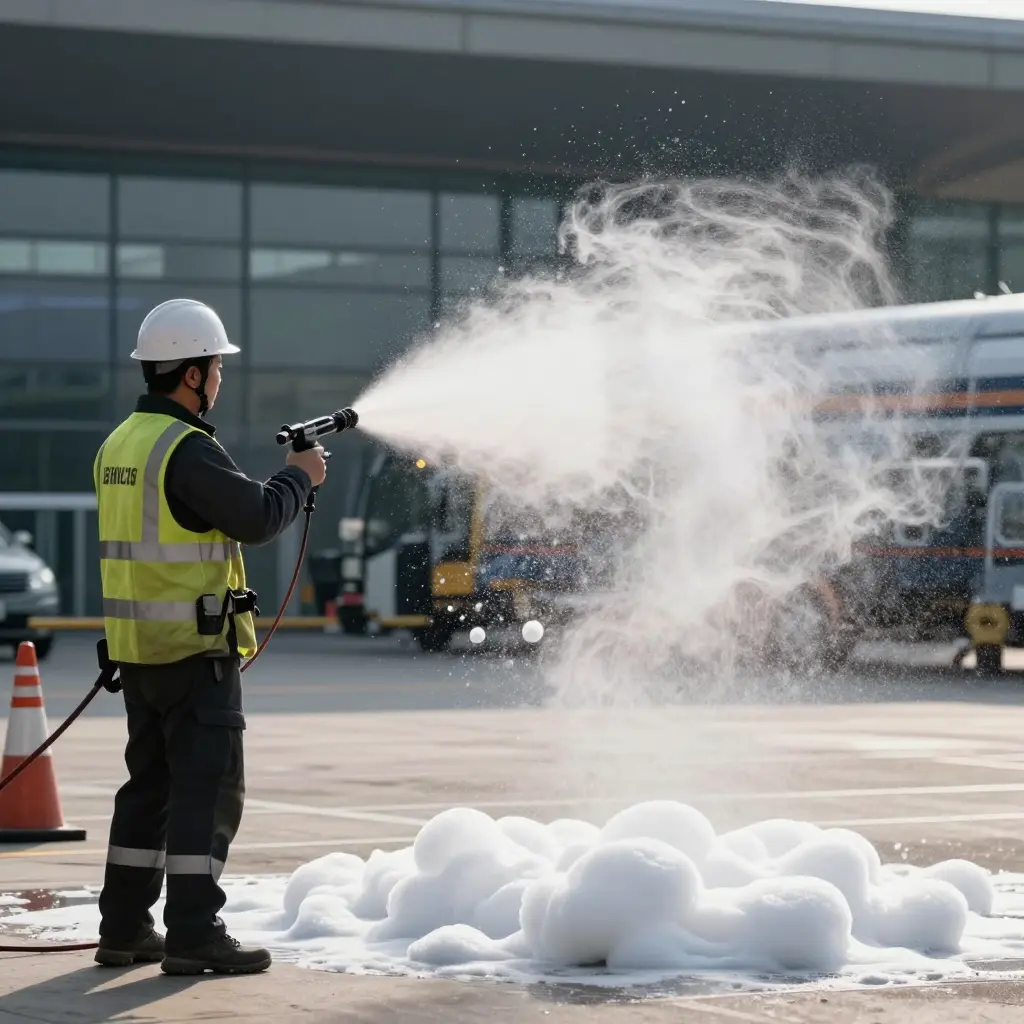
An airport crash tender foam blanket is the continuous, vapor-suppressing layer of aqueous film-forming foam (AFFF) or fluorine-free foam that a crash tender lays across a fuel spill to keep fuel away from oxygen and ignition sources. ARFF performance standards tie that layer to a rated application rate: a fixed discharge density, usually given in liters per minute per square meter (L/min/m2), that a vehicle must deliver across the hazard area.
The rated figure assumes still air. It describes how fast foam has to be applied to build a blanket when gravity and the foam’s own spreading behavior are the only forces acting on it.
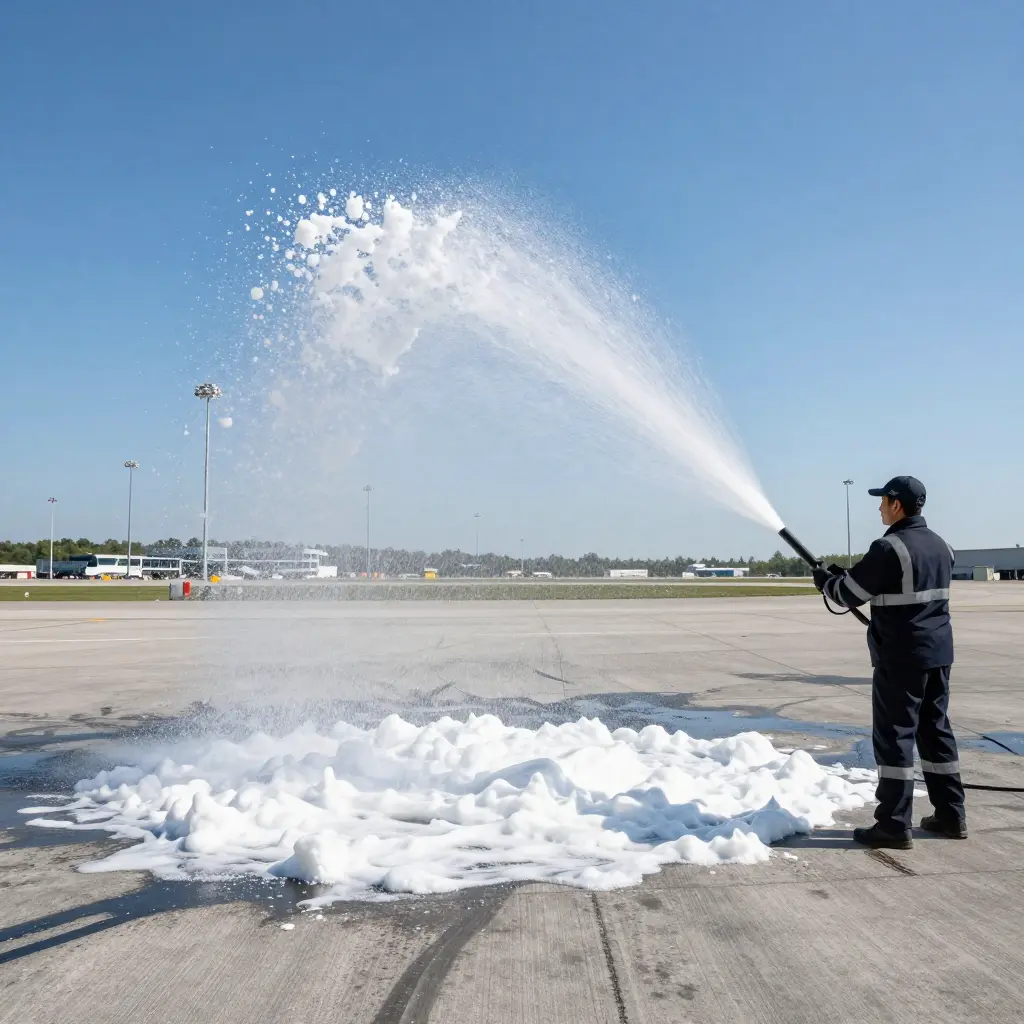
On a wind-exposed apron that assumption fails. Wind-driven runoff across the apron can outrun the rated application rate of an airport crash tender foam blanket, because aerodynamic shear, fluid surface tension, and accelerated apron drainage act in combination to strip applied foam from the fuel surface faster than a still-air-rated flow can replenish it. A vehicle can meet its nameplate number and still lay a nominally compliant blanket that never reaches full integrity over the hazard.
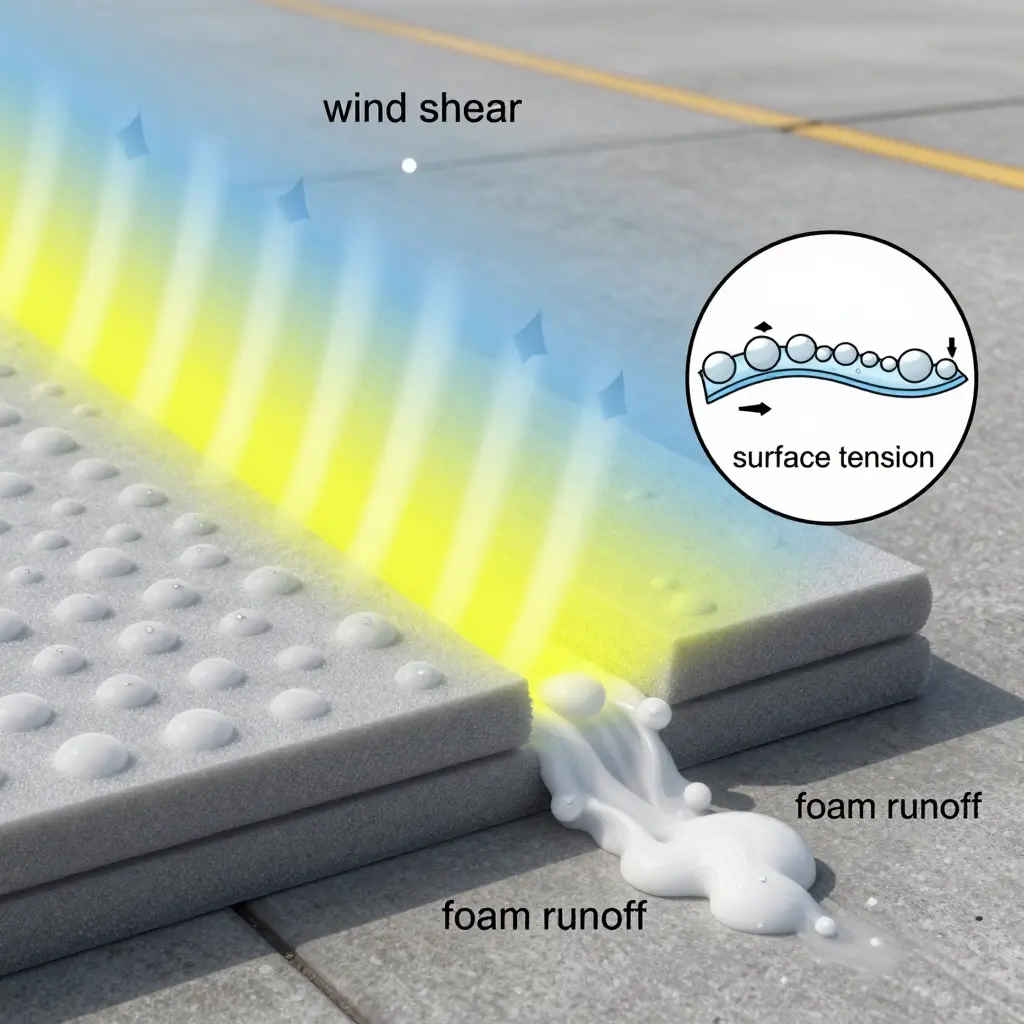
Three forces do the work, and they compound:
- Wind shear. Moving air drags tangentially across the foam surface, and the shear stress that develops pushes the blanket downwind of the spill.
- Surface tension. How readily the blanket spreads and clings depends on the balance between foam and fuel surface tensions; where that balance is disturbed, the film ruptures and drains.
- Apron drainage. Impervious concrete and engineered gradients carry runoff away from the spill, removing foam from the protected area faster than it is replaced.
Off-nominal delivery makes all three worse. When proportioning drifts, discharge density falls further below nameplate and the gap between rated and effective coverage widens – a condition that often goes unnoticed on the ramp.
For ARFF crews, the result is a blanket that looks established but suppresses incompletely, leaving fuel surfaces exposed and re-ignition a live risk.
The Physics of Foam Blanket Stability and Loss
A foam blanket is not a static coating. It loses mass continuously to gravity drainage, evaporation, and, on an exposed apron, wind. Two mechanisms explain why a rated application rate underdelivers.
Wind Shear: Stripping Mass From the Interface
Wind shear is the tangential force air exerts as it crosses the foam surface. Air moving over an apron sets up a velocity gradient: fast above the blanket, slow at the surface. The difference produces a shear stress at the foam-air interface that scales roughly with the square of wind speed.
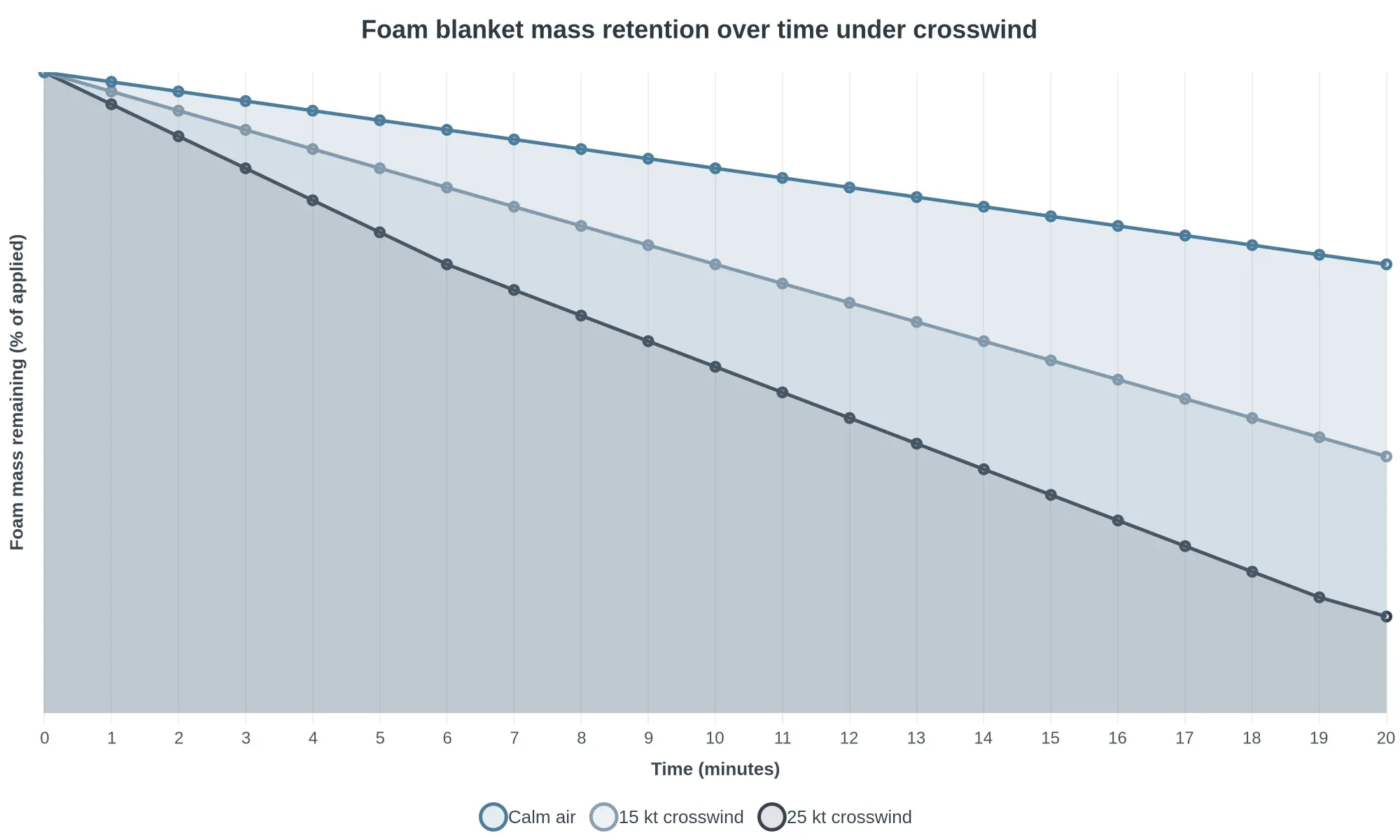
Up to a point, the elastic surface film absorbs that load. Past it, the stress exceeds the foam’s internal yield stress – the point where bubble lamellae start sliding past one another – and the blanket deforms plastically. Foam detaches and moves downwind as foam runoff. Because the removal never stops, a steady crosswind of even 15-20 knots can strip mass faster than the tender replaces it. This is the same kind of drift loss that ARFF crews often miss on the ramp.
Surface Tension: Spreading Versus Displacement
Surface tension governs how a blanket spreads and how hard it is to shove aside. Three things are in play: the surface tension of the bubble lamellae, the wettability of the substrate (how strongly the apron and fuel attract liquid), and the foam’s structural viscosity.
Low surface tension on a wettable substrate lets the blanket spread thin and fast – but a thin film has less mass and yield stress to resist displacement. High structural viscosity slows spreading while increasing shear resistance. Every ARFF crew inherits that trade-off from the concentrate it carries.
Why the Rated Application Rate Understates the Challenge
A rated application rate is measured in still air. It assumes foam mass stays where it lands and is lost only to drainage. In the field, wind shear adds a second, continuous removal term. Once wind shear plus runoff approaches or exceeds the application rate, the blanket can never reach equilibrium thickness, no matter how long the tender discharges.

Apron Drainage Behavior and Runoff Acceleration
An apron is built to get water off the surface quickly, and it does the same thing to foam. Slope, texture, and drainage hardware all move liquid away – exactly the behavior that undermines a stable blanket.

Pavement slope and crossfall. Most aprons are graded with a crossfall of roughly 1.0 to 2.0 percent toward inlets. That looks trivial, but once the blanket thins, gravity accelerates lateral flow down the fall line. Foam migrates toward the low edge and the inlets instead of staying where it was applied.
Surface texture and porosity. Asphalt is porous, and older pavements are cracked. Foam solution wets and penetrates the aggregate, taking volume out of the layer above the fuel. Open-textured surfaces increase wetted contact area and lengthen drainage paths, so part of the applied agent never contributes to the measurable blanket.
Drainage grates. Inlets, trench drains, and slot grates are collection points that remove foam from the surface entirely. Foam that reaches a grate is lost from the protected area rather than pooling against the hazard.
Expansion joints. Concrete aprons are divided by expansion joints that act as linear sumps. Foam drains into the gaps and leaves coverage.
The practical result is a gap between an instantaneous blanket and an effective coverage window. The rated rate implies uniform depth sustained across the target; what actually happens is a finite volume of foam that reaches the downwind edge and is gone. Re-forming the blanket takes new agent, and the loss is effectively irreversible because the solution does not return to the surface.
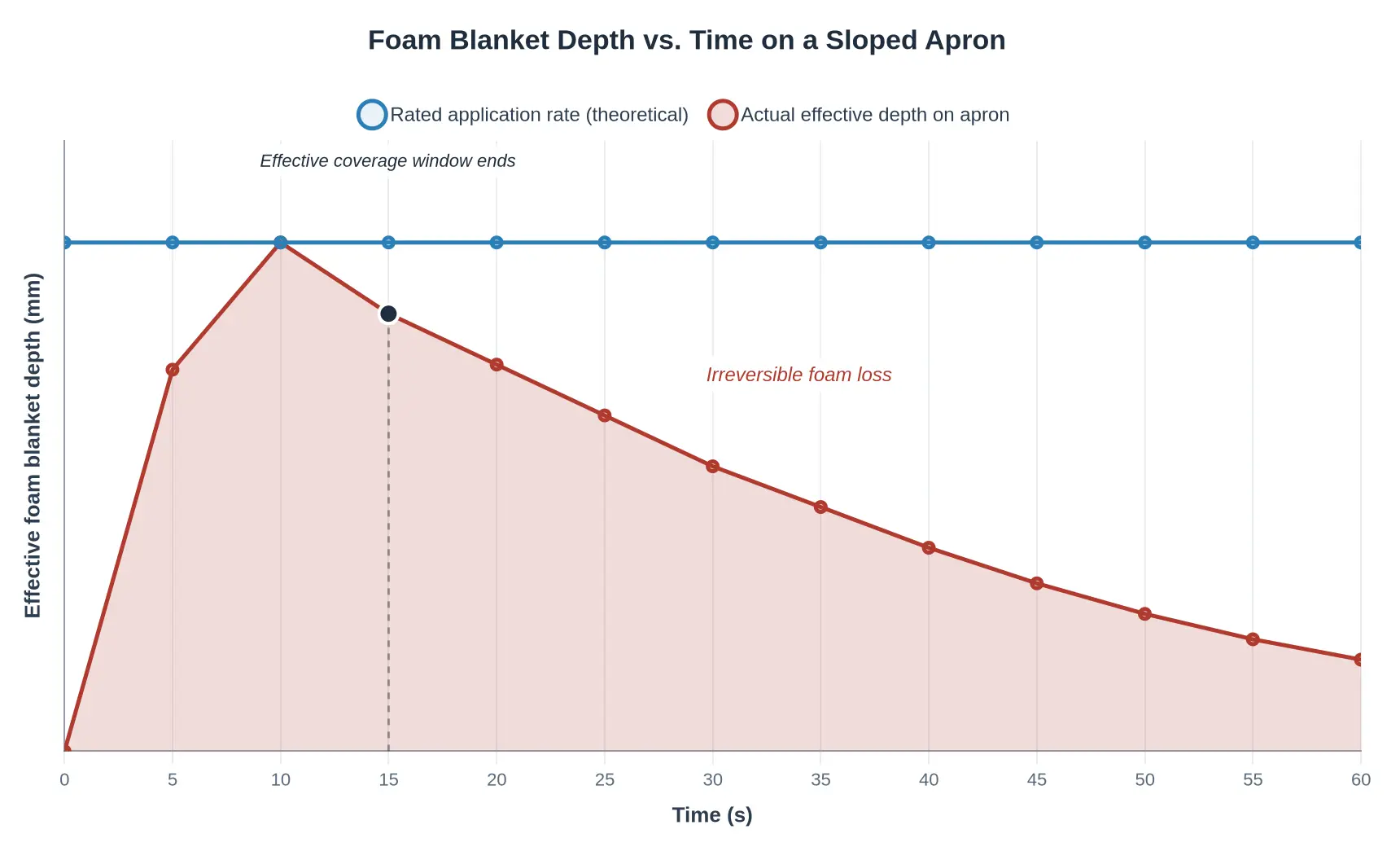
This is why an airport crash tender foam blanket degrades faster than the rated application rate implies: the rated figure assumes replenishment, while the apron keeps subtracting volume through slope, texture, grates, and joints.
Rated vs. effective application rate: quantified for the apron
The table below shows how apron crosswind turns a nominal rated application rate into a much lower effective useful rate. The values are indicative modelling figures, not certified test data, and are meant to illustrate the runoff mechanism rather than predict any specific vehicle or agent.
| Scenario | Nominal Rated Rate (L/min/m2) | Wind-Induced Loss Factor | Effective Useful Rate (L/min/m2) | Time to Blanket Failure |
|---|---|---|---|---|
| No wind baseline (0 kt) | 4.1 | 0% (reference) | 4.1 | > 15 min (stable) |
| Light crosswind (5-10 kt) | 4.1 | ~15% | 3.5 | ~11 min |
| Moderate crosswind (10-15 kt) | 4.1 | ~35% | 2.7 | ~7 min |
| Fresh crosswind (15-20 kt) | 4.1 | ~55% | 1.8 | ~4 min |
| Strong crosswind (20-25 kt) | 4.1 | ~75% | 1.0 | ~2 min |
Indicative modelling values for illustration only; effective rate is approximated as rated rate x (1 – loss factor), with time to blanket failure reflecting progressive drainage and shear-driven runoff.
The pattern holds across the table: as crosswind rises, the loss factor climbs and the effective useful rate collapses toward, then below, the drainage threshold. The pump still delivers the nominal 4.1 L/min/m2, but the foam that stays on the fuel surface is a fraction of what the rating implies. For how drift and proportioning interact with this drainage behavior, see why foam drift often goes undetected on the ramp.
Why the Rated Application Rate Is Not a Safety Benchmark
The application rate published for an ARFF airport crash tender foam blanket is a laboratory figure. It comes from controlled, still-air tests on a level test pad, with a fixed nozzle at a fixed height over a stationary fuel pan. None of that reproduces an operational apron.
Under those conditions foam accumulates faster than it drains, so the reported figure measures mass delivered per unit area per unit time. Extrapolating it to a real apron with crosswind and grades introduces systematic error: wind shear moves the blanket downwind, graded surfaces route it toward drain inlets, and field observation shows foam being removed continuously rather than consumed only by heat.
| Parameter | Rated test protocol | Operational apron |
|---|---|---|
| Wind | Still air | Crosswind, 30+ kn possible |
| Surface | Low slope, non-draining pad | Graded, draining surface |
| Nozzle | Fixed height and angle | Operator-variable aim |
| Foam loss | Minimal drainage | Continuous wind-driven runoff |
| Reported metric | Mass delivered per area per time | Mass retained under shear |
Mass balance makes the consequence plain. Sustained coverage requires replenishment at the runoff rate, not the initial application rate. Where crosswind-driven foam runoff exceeds the rated figure, the delivered mass cannot hold a stable blanket.
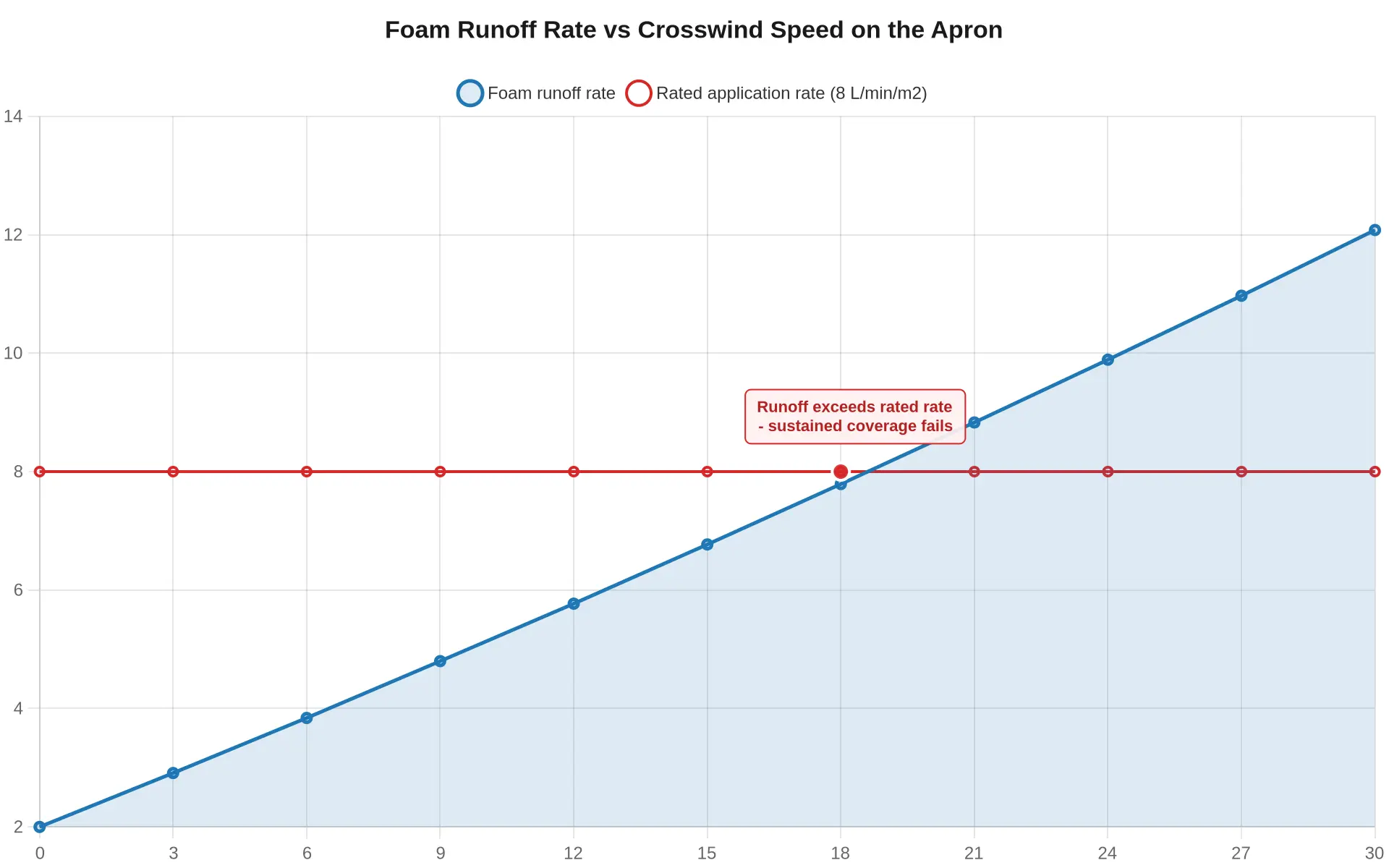

The rated figure therefore describes delivery, not sustained coverage. It is an upper bound measured over a sheltered pad, while the apron is a draining, wind-loaded environment that consumes foam faster than the test stand predicts. Meeting the rated rate on the gauge does not guarantee a continuous blanket. Delivery accuracy also drifts in real time, often without an obvious alarm, which is why proportioning drift can go undetected on the ramp long before runoff exposes the gap.
Factors That Accelerate Foam Runoff from an Apron Foam Blanket
These operational and physical factors determine how fast an expanded blanket migrates off the apron. On their own they erode coverage; together they widen the gap between the rated application rate and the rate actually sustained over the hazard.
- Crosswind velocity and gusting – sustained wind shear advects expanded foam downwind, stripping the blanket faster than the crash tender can replace it.
- Apron crossfall and longitudinal slope – even a nominal 1-2% drainage gradient drives gravity-assisted flow toward low points and thins the blanket on the windward edge.
- Pavement surface texture and porosity – open-graded or porous asphalt wicks aqueous film and foam solution away from the fuel surface, defeating the seal.
- Drainage infrastructure – trench drains, slot drains, and low-point catch basins carry runoff off the spill footprint before it can reseal.
- Foam expansion ratio and drainage time – foams with short 25% drainage times give up their solution quickly, feeding the runoff cycle.
- Film-forming versus protein foams – AFFF and AR-AFFF spread a low-viscosity film that shears readily, while protein and fluoroprotein foams hold a more cohesive, durable blanket.
- Application angle and reach – shallow nozzle trajectories and long reach reduce impingement momentum, so the blanket lands thin and drifts before it consolidates.
- Substrate temperature and thermal convection – hot pavement and fire-driven convection lift and fracture the blanket, compounding wind-driven losses.
Proportioning and Application Tactics: Matching Delivery to Loss
The runoff analysis carries one operational message: a blanket persists only where replenishment matches or exceeds runoff loss. When wind shear accelerates drainage across the apron, the loss term grows and any static assumption about coverage falls apart.
Proportioning accuracy comes first. A system drifting off its set percentage delivers less effective agent per litre of solution, so the actual replenishment rate falls below target even when the pump runs at full rating. Undetected drift compounds wind-driven loss and quietly eats the protective margin.
Nozzle selection and reach come next. Nozzles that throw short, or produce coarse and poorly aspirated patterns, cannot put foam where it is needed; the delivered mass scatters instead of banking. Longer reach and controlled expansion matter more under crosswind than they ever do on a calm test range.
Delivery continuity ties it together. Intermittent application lets the blanket reset toward zero between passes, so loss outpaces gain as a matter of routine.
The “rated application rate” is a steady-state reference figure, not a wind-adjusted apron value. Treating it as a guarantee leads to under-resourcing, thin blankets, and premature break. Agent condition sets the expansion you can actually achieve, so operators setting realistic delivery targets should also track how temperature swings shorten agent shelf life. Sustainable coverage is an engineering balance between loss and replenishment, not a nameplate number.
Standards, Specification, and Regulator Implications
The physics of wind-driven runoff has direct consequences for how ARFF foam performance is codified. Today’s rated application rate benchmarks – embedded in test methods such as NFPA 412 and referenced across ICAO and EASA guidance – are delivery-oriented: they verify that an airport crash tender can put foam onto a test pad at a defined flow density per unit area per minute. They capture the moment of application, not what remains afterward. A rated flow can be satisfied while the blanket forming on the apron is simultaneously thinned, torn, and drained by wind shear, surface runoff, and uneven drainage gradients.
From delivery benchmarks to coverage duration
For specifiers, manufacturers, and regulators, the constructive next step is to supplement – not replace – delivery-oriented ratings with metrics that describe sustained performance:
- Wind-inclusive test protocols – add crosswind and gust profiles to foam application trials so qualified rates reflect realistic apron exposure.
- Effective coverage duration metrics – measure how long a specified blanket thickness is maintained, not just how fast it is laid down.
- Runoff loss factors – apply a correction for slope, surface tension, and drainage that reduces effective coverage.
| Dimension | Current rated benchmark | Proposed complementary metric |
|---|---|---|
| Basis | Delivery-oriented flow density | Sustained coverage over time |
| Wind | Nominally still / sheltered | Crosswind and gust inclusive |
| Surface | Idealized test pad | Slope, tension, drainage corrected |
| Output | Application rate (L/min/m2) | Effective coverage duration |
Constructive alignment
None of this argues that existing standards are misguided. Delivery verification remains essential for asset acceptance, fleet comparison, and procurement. The point is that the rated application rate sits at the start of the firefight, while the safety margin lives in what persists. Complementary coverage metrics would give ARFF services, vehicle builders, and regulators a shared, defensible measure of real protection – one that accounts for wind, surface, and time rather than flow alone.
Frequently Asked Questions: Wind-Driven Runoff and the Rated Application Rate
Why does wind-driven runoff exceed the rated application rate?
Wind shear drags the blanket sideways across the apron faster than gravity drains it, sweeping fresh foam off the fuel surface. The blanket never settles at design thickness, so runoff outruns the rated rate and forces continuous reapplication.
Is the rated application rate invalid?
No. It remains a valid baseline, but it assumes near-zero wind on a flat surface. In a crosswind, real coverage drops, so treat the rated figure as a minimum reference – especially when foam proportioning accuracy drifts.
How do apron slope and drainage influence foam loss?
Apron grades and drainage channels send the blanket downhill and concentrate runoff at low points. Steeper slopes lose foam faster, and drain inlets pull it away from the fuel, thinning coverage and demanding a higher sustained application rate to hold the seal.
Does higher expansion foam reduce runoff?
No. Higher expansion foam is lighter and airier, so wind shear displaces it more easily, often increasing runoff despite the greater volume. Lower expansion foam holds its place better in wind but covers less volume per litre of solution. Selection has to balance expansion ratio against expected wind and the apron.
How can operators compensate tactically?
Aim upwind, angle the stream to counter shear, and apply at increased rates to build reserve depth. Extending application duration and repositioning the appliance to reduce crosswind exposure both help hold coverage.
How could wind-inclusive testing change specifications?
Wind-inclusive certification would define wind-adjusted application rates and minimum blanket thickness thresholds. Specifications could then call for wind-tolerant expansion ratios and give ARFF teams realistic performance data instead of idealized still-air figures that understate actual runoff.
Conclusion: Redefining Coverage by Effective Duration
The rated application rate for an airport crash tender foam blanket is a delivery specification. It quantifies the volume of expanded foam discharged per unit time under controlled conditions, and it says nothing about the wind-driven runoff that starts eroding the blanket the moment it forms. Three engineering realities drive that gap. Wind shear acting against the foam’s surface tension strips the blanket from the fuel surface faster than it can be sustained. Apron drainage channels and gradients let foam migrate toward low points, thinning coverage across the hazard area. And because the agent is consumed and displaced continuously rather than applied once, sustained replenishment is unavoidable.
Together they mean a good application-rate number can hide a coverage shortfall caused by wind-driven runoff. The way forward is to define coverage by effective duration: the time a blanket actually suppresses vapor and resists re-ignition under real wind and drainage conditions. That is the measure that would make ARFF specifications reflect performance on the ramp rather than performance on paper.