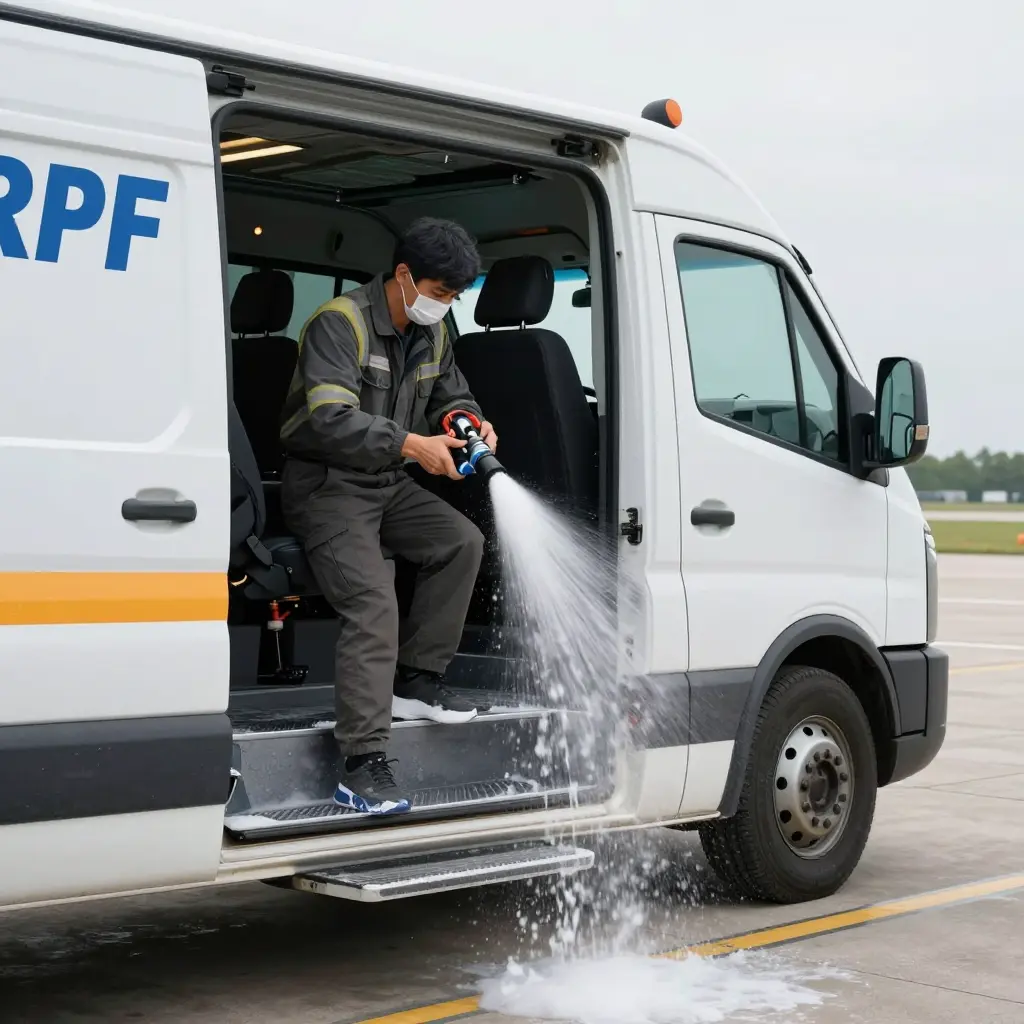
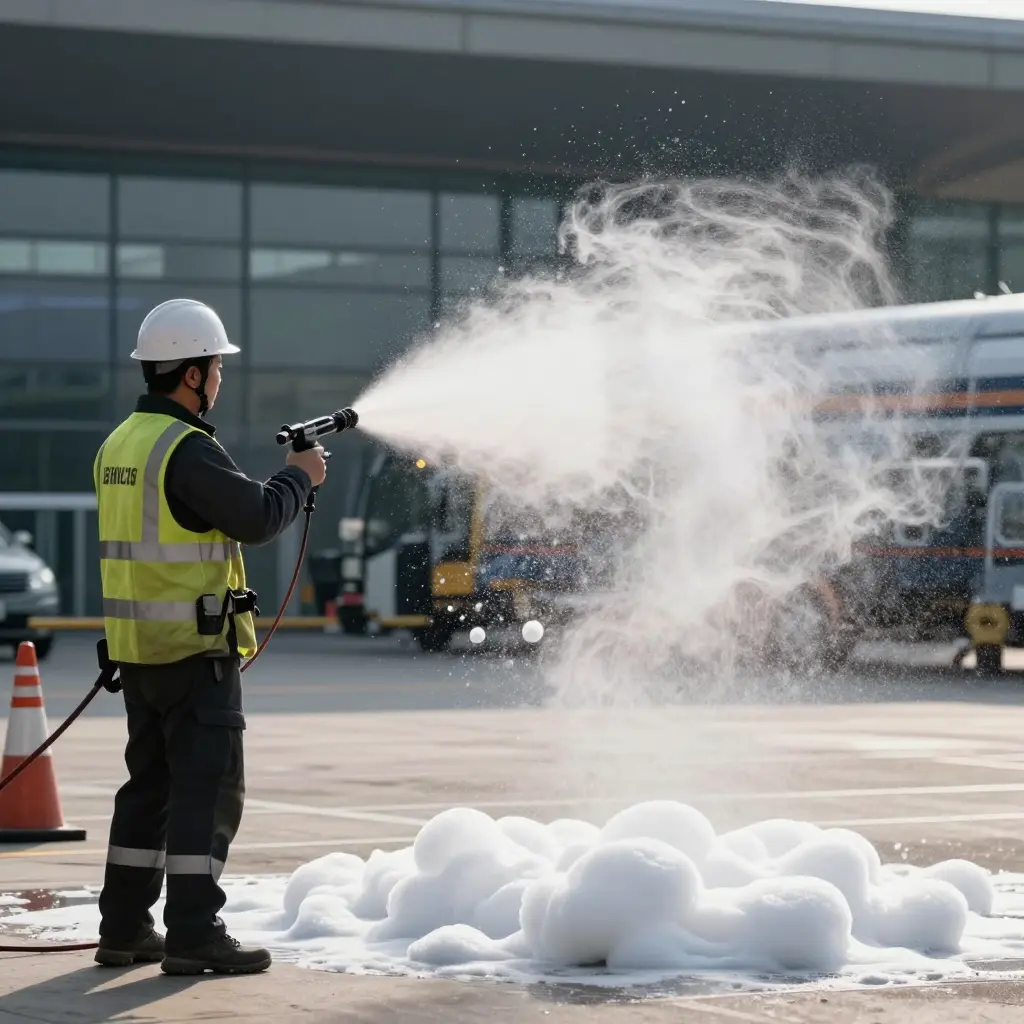
Airport Crash Tender Pump Relief Valve: Why Slamming the Turret Valve Shut Sends a Pressure Spike Back Down the Piping
When the Turret Valve Closes Too Fast, the Piping Feels It
Shut a turret valve quickly on an airport crash tender pump relief valve system and the same thing happens every time. The pump shudders, the discharge piping kicks, and the pressure gauge jumps past its set point before it settles. The spike does not stay at the turret. It travels back down the pipe and loads the relief valve along with everything between.
The behavior is predictable and entirely physical. It happens on the pump’s discharge side, and it grows with how fast the valve closes and how much water was moving when it did.
What Water Hammer Actually Is
Water hammer is the pressure surge produced when a moving column of liquid is forced to stop or change direction abruptly. The column’s momentum has to go somewhere, and it shows up as a sharp, brief spike in pressure.
Why the Spike Appears at the Relief Valve
Water already moving through the pipe keeps its momentum after the valve shuts. The valve stops; the water does not. That energy becomes a pressure wave that reflects off the closed valve face and runs upstream.
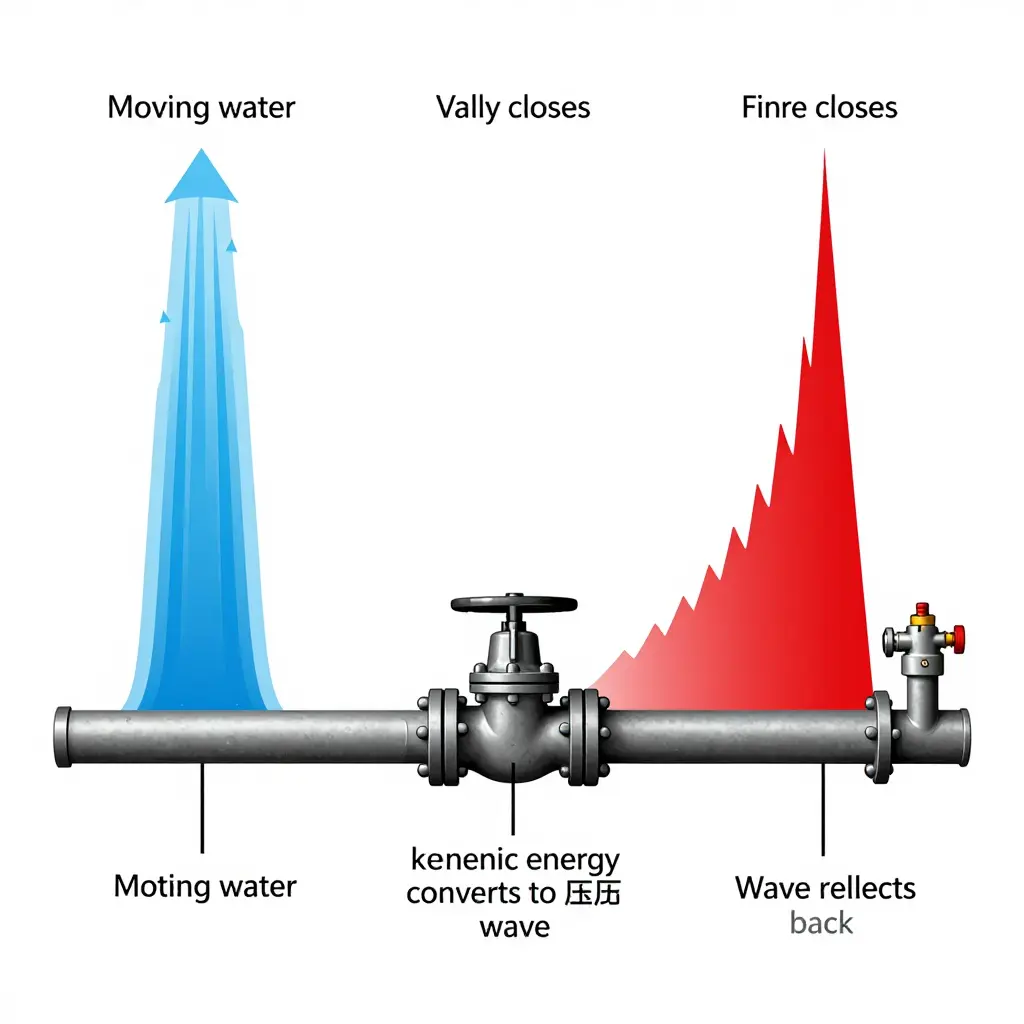
The sequence is the same every time, which is why the symptom is so consistent:
- The turret valve closes faster than the water column can slow down
- The moving water slams into the closed valve face
- Kinetic energy turns into a pressure wave that reflects back up the pipe
- The wave travels upstream to the pump and the relief valve
- The surge stacks on the pump’s steady discharge pressure and briefly exceeds the relief valve’s set point
That stacked surge is what wears the relief valve, the piping, and the pump casing. Repeated spikes cause damage long before anything fails outright.
What This Article Covers
The article covers the problem in two parts. The first is the fluid dynamics: how momentum, pipe length, and closure time set the size of the surge. The second is what that means for operation and maintenance, including relief valve settings, closing technique, and how foam proportioning can drift unnoticed, all of which ride on the same pressure dynamics.
The Fluid Dynamics Behind Water Hammer
Slamming a turret valve shut can send the pressure at the valve up by tens of bar in a fraction of a second. That surge is water hammer. There is nothing mysterious about it; it is ordinary physics playing out inside the piping. Understanding the mechanism is the first step toward respecting the procedure.
The Moving Water Column Stores Momentum
Water is heavy, roughly 1 kg per litre, and with the pump running, the entire column between the pump and the turret is moving fast. That mass carries momentum (mass times velocity), and like a loaded truck, it does not stop instantly. More speed and more pipe length mean more stored momentum waiting to cause trouble.
The Turret Valve Closes: Kinetic Energy Becomes Pressure
While the water flows, it holds kinetic energy. The instant the valve snaps shut, that moving water has nowhere to go but is still moving. Stopping a mass of fluid in a millisecond means something has to absorb its energy, and because liquids are nearly incompressible, the only place for it is pressure. The kinetic energy converts almost directly into a pressure spike at the valve. The faster the column stops, the larger the spike.
The Pressure Wave Travels Back Through the Piping
The high-pressure slug does not stay put. It moves like a sound wave, racing back up the line from the turret toward the pump and reflecting off bends, tees, and the pump itself. That returning wave is the signature of water hammer: a transient ripple of high and low pressure bouncing through the piping at the speed of sound in water. Over thousands of cycles, the oscillation fatigues fittings, couplings, and valve seats. It can also throw off the accuracy of foam proportioning systems, which is one more reason to keep transients small.
Why Wave Speed Depends on Fluid and Pipe Properties
How fast the pressure wave travels, and therefore how quickly it returns, depends on two things:
- The fluid’s bulk modulus (how stiff the water is), which sets the theoretical maximum wave speed.
- The pipe’s stiffness and wall thickness. A flexible or thin-walled pipe absorbs part of the energy and slows the wave.
That coupling is why the same valve action produces a different spike on a rigid steel line than on a longer, more flexible hose run. A stiffer system and a faster closure give a sharper spike that reaches the pump and relief valve sooner.
The Pressure Wave Event, Step by Step
- The pump runs, and water flows steadily through the piping and out the turret.
- The turret valve closes rapidly, cutting off the outlet for the moving column.
- Kinetic energy converts into a pressure spike at the valve.
- The high-pressure wave races back up the piping toward the pump.
- The wave reflects and oscillates until friction and the relief valve damp it out.
Why the Relief Valve Is Your Safety Net
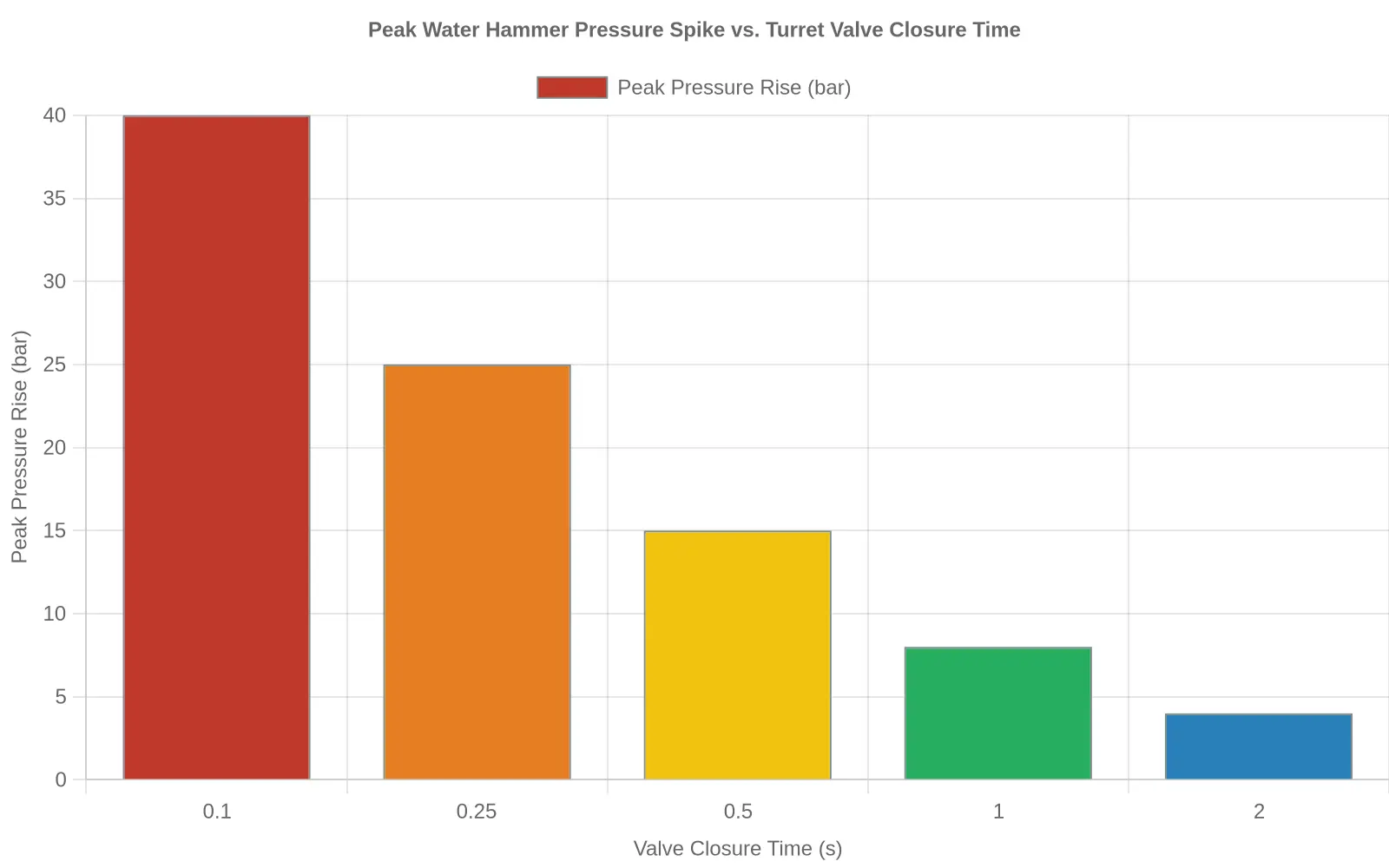
The relief valve exists because this chain of events is inevitable whenever operators move valves quickly. It opens to vent the excess and protect the pump, pipe, and fittings from the surge. Prevention is the better strategy, though: close the turret valve gradually so the energy is released over time instead of stored in one violent spike. The chart below shows how much a slower closure softens the peak.
The Pump Relief Valve: Your Last Line of Defense on the Water Circuit
A crash tender’s fire pump is built to move huge volumes of water and foam at pressure, and that same muscle is what makes the discharge system dangerous to itself. The airport crash tender pump relief valve exists for one reason: to keep pressure from tearing apart the hardware that produces it. In ARFF service it is a safety device first and a plumbing component second, sitting between a pump that will happily generate more pressure than the piping can survive and a network of valves, gauges, seals, and turret lines that cannot.
What the Relief Valve Actually Protects
The relief valve is plumbed into the pump discharge and set to open before pressure reaches a level that would damage downstream components. It handles both the slow, steady buildup of ordinary operation and the fast, violent spikes that follow abrupt valve movement.
Its core functions:
- Caps steady overpressure – vents excess flow when a closed discharge leaves the pump pushing against a dead end.
- Absorbs transient surges – reacts to the spike created when a turret or nozzle valve slams shut.
- Protects pump and piping – shields the casing, impeller, mechanical seals, gauges, and hoses from rupture or fatigue.
- Provides a controlled bypass – diverts water back to the tank or suction side until pressure falls below the setpoint.
- Preserves foam-circuit integrity – keeps spikes from distorting proportioning hardware downstream.
Setpoint Behavior: The Pressure It’s Tuned To
The setpoint is the pressure at which the valve starts to crack open. It is normally set above the pump’s maximum working pressure but well below the rated strength of the weakest component in the circuit. Engineers tune the cracking pressure (when the valve just begins to weep) and the reseat pressure (when it closes again) so the valve does not chatter. Under normal operation the relief valve stays shut, and it earns its keep only when something goes wrong.
Steady Overpressure vs. Traveling Pressure Waves
These are two different enemies, and the relief valve handles them in very different ways.
Steady overpressure builds gradually. A gate valve is throttled, a discharge is closed, or thermal expansion raises pressure over several seconds. The relief valve responds comfortably within its design window.
Transient pressure waves are another matter. Slamming a turret valve shut converts the moving water’s kinetic energy into a wave that races back through the piping at roughly the speed of sound in water. That wave can exceed the setpoint many times over before the spring and disc have started to move.
How It Reacts to a Surge
A mechanical relief valve typically responds in tens to hundreds of milliseconds. A pressure wave crosses the length of the truck in a fraction of that time. The valve therefore cannot catch the first, sharpest peak, but it is decisive for everything that follows: it opens to dump flow, truncates the following reflections, and keeps the oscillation from settling at a damaging level.
Put another way, the relief valve limits duration and residual pressure; it does not erase the impact. That is why operators are trained to move turret and discharge valves smoothly, and why understanding how pump-system variables drive foam proportioning matters for keeping the whole circuit intact.
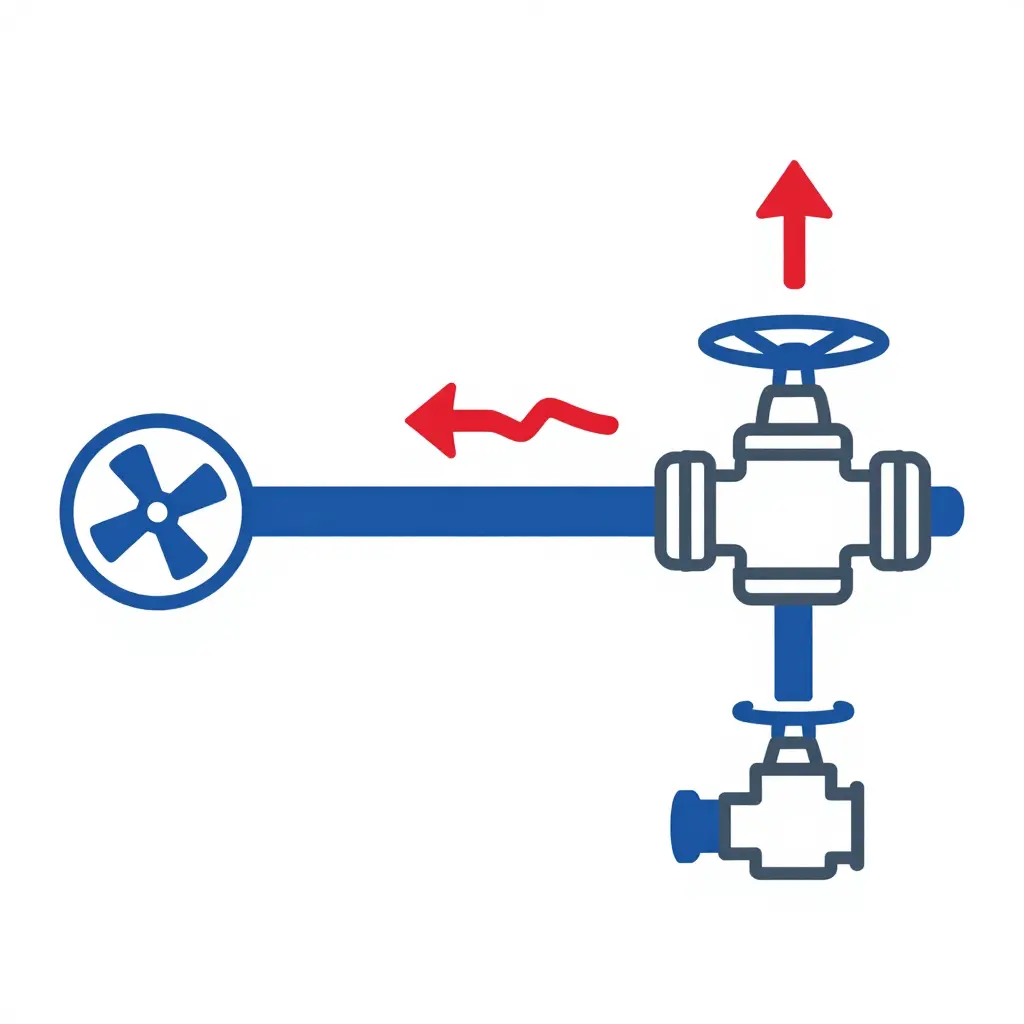
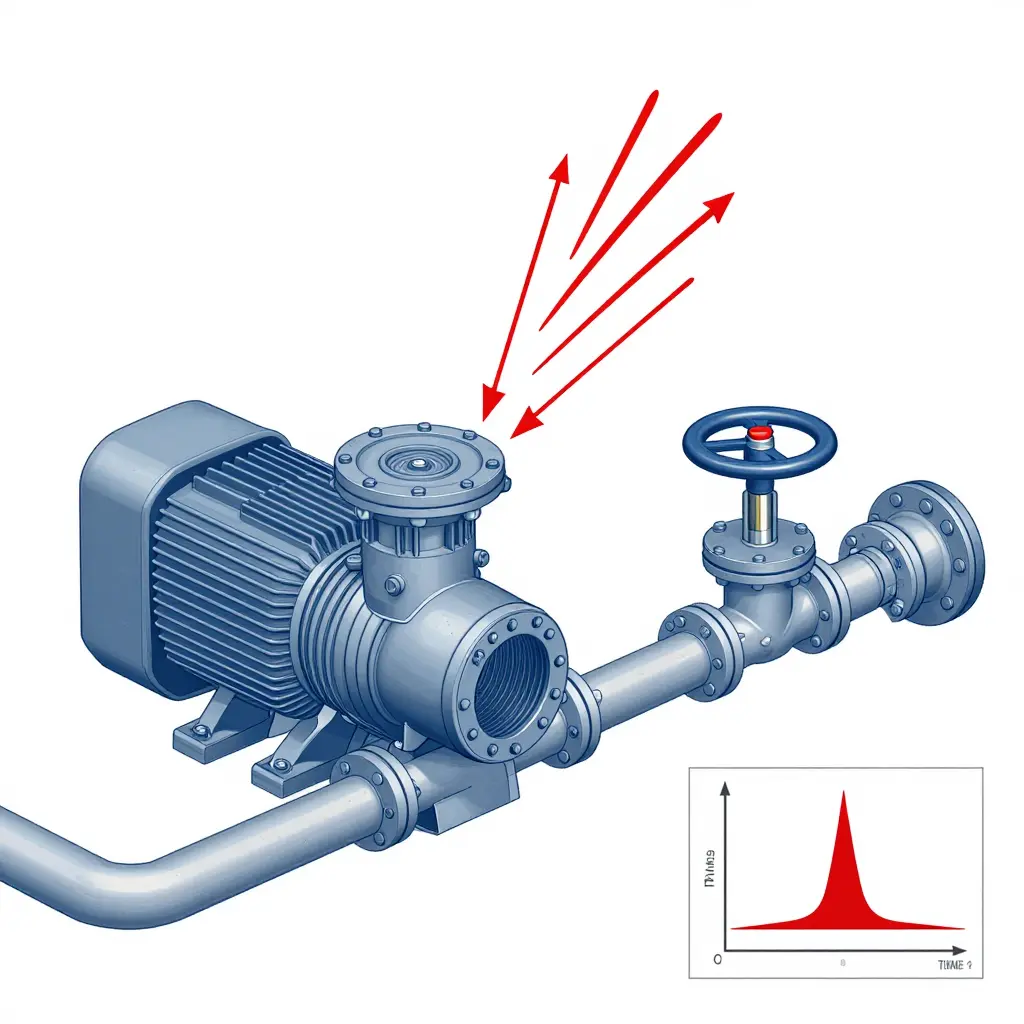
Reading the diagram: how a shut turret valve fires a surge backward
This schematic strips the crash tender’s water path down to its essential parts so the cause and effect is hard to miss:
- Pump (left): the energy source. It keeps pushing flow into the discharge line at full pressure.
- Discharge piping (center): the stretch of moving water that carries momentum along the line.
- Turret valve (right): the delivery point. When it slams shut, it stops the flow.
- Relief valve (branch): the safety branch on the discharge side, ready to vent the excess when pressure climbs.
The critical detail is the direction of the arrows. They point backward, from the shut turret valve toward the pump. That reversed flow of energy is the heart of the pressure spike. The column of water already has momentum, and closing the valve doesn’t erase that energy, it reflects it. The whole mass rebounds, and a pressure wave races back up the pipe (water hammer).
The sine-wave symbol near the arrows stands for that surge: a traveling pressure pulse, not steady flow. The farther it travels, the more pipe sees the spike, which is exactly why the relief valve sits where it does – to intercept the wave before the pressure finds a weaker component.
Keep this picture in mind: the danger isn’t only at the turret you just closed. It’s everywhere upstream of it, all the way back to the pump.
Why Slamming the Turret Valve Shut Sends a Pressure Spike Back Down the Piping
When an operator snaps the turret valve closed, the water column racing through the discharge piping does not stop with it. The valve slams, the water keeps going, and that momentum has to become something. It becomes a pressure spike that flashes backward through the system as water hammer, hammering the pump, the pipe joints, and the airport crash tender pump relief valve. Knowing why this happens is the difference between smooth operation and a cracked seal.
A Moving Water Column Cannot Stop on Command
Water has mass. In a crash tender, discharge flow can move at several metres per second, and the whole column from the pump to the turret travels at that speed.
When the valve closes, that column has to be brought to a dead stop. The only way to stop moving mass is to apply a force, and in a closed pipe the force comes from a pressure wave generated by water piling up against the shut valve. The faster the velocity changes, the larger the force.
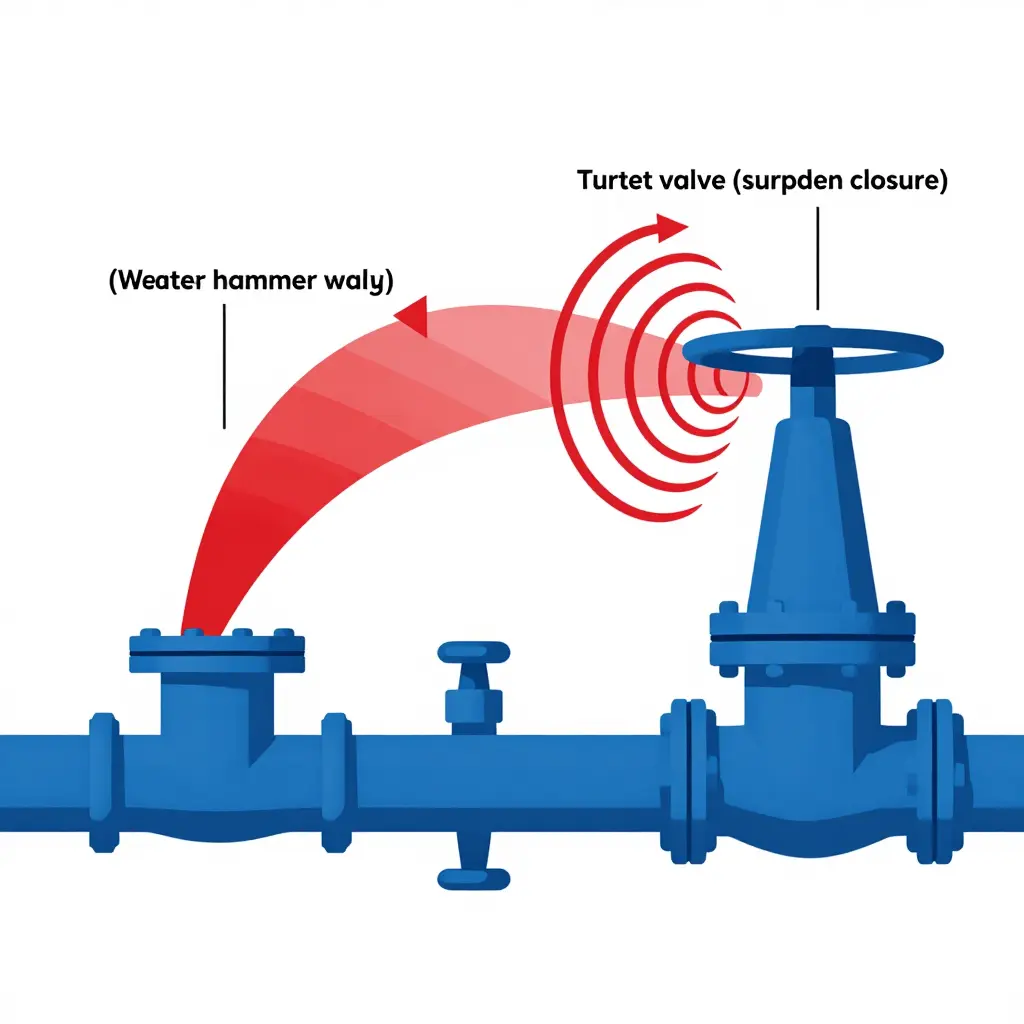
Fast Closure Shortens the Deceleration Window
The deceleration window is the time the water column is given to slow down, and it drives the size of the spike.
- Gradual closure stretches that window over a second or more. Velocity drops in gentle steps, energy is absorbed smoothly, and the surge stays small.
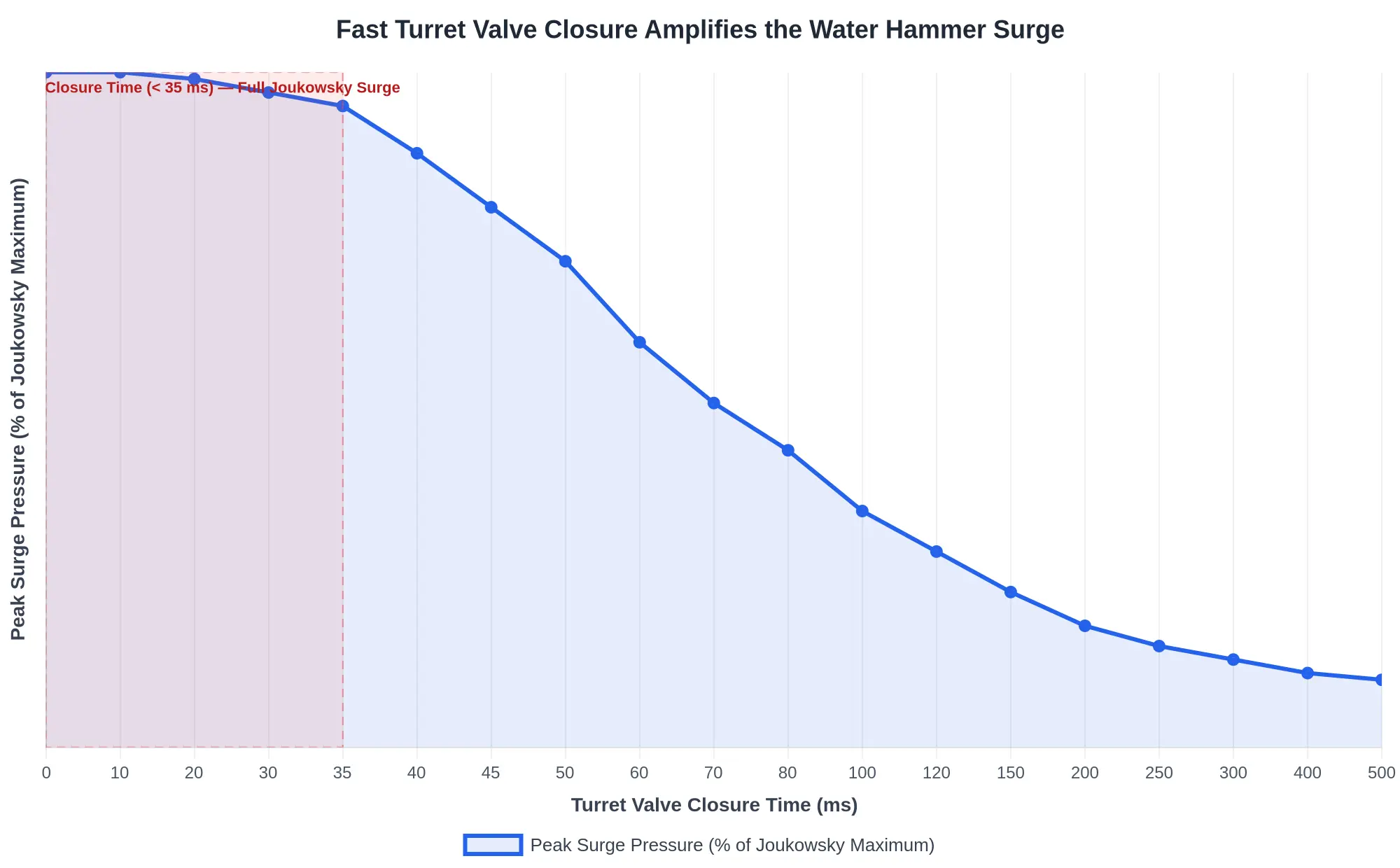
- Abrupt (slam) closure compresses the window to a few milliseconds. The full velocity change happens almost instantly, the pipe has no time to relieve the pressure, and the spike approaches its theoretical maximum.
This follows the Joukowsky relationship. For a rapid closure the surge pressure equals the fluid’s density times the wave speed times the change in velocity (ΔP = ρcΔv). Notice what that says: the peak depends on how much velocity the water loses, and it reaches that maximum only when the valve closes within the critical time. Close more slowly and the peak falls below the Joukowsky value.
How Fast Closure Outruns the Relief Valve
Every piping run has a critical closure time, roughly the time a pressure wave takes to travel to the end of the pipe and reflect back. Close the turret valve faster than that and the surge develops at full strength before any upstream device can react.
The airport crash tender pump relief valve is a mechanical responder. It needs a fraction of a second to sense rising pressure and open. Slam the valve inside that fraction and the pressure spike is already traveling back down the pipe before the relief valve lifts. The protection is real, but it is not instant, and water hammer exploits exactly that gap.
Gradual vs. Abrupt Closure: Same Energy, Different Outcome
| Factor | Gradual Closure | Abrupt (Slam) Closure |
|---|---|---|
| Deceleration window | 1 to 2 seconds | A few milliseconds |
| Velocity change per step | Small and staged | Full and instant |
| Surge magnitude | Low (often under 20 percent) | Near theoretical maximum (up to 100 percent) |
| Relief valve response | Has time to lift | Outrun by the spike |
| Stress on seals and joints | Minimal | High and cumulative |
What a Pressure Spike Stresses, and Why Operators Care
The consequences land on the hardware closest to the surge:
- Seals and gaskets deform or extrude under the momentary overload, setting up slow leaks.
- Pipe joints and couplings take the repeated shock, and fatigue cracks start small.
- The pump casing absorbs the reflected wave, loading bearings and wear rings.
- The relief valve itself wears faster each time it is forced to chase a spike it was never sized to catch cleanly.
Surge damage rarely announces itself on the first slam. It accumulates quietly, much like the way foam proportioning drift can go undetected on the ramp until performance has already slipped.
The energy in the moving water is unavoidable; how fast you release it is in the operator’s hands. Easing the turret valve closed spreads that energy into a harmless trickle of pressure. Slamming it converts the same energy into a pressure spike that the airport crash tender pump relief valve and the rest of the system have to survive.
Slam a fully open turret valve shut and the pump’s moving column of water has nowhere to go: its kinetic energy becomes a pressure spike that races back down the piping. How large that spike gets depends almost entirely on how fast the valve closes, and whether the relief valve can absorb the surge before it does real damage.
| Closure Behavior | Approx. Closure Time (illustrative) | Relative Pressure Spike (illustrative) | Relief Valve Response Adequacy (illustrative) | Operator Risk |
|---|---|---|---|---|
| Gradual | 3-5 s | Minimal (about 1.1x static) | Absorbs easily; relief valve typically stays seated | Very low |
| Moderate | 1-2 s | Low to moderate (about 1.3x static) | Handled comfortably within rated capacity | Low |
| Abrupt | 0.3-1 s | High (about 1.6x static) | May lift; recovery marginal, some overshoot | Moderate |
| Slammed (near-instant) | < 0.3 s | Severe (about 2x static or more) | Likely overwhelmed briefly; spike can exceed set pressure | High |
The chain is direct: the faster the turret valve closes, the taller the pressure spike, and the less margin the relief valve has to catch it. Slowing a closure from a slam to a deliberate two-to-three-second ramp-down can shrink the surge dramatically and keep it inside the relief valve’s design envelope. That is why operators are trained to feather the valve, not slam it.
Factors That Change Water-Hammer Pressure-Spike Severity
When an operator slams the turret valve shut, the kinetic energy of the moving water has nowhere to go except into the pipe wall. How violent the resulting pressure spike turns out to be is not random; it is the sum of several physical and mechanical variables. The factors below are the levers operators and maintainers control.
- Flow velocity / flow rate. The faster the water is moving when the turret valve closes, the more kinetic energy has to convert into pressure. High nozzle flows and full-throttle pump settings produce sharper spikes than a gently throttled stream.
- Closure time. A slow, deliberate valve stroke lets the flow decelerate gradually; an instant slam traps full velocity in the pipe and drives the water hammer surge toward its maximum amplitude.
- Pipe length and material elasticity. Longer runs give the wave more distance to travel and reflect, and rigid steel pipe flexes far less than a hose or composite line. Both stiffen the pressure spike rather than absorbing it.
- Fluid bulk modulus. The stiffer (less compressible) the fluid, plain water versus aerated water or foam solution, the smaller the cushion available to absorb the surge, and the higher the resulting peak.
- System pressure and pump speed. Static head already in the line raises the baseline the surge builds on, and higher pump RPM adds flow and energy, so a fast-idle setting leaves less margin before the relief valve lifts. The same unstable pressure that feeds a spike can also let foam proportioning drift silently, which is why crews track both together (why foam proportioning drift goes undetected on the ramp).
- Aeration / entrained air. Bubbles act as a compressible cushion that softens the wave, so a well-bled, air-free line actually spikes harder than one carrying entrained air. It is a counterintuitive point for operators bleeding valves.
- Relief valve setpoint and response speed. A relief valve set too high, or slow to open, lets the pressure spike overrun the system before it can dump flow. An accurate, fast-responding setting is the last line of defense.
- Piping geometry (bends and constrictions). Every fitting, elbow, and narrowed section reflects and concentrates the traveling wave, so convoluted turret supply routing tends to amplify the peak compared with a straight, generously sized run.
Treat each item as both an operating habit and a maintenance checkpoint: verify relief valve setpoints, bleed air, and inspect for partially blocked or restrictive lines before the next call.
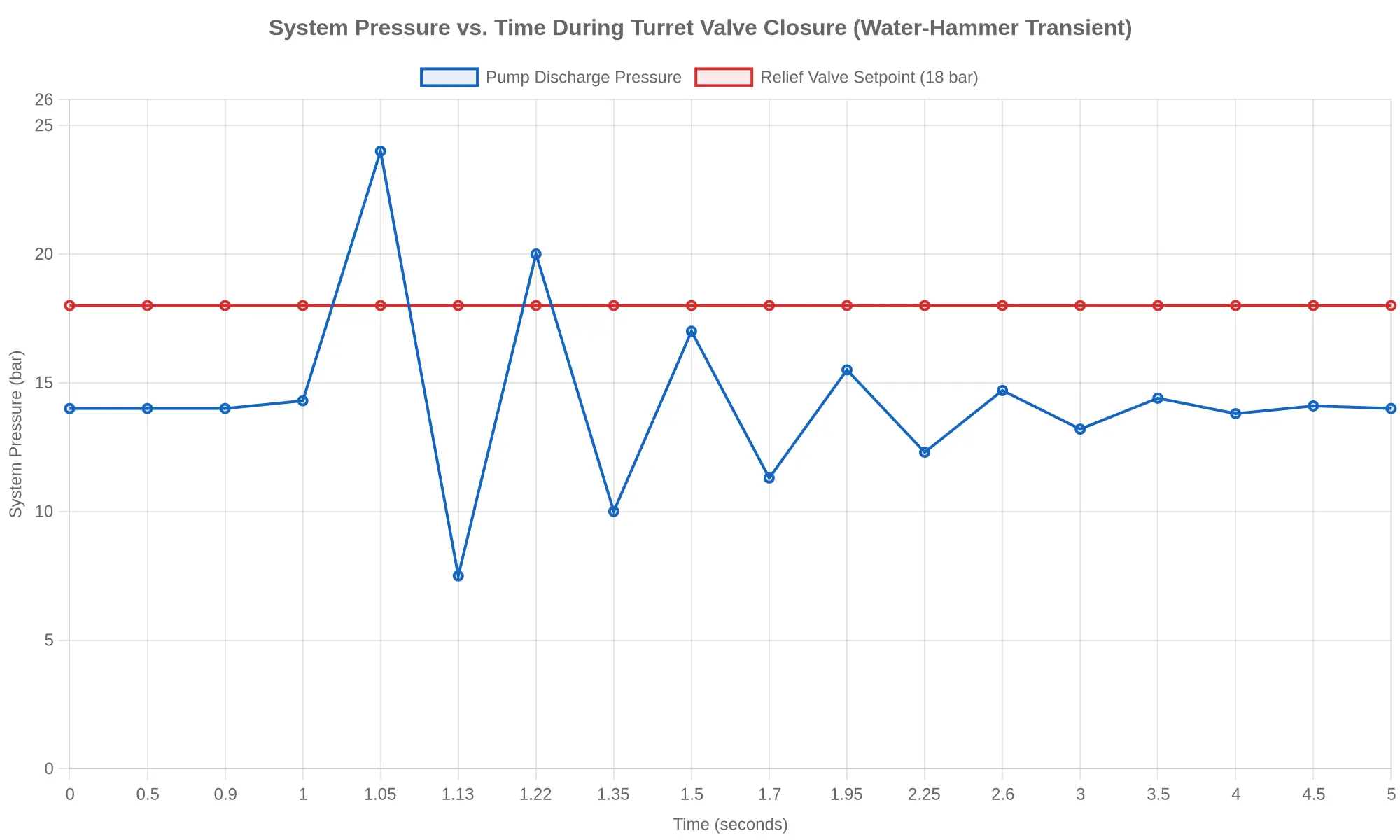
Figure 1: System pressure vs. time during turret valve closure. Pump discharge pressure holds a steady 14 bar baseline, then spikes to roughly 24 bar the instant the turret valve slams shut, overshooting the 18 bar relief-valve setpoint before the oscillations damp back toward the steady-state line.
What the chart demonstrates
The pressure transient from an abrupt turret valve closure is not a gentle rise but a near-instantaneous surge that overshoots the relief valve setpoint. That is why the relief valve is the last line of defense against water hammer, and why its condition matters. The decaying oscillation also shows how the surge travels back and forth through the piping, dissipating as friction and system compliance absorb the kinetic energy of the suddenly halted water column.
Why the Relief Valve May Not Fully Absorb the Spike
On paper, the relief valve looks like the answer to water hammer: slam the turret valve shut, a pressure spike heads back down the piping, and the relief valve catches it. In practice the promise breaks down. The valve is a mechanical device reacting in milliseconds, while the spike is a fluid-dynamic event moving at the speed of sound. That gap is the difference between believing you are protected and actually being protected.

Response Lag vs. Wave Propagation Speed
When a turret valve slams shut, the moving column of water is forced to stop almost instantly. Its kinetic energy has nowhere to go, so it converts into a sharp pressure spike – the classic water hammer effect.
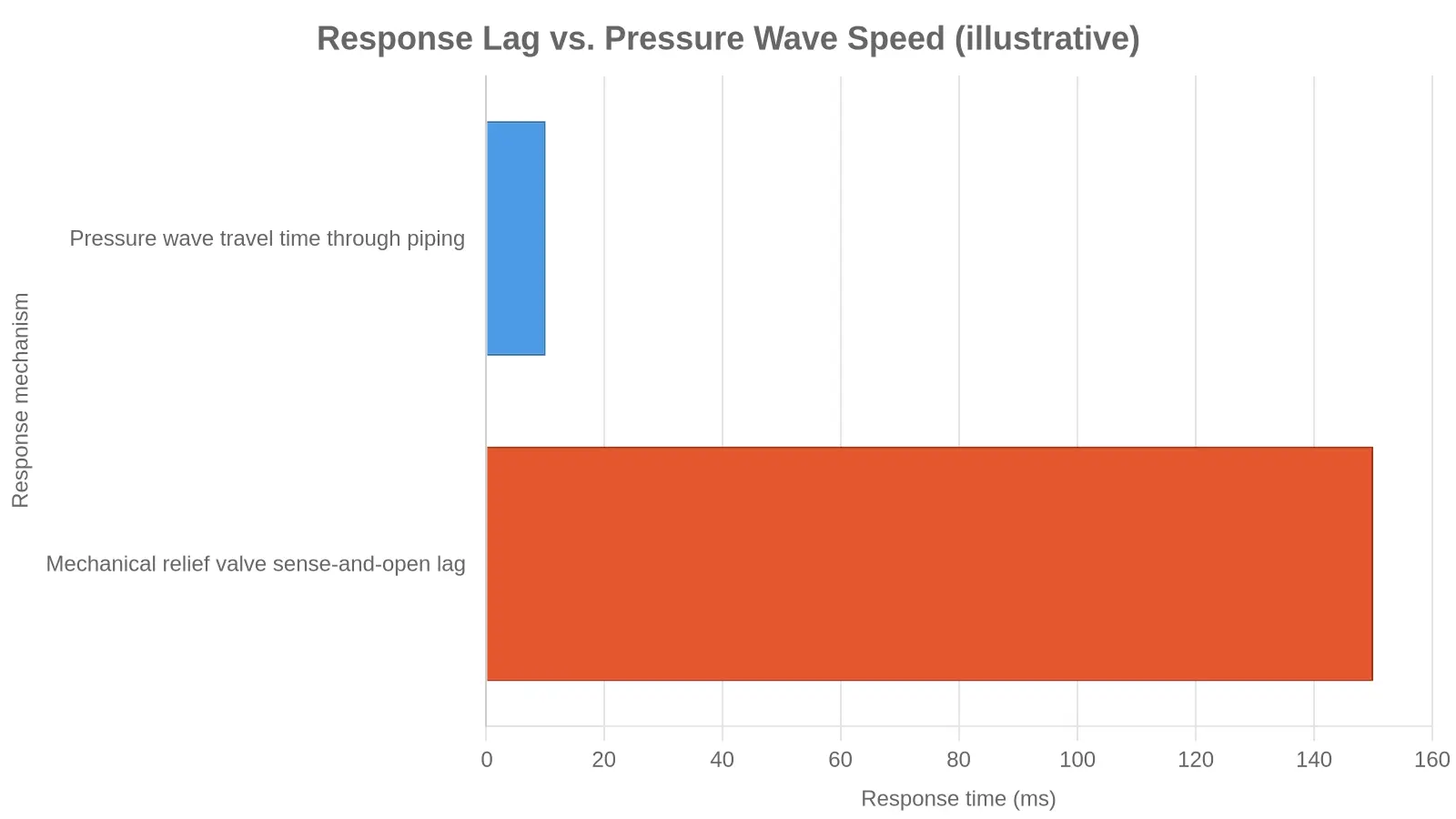
The spike does not wait for the valve. It propagates through the water at roughly 1,200 m/s (about 4,000 ft/s). In a 6-metre run of piping, the wave reaches the relief valve in a few milliseconds, reflects, and stacks on itself.
A mechanical airport crash tender pump relief valve, by contrast, has to sense rising pressure, overcome spring preload, and physically open. That sense-and-open sequence typically takes tens to hundreds of milliseconds – an order of magnitude longer than the wave’s journey.
The valve reacts on a mechanical timescale; the wave moves on an acoustic one. By the time the valve begins to move, the peak of the spike has already passed it.
Why a Setpoint Alone Cannot Guarantee Protection
Operators often treat the relief valve setpoint as an absolute ceiling. It is not. A setpoint is a threshold, not a guarantee.
The valve only has to begin venting once local pressure crosses that threshold, and even that takes time. A fast-traveling transient can overshoot the setpoint, damage seals, gaskets, and pipe supports, and largely dissipate before the valve fully opens. The setpoint limits sustained overpressure; it does not clip a sub-second transient.
The Role of Valve Sizing and Location
Two factors decide how much of the spike the valve can realistically absorb:
| Factor | Effect on spike absorption |
|---|---|
| Valve sizing (flow capacity) | An undersized valve cannot dump enough flow to relieve a large spike; an oversized valve may respond lazily to small ones |
| Position relative to the turret | The further the valve sits from the turret valve, the longer the wave travels before relief, and the more piping absorbs the shock |
| Proximity to the closure | A valve placed close to the closing turret valve senses the spike sooner and vents it before it stacks |
Geometry and sizing set the practical limit of protection, not just the setpoint number on the spec sheet.
Repeated Spikes Cause Fatigue and Progressive Damage
A single spike rarely destroys a system outright. The real damage is cumulative. Every slam of the turret valve sends another pressure spike cycling through the piping, welds, seals, and the relief valve itself.
Cyclic loading leads to metal fatigue. Over hundreds of operations, it shows up as weeping joints, stretched seals, drifting setpoints, and eventually cracked welds or a relief valve that no longer seats cleanly. The valve that was supposed to protect the system can quietly become another failure point.
What This Means on the Ramp
Because relief valves cannot fully absorb fast transients, protection depends on operating discipline as much as hardware:
- Close the turret valve gradually during shutdown. Throttle down before isolating flow rather than slamming it shut.
- Sequence the pump and valve so flow changes are gradual, reducing the size of the initiating wave.
- Inspect relief valves and piping for fatigue signs, and verify setpoints during routine service.
- Monitor pump parameters so unexpected pressure behavior is caught early. The same discipline that catches other hidden faults applies to undetected proportioning drift on the ramp, which is found by watching trends rather than trusting a single reading.
The relief valve is a critical safeguard, but it is a reactive one. Smooth operating technique is what keeps the spike small enough for it to work at all.
Maintenance and Inspection Implications: Turning Water-Hammer Physics into Shop Practice
Knowing that slamming a turret valve shut sends a pressure wave racing back to the pump is only useful if it changes what crews and mechanics do every shift. The lesson comes down to three habits: keep the airport crash tender pump relief valve healthy enough to shed a surge, keep the piping strong enough to absorb one, and train operators so they never create one in the first place.
Inspect the Relief Valve for Setpoint and Free Movement
The relief valve is your last line of defense against a pressure spike, and a sticky, mis-set, or seized valve cannot open fast enough when the surge arrives.
- Confirm the setpoint against the manufacturer’s spec for your pump rating.
- Cycle the valve manually and confirm full, unobstructed travel, with no binding or corrosion.
- Inspect the seat and spring for wear, pitting, or fatigue that shifts cracking pressure.
Check Piping Supports and Joints for Stress
Water hammer punishes the hardware, not just the fluid. Repeated surges loosen clamps and fatigue welds, so look for loose or cracked pipe supports, weeping flanges, stress cracks at elbows, and shiny rub marks where pipe meets bracket.
Watch for Fatigue and Leakage
Because the wave flexes the system on every pass, small defects grow over time. Trends matter more than single readings. A joint that weeps only after a turret test is telling you the surge is already doing damage.
Confirm Pilot and Relief Response
On pilot-operated relief valves, verify that the pilot senses pressure correctly and that the main valve follows. Test response under realistic flow, not just at idle, and log the cracking pressure at every service.
Train Operators to Avoid Abrupt Turret Valve Closure
Most water hammer is operator-created. Coaching crews to throttle the turret valve closed gradually instead of snapping it shut removes the steep flow deceleration that generates the spike. That one habit prevents more damage than any repair.
Routine Checks That Reduce Water-Hammer Exposure
| Check | Frequency | What to look for |
|---|---|---|
| Relief valve setpoint and travel | Weekly / service | Correct setting, free movement |
| Piping supports and joints | Monthly | Loose clamps, weeping flanges, cracks |
| Leak and fatigue trends | Every wash-down | New weeps, rub marks |
| Pilot / relief response test | Per service interval | Correct cracking pressure, fast action |
| Operator valve-handling drill | Ongoing | Gradual closure, no slamming |
Pairing these checks with disciplined valve handling keeps surge pressures within design limits, the same habit of catching subtle pump-system faults early that keeps foam proportioning from drifting undetected. Prevent the spike, and the piping stays sound.
Frequently Asked Questions
What exactly causes the pressure spike when the turret valve is shut?
Every liter of water moving through the piping carries kinetic energy. When the turret valve slams shut, the moving column is stopped almost instantly, so the energy has nowhere to go and converts into a sharp pressure spike. This surge is water hammer, and it races back down the piping as a shock wave that can reach several times the normal working pressure of the airport crash tender pump relief valve system.
Can the relief valve fully prevent water hammer damage?
No. A relief valve is a pressure-limiting safeguard, not a cure for water hammer. It reacts only after the surge has formed, and it protects only the piping section where it is installed, so it cannot stop the shock wave from reaching bends, fittings, or the pump itself. Treat the relief valve as the last line of defense, never the first.
Does closing the turret slowly really matter?
Yes, and it is the single most effective way to control the surge. Slowing the closure stretches out the deceleration of the water column, giving the energy time to dissipate instead of concentrating into one spike. A turret valve that snaps shut in roughly a second can produce a pressure spike many times larger than one closed gradually over several seconds.
What signs indicate the relief valve is not protecting the system?
Listen and watch for recurring hammering or banging in the piping, pipes that jump or shudder, weeping joints and flanges, or a relief valve that either never discharges or dumps constantly. These telltales suggest the valve is undersized, worn, wrongly set, or simply not keeping up with the surge. Left unaddressed, the same energy that stresses the relief valve can also disturb downstream equipment such as your foam proportioning system.
How does piping length affect the surge?
Longer runs of piping hold more water, so there is more moving mass to stop and more momentum to convert into pressure. The pressure wave also has farther to travel, extending the time it takes to reflect and recombine, which can amplify the peak and prolong the hammering. That is why two crash tenders with identical pumps but different piping layouts can see very different surge severity.
Conclusion: Smart Valve Habits Protect the Whole Pump System
Everything here comes back to one practical truth: how an operator closes the turret valve decides whether the pump system survives the next few seconds. Slam it shut and the moving column of water has nowhere to go, and its momentum turns instantly into a pressure spike that races back down the piping. That surge, the classic water hammer effect, can arrive faster than the airport crash tender pump relief valve can open and vent the excess, producing a brief but violent over-pressure event that stresses seals, gauges, fittings, and the relief valve itself.
The Core Recommendation
The fix is not a new component; it is a change in technique. Operators should close the turret valve gradually and deliberately, modulating the flow down before shutting it off completely. That gives the relief valve the reaction time it needs to absorb the residual surge. Combined with consistent inspection – checking relief-valve settings, actuator response, and piping supports – crews can catch the small degradations that turn a manageable surge into a failure.
Key Takeaways
- Slamming the turret valve shut converts flow momentum into a pressure wave, not a clean stop.
- That water hammer pressure spike can exceed the relief valve’s ability to respond in time.
- Gradual valve closure lets the relief valve react and dissipates the surge safely.
- Routine inspections keep relief-valve settings and response times within spec.
- Written procedures and crew training turn good habits into standard practice.
Maintenance teams should treat subtle system faults the same way they treat pressure surges: as early warnings worth chasing down. Routine checks that reveal issues like undetected foam proportioning drift follow the same discipline.
Looking Ahead
As ARFF fleets modernize and pump pressures climb, the margin for error around the turret valve only gets thinner. By closing valves gradually and inspecting on schedule, operators and maintainers can stay ahead of water hammer before it ever reaches the relief valve, protecting both the pump system and the people who depend on it.