Airport Crash Tender Tire Sidewall Cracking: Why Slow Leaks on the Apron Are Not a Mileage Problem
ARFF fleet managers and GSE tire technicians keep running into the same misdiagnosis: sidewall cracks and slow leaks on crash tender tires that have barely moved. The tread is fine. The trouble comes from where the truck is parked, how long it sits untouched, and what the rubber is exposed to between calls.
Mileage is the wrong lens. On a parked crash tender, sidewall cracking and slow leaks are driven by environmental exposure, long static idle periods, underinflation, and the calendar aging of rubber, not by distance run. Mileage-based replacement schedules are especially poor at catching these tires, because the ones failing quietly in place are exactly the ones that never trip an odometer threshold.
Four things drive most low-mileage tire failures:
- Environmental exposure, including UV radiation, ozone, heat, and temperature swings
- Prolonged static idle time that settles and stresses rubber in a single position
- Underinflation and gradual pressure loss that flexes sidewalls beyond design limits
- Age-related rubber aging that hardens and cracks compounds regardless of use
An apron bakes parked equipment in sun and swings it through temperature extremes day after day, the same stress that shortens the shelf life of foam concentrate in storage. The sections below take each cause in turn and turn it into inspection, storage, and replacement practice built on condition and calendar age rather than distance run.
Why Low Mileage Does Not Protect Crash Tender Tires
On paper, a low-mileage crash tender tire looks healthy: the odometer creeps up slowly, tread depth stays within specification, and the vehicle may log only a few hundred miles a year. That clean record is exactly why the failure goes unnoticed. Tread wear is a mileage-driven condition. Sidewall degradation is not.
An ARFF vehicle runs on long spells of standby, then sprints. The tender sits on the apron for weeks at a time, often in the same position, then rolls at full load to a single call. That pattern removes almost no measurable tread, but it leaves the casing exposed to months of ozone and sunlight and long stretches at low pressure. Rubber oxidizes, ozone attacks it, and UV radiation hardens the sidewall compound whether or not the wheel ever turns.
Compare a line-haul truck covering 80,000 miles a year. Its maintenance schedule can safely assume that usage equals wear, because tread consumption and heat cycling set the replacement interval. A crash tender breaks that assumption: the dominant aging mechanisms are chemical and calendar-based, not mechanical. A tire can be six years old, hold full tread, and still weep air through hairline sidewall fissures.
- Mileage-driven wear: tread abrasion, casing heat cycles, measurable by odometer and tread depth.
- Time-and-environment-driven aging: ozone and UV sidewall cracking, oxidation, static flat-spotting, underinflation creep, measurable only by inspection and date codes.
The clock here is exposure, not mileage, much the way temperature swings shorten stored foam concentrate. What matters for a tire that rarely turns is elapsed time and the conditions it sat in.
| Degradation Factor | Primary Mechanism | Whether Mileage Reflects It | Typical Location of Damage | Inspection Priority |
|---|---|---|---|---|
| Tread abrasion (mileage-driven) | Mechanical friction between tread rubber and pavement; wear accrues with distance traveled. | Yes – wear is directly proportional to miles/kilometers driven. | Tread band / contact patch. | Routine – track via tread depth at mileage intervals. |
| Ozone/UV sidewall cracking | Atmospheric ozone and ultraviolet radiation attack unsaturated bonds in sidewall rubber, producing micro-cracks that grow even when the vehicle is stationary. | No – governed by exposure time and sunlight, not distance. | Sidewall (outer casing, often upper shoulder). | High. |
| Underinflation-induced sidewall stress | Low inflation pressure increases sidewall flex and heat buildup; repeated flex fatigue weakens the casing and can open slow leaks at the bead/sidewall. | No – driven by pressure state, not distance; a parked tire can remain underinflated indefinitely. | Sidewall and bead area. | High. |
| Static idle deformation | Prolonged parking loads a single contact patch; rubber takes a compression set (flat-spot) and sidewall stress concentrates, encouraging cracking. | No – low mileage actually increases idle time and thereby raises risk. | Contact patch / lower sidewall. | Medium to High. |
| Calendar rubber aging | Oxidative aging and compound cross-link changes over time degrade elasticity; the tire hardens and cracks regardless of use. | No – governed by age (date code) and storage environment. | Sidewall and tread (overall casing). | High. |
Ozone and UV Degradation: The Chemical Attack on Sidewall Rubber

How Ozone Attacks the Sidewall
Ozone is a reactive form of oxygen that occurs naturally in ambient air and is generated locally by electrical equipment, motors, and welding. Sidewall compounds are built from polymers such as natural rubber, SBR, and polybutadiene, all of which contain unsaturated carbon-carbon double bonds. Those double bonds are the weak point. When ozone meets a stretched sidewall, it reacts directly with them, splitting the polymer chains and forming brittle ozonides at the surface. The result is a network of fine micro-cracks running perpendicular to the direction of stress – the signature of ozone cracking.
Why Flexing Makes It Worse
The sidewall is never fully at rest. Even a parked crash tender carries its own weight, and every change in load, temperature, or inflation pressure flexes the sidewall. Each cycle pulls the micro-cracks open, exposing fresh rubber to more ozone and letting the cracks deepen. Over thousands of static load cycles, shallow surface checking grows into visible cracks. Sunlight does its own damage: ultraviolet light drives photo-oxidation, breaking polymer bonds, forming peroxides and carbonyl groups, and embrittling the surface layer until it can no longer flex without splitting.
Why the Sidewall, Not the Tread
The tread spends its life being scuffed, warmed, and worn away, continuously shedding any oxidized surface layer as it goes. The sidewall does not. It faces the most direct sunlight, the highest concentration of airborne ozone, and the constant strain of inflation pressure, which is why the apron hits the sidewall hardest while the tread stays comparatively protected.
Why Mileage Counters Miss It
Ozone and ultraviolet attack act on time and exposure, not distance. A crash tender that rolls only a few thousand miles a year but stands outdoors on the apron for thousands of hours accumulates sidewall damage the entire time it sits still. The odometer records motion. It records nothing about the hours of sunlight and airborne ozone the rubber has absorbed.
From Surface Cracks to Slow Leaks
Cracks rarely stay on the surface. Under continued flexing they work inward along the stress field toward the casing plies and the bead area. Once a crack reaches the bead-to-rim interface, it compromises the seal and gives air a path out. The result is the characteristic slow leak – a tire that loses a few psi over days on the apron, never flat enough to catch during a quick walkaround, yet steadily eroding crash tender readiness.
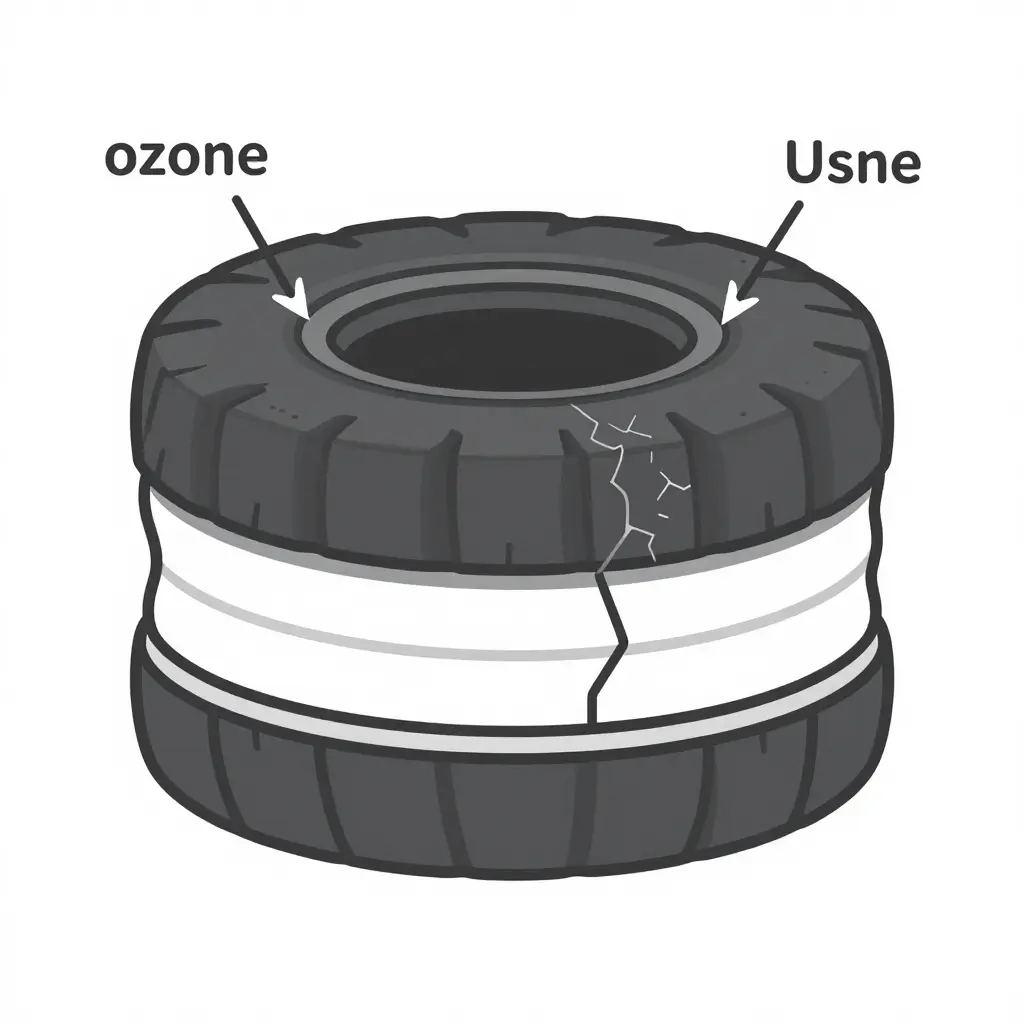
A schematic cross-section of a crash tender tire sidewall: arrows depict ozone and UV attacking the outer rubber surface, where micro-cracks form and propagate inward toward the casing.
Underinflation: The Hidden Driver of Sidewall Cracking and Slow Leaks
Underinflation belongs near the top of the list of overlooked causes of sidewall cracking, and low annual mileage is exactly why it hides. Pressure loss does its damage while the truck sits on the apron; nothing about the odometer reveals it.
Below the specified pressure, the sidewall deflects further with every roll, and the extra movement turns into heat. That heat ages the rubber compounds and casing plies faster and speeds fatigue cracking along the sidewall. The fine cracks then deepen and give moisture and ozone a way in.
Low pressure also puts the bead to work against the rim. The seal loosens, small leakage paths open, and air escapes slowly. Underinflation causes leaks, and leaks deepen underinflation – a cycle that feeds itself.
A truck that sits for days or weeks between calls is the worst case. Gradual pressure loss goes unnoticed between checks; a worn valve seal seeps steadily; and temperature swings on the apron make the air inside the tire expand and contract, so a cold night drops the reading and a warm day hides it. That is the same temperature swings accelerate the degradation of stored equipment at work, and tires sit in it too.
For vehicles like these, pressure management does more for tire life than mileage ever will. A tire that has traveled only a few hundred miles can still fail if it has spent months underinflated.
Underinflation warning signs
- Excessive sidewall deflection or bulging near the ground contact area
- Fine circumferential or radial cracking along the sidewall
- Warm sidewalls after short, low-speed movements
- Pressure that consistently falls between checks with no visible damage
- Bead-area seepage, corrosion, or debris around the rim flange
- Flat-spotting or uneven wear from prolonged static standing
The chart shows the split. From new to 36 months, the sidewall crack severity index climbs steeply while mileage accumulation stays nearly flat, so degradation tracks time, ozone and UV exposure, static idle time, and environmental aging rather than distance driven.
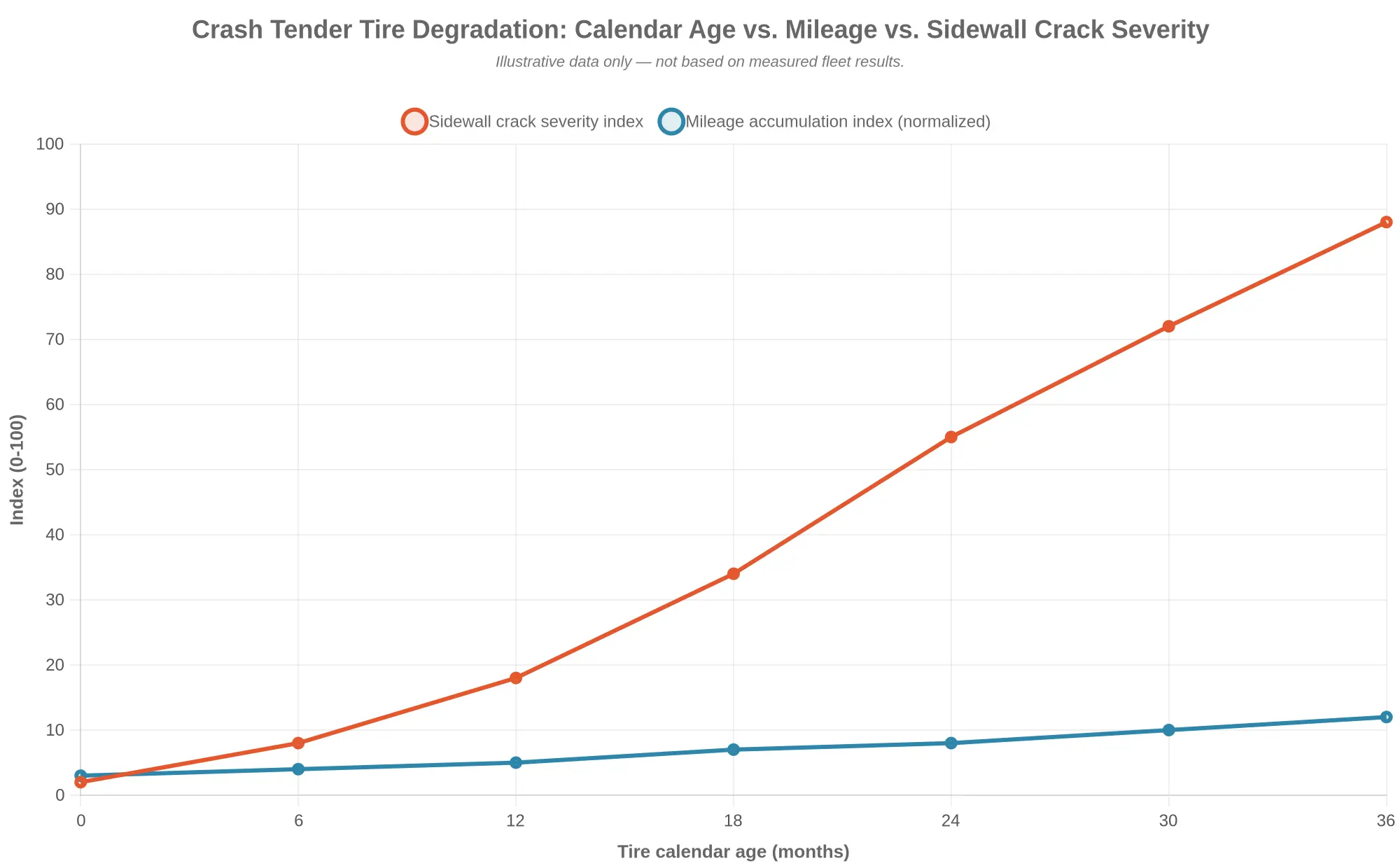
Data are illustrative and normalized to a 0-100 index for comparison only – not measured fleet results. Values are intended to demonstrate the trend, not to predict any specific tire’s performance.
Static Idle Time: Why Rarely Driven Does Not Mean Rarely Degraded
A crash tender is built to sit ready. That is the job. But long idle stretches work on the tire in ways a mileage-based schedule never sees.
Compounds include protective waxes that migrate to the sidewall surface as the tire flexes in service. That wax bloom is a sacrificial barrier against ozone and UV. Let the tire sit motionless for weeks and the migration slows or stops, the barrier thins, and the sidewall sits exposed.
Ozone hits hardest where rubber is held under constant strain. A parked tire keeps the same contact patch bearing the same load in the same position, which concentrates ozone cracking along the sidewall as small radial checks that deepen over time.
Flat-spotting follows. Under continuous load in one position, the sidewall and tread deform and take a temporary or permanent set, and the flexed region becomes the weak point where cracks start and slow leaks begin.
Bead and seal micro-leakage comes next. Without the normal cycling of heat and pressure, bead seating can relax and minute gaps open at the rim seal. Air escapes slowly, the tire runs lower, deflection rises, and the whole cycle speeds up.
That is why crash tender tire aging is a calendar and exposure problem rather than a mileage one. A tire with a few hundred miles can be more degraded than a highway tire with tens of thousands, because time, ozone, load, and stillness do the damage – much the way temperature swings shorten the shelf life of stored foam concentrate.
Age-Related Rubber Aging: Why Calendar Time Degrades Sidewall Compounds
Rubber is not inert. From the moment a tire is cured, its sidewall compound begins a slow chemical transformation that tread depth cannot reveal, and it proceeds regardless of miles driven.
Oxidation Breaks Down the Polymer
Oxygen reacts with the unsaturated bonds in the rubber polymer chain. Over months and years, oxidation cross-links and scissions the molecular structure and progressively stiffens the compound. Time, heat, and atmospheric exposure set the rate; distance traveled does not.
Plasticizers and Antiozonants Deplete
Plasticizers, waxes, and antiozonants are mobile additives blended into the compound to keep it supple and resist ozone attack. They migrate toward the surface and volatilize over time. As they deplete, the sidewall loses the chemistry that maintained flexibility – the same shelf-life chemistry seen when temperature swings shorten the shelf life of stored agents.
Hardening Reduces Elasticity
With oxidation advanced and plasticizers lost, the sidewall compound hardens and its elasticity falls. Hard, inelastic rubber cannot deflect and recover under load. Instead of flexing, it fractures; strain produces cracks rather than reversible deformation.
Brittle Cracks Propagate
Surface crazing develops into brittle cracks that run along and into the sidewall. Once a crack tip forms, stress concentrates at its edge and drives propagation. Moisture enters, reinforcing cords are exposed, and a slow leak appears on the apron.
Why Calendar Age Governs Tire Service Life
Static idle time accelerates the decline. A parked crash tender barely flexes its tires, so protective waxes are not redistributed and the sidewall sits exposed to UV, ozone, and thermal cycling. Service life is therefore bounded by calendar age and exposure rather than mileage. Two tires with identical tread can differ enormously in structural integrity, and the degraded one is usually the low-use spare that never moved.
Age Limits and Periodic Inspection
That is why low-use emergency vehicles need a maximum age limit and scheduled inspection rather than a wait-for-visible-failure approach. Crash tender tire replacement should follow the calendar intervals set out in the manufacturer’s maintenance guidance, supported by periodic checks of sidewall crazing, crack depth, and molded date codes.
Storage and Apron Management: Best Practices That Govern Crash Tender Tire Reliability
On a vehicle that may log only a few thousand kilometers in a year, mileage says almost nothing about tire condition. Time, exposure, and how the truck is parked decide whether sidewalls crack and leak. Effective crash tender tire storage and apron tire management take aim at those three variables directly.

Storage Layout and Apron Placement
- Park on level, drained, sealed surfaces. Standing water and spills of fuel, foam concentrate, or glycol are drawn into the rubber compound, softening the sidewall and accelerating crack growth. Dry footing also prevents flat-spotting of the tread.
- Place tenders in shade or under a roof. Ultraviolet radiation breaks polymer bonds at the sidewall surface. Less UV flux means slower surface oxidation, and therefore fewer of the fine crazing lines that later open into cracks.
- Keep parked units away from ozone sources. Battery chargers with arcing contacts, electric motors, welding bays, and running ground support equipment all generate ozone. Ozone attacks the double bonds in rubber, and the damage appears first where flex stress is highest, which is the sidewall.
- Leave a gap between vehicles. Tire-to-tire contact traps moisture, concentrates load on one contact patch, and hides emerging damage from the inspector’s line of sight.
Protective Measures and Inflation Control
- Use opaque, breathable covers. A tight-fitting cover blocks UV and limits ozone contact while letting heat and moisture escape. Sealed plastic sheeting does the opposite: it traps heat against the casing and speeds up aging.
- Maintain correct inflation and verify it with a calibrated gauge. Underinflation increases sidewall deflection, so every movement cycle flexes already-aged rubber and opens surface cracks. It is also the direct cause of most slow leaks, which are then misread as a tire defect.
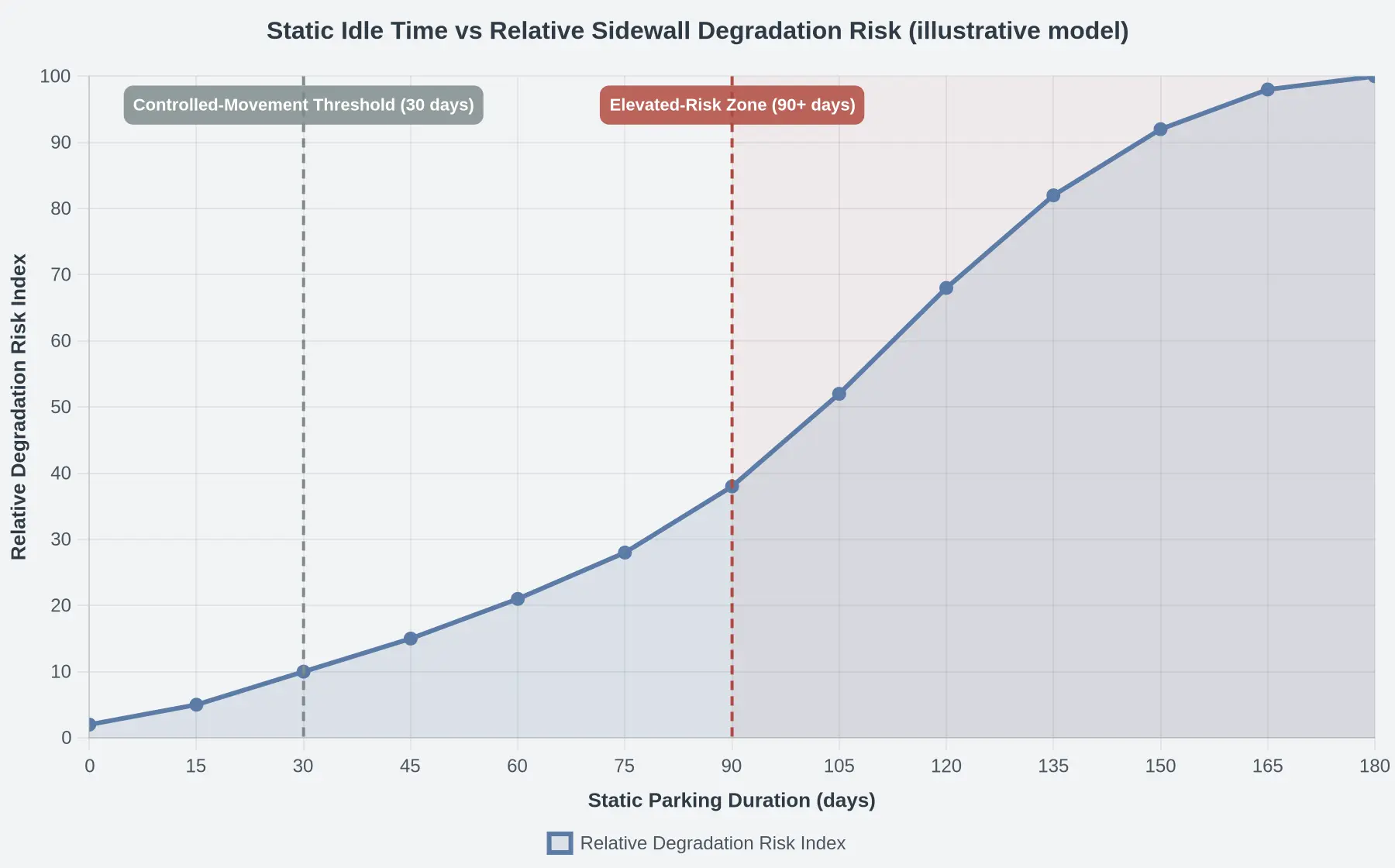
- Move each unit periodically under control. A short low-speed run of a few hundred meters every 30 to 60 days flexes the sidewall and redistributes the antioxidant and wax compounds that bloom to the surface as a protective film. Without movement, that film is not replenished and cracks initiate from the outside inward.
- Control the storage environment. Ventilate bays, block radiant heat, and avoid parking beside heat-soaked equipment or exhaust outlets. Stable conditions matter for every stored material on the truck, not just rubber; the same logic behind why temperature swings shorten the shelf life of stored crash tender fluid applies to the tire sidewall.
- Rotate the fleet on a schedule. Rotation keeps no single tender static for months and spreads exposure evenly across the set.
| Storage condition | Pressure check | Controlled movement | Sidewall inspection |
|---|---|---|---|
| Covered, shaded, ventilated bay | Every 14 days | Every 30 days | Monthly |
| Covered but unheated | Every 7 days | Every 30 days | Every 14 days |
| Open apron, partial shade | Every 7 days | Every 14 days | Every 7 days |
| Direct sun, no cover | Every 3 to 7 days | Every 14 days | Every 7 days |
Why Storage Discipline Outweighs Mileage Targets
Mileage-based policies assume that wear is the limiting factor. For a low-use ARFF fleet, it is not. Rubber ages by calendar time and environmental exposure: a tire with 3,000 km and seven summers in direct sun can be in worse condition than one with 40,000 km kept under cover.
Base replacement and inspection decisions on age, storage conditions, and physical findings. Treat pressure logs, movement records, and storage location as the primary reliability data for crash tender tires, and mileage as a secondary input at best.
For scheduled movement to be effective, the vehicle has to be serviceable in every other respect. A tender parked because of an unrelated defect sits static longer than planned, and that unplanned idle time is exactly what drives sidewall degradation.
Frequently Asked Questions About Crash Tender Tire Sidewall Cracking
These questions come up in every ARFF tire conversation. The answer to each one turns on the same point: apron tire problems are driven by time and environment, not mileage.
Does low mileage mean my crash tender tires are fine?
No. Mileage only measures tread wear caused by rolling, while sidewall cracking is a chemical aging process driven by time, ozone, UV, and heat rather than distance traveled. A crash tender that sits idle for months on the apron can develop more sidewall degradation than one driven regularly. Condition should always be judged by calendar age and visual inspection, never by the odometer alone.
How long do crash tender tires safely last in calendar terms?
Tire and ground-equipment guidance commonly puts maximum service life at roughly six to ten years regardless of mileage, and many ARFF operators replace at the conservative end of that range. Rubber compounds continue to cure and lose elasticity over time, and radiant heat from apron surfaces accelerates that change. Because these tires carry emergency-response risk, calendar age should override remaining tread depth when replacement decisions are made.
Are sidewall surface cracks always a safety risk?
Not always. Shallow surface “weather checking” is often cosmetic and does not compromise the casing or its load-bearing plies. However, cracks that penetrate toward the cord, cluster near the bead, or run deep into the sidewall signal structural degradation. Superficial aging and integrity-threatening defects look similar to an untrained eye but demand very different responses, so it is worth knowing which one you are looking at.
What are the main causes of slow leaks on the apron?
Slow leaks on the apron typically stem from bead-seal degradation, valve stem leakage, and microscopic sidewall cracks rather than punctures. Constant heat cycling expands and contracts the tire, gradually breaking the seal between the bead and the rim. Because these losses are gradual, they often go unnoticed until underinflation increases sidewall flex, which in turn accelerates cracking in a self-reinforcing cycle.
Does parking outdoors accelerate cracking?
Yes. Continuous exposure to UV radiation, ozone, and temperature swings accelerates oxidation of the rubber compounds, making sidewalls brittle and prone to cracking faster than shaded or indoor storage would allow. This is the same environmental mechanism by which temperature swings shorten equipment service life, so controlled storage pays off. Covering tires or parking under shade can measurably extend the time to visible cracking.
Conclusion: Age and Environment, Not Mileage, Define Tire Condition
Sidewall cracking and persistent slow leaks on the apron are not mileage problems. They come from environmental exposure, chronic underinflation, extended static idle time, and calendar-based rubber aging. A crash tender that answers only a handful of calls a year can still sit on dangerously degraded tires, because UV radiation, ozone, heat cycling, and time do more to rubber than tread wear will on a truck that rarely moves. Mileage-based maintenance logic simply cannot see these failure modes, so inspection and replacement have to run on environment and age instead.
The shift is simple: treat the apron as a hostile storage environment rather than a neutral parking area, and build tire care around how tires are exposed, inflated, parked, and aged instead of how far they have rolled. The same holds for the rest of the apparatus. A crash tender is ready only when its tires, its agent delivery, and its stored foam concentrate are all sound. Foam proportioning drift goes undetected on the ramp for the same reason hidden, time-driven degradation goes unnoticed anywhere else on the vehicle, and temperature swings shorten foam agent shelf life because stored equipment ages even when it never moves.
Key Takeaways
- Ditch mileage as the trigger. Inspect and replace crash tender tires based on age, exposure, and inflation history, not odometer readings that underestimate stationary degradation.
- Schedule inspections by calendar, not duty cycle. Add monthly sidewall and pressure checks so UV/ozone cracking and slow leaks are caught long before they compromise response readiness.
- Control the apron environment. Use covers, shade, or indoor storage where possible to limit UV radiation and ozone attack on sidewalls during long idle periods.
- Maintain inflation discipline. Correct chronic underinflation, which accelerates sidewall flex cracking and turns minor porosity into persistent slow leaks.
- Establish a hard retirement age. Track manufacturing dates and replace tires on a fixed time horizon regardless of remaining tread depth.
- Adopt holistic readiness checks. Treat tires, foam proportioning, and concentrate storage as one system, since each degrades quietly over time rather than through visible use.
Where Integrated Support Sustains Emergency Readiness
Emergency vehicle readiness rarely comes down to one component. It depends on the vehicle, the equipment specified for it, the service routine, and support across the asset’s life – the same point this article makes about tires. CIMC Fire Rescue works on that basis as an international firefighting enterprise, supplying intelligent firefighting equipment and integrated “vehicles + equipment + services + station-building” solutions to airports, municipalities, and industrial operators worldwide.
The company’s global footprint and engineering teams let it manage crash tenders and other critical assets from initial specification through years of in-service operation. Its engineering, service, and manufacturing groups work to the same commitment: dependable performance under demanding conditions, and continued quality in every system placed into service. For ARFF fleet managers, that integrated model matches a plain fact – tires, foam systems, and vehicles each degrade on their own timeline, and only coordinated equipment, service, and lifecycle support keeps them mission-ready. More on the company’s firefighting capabilities is available at cimcfirerescue.com.